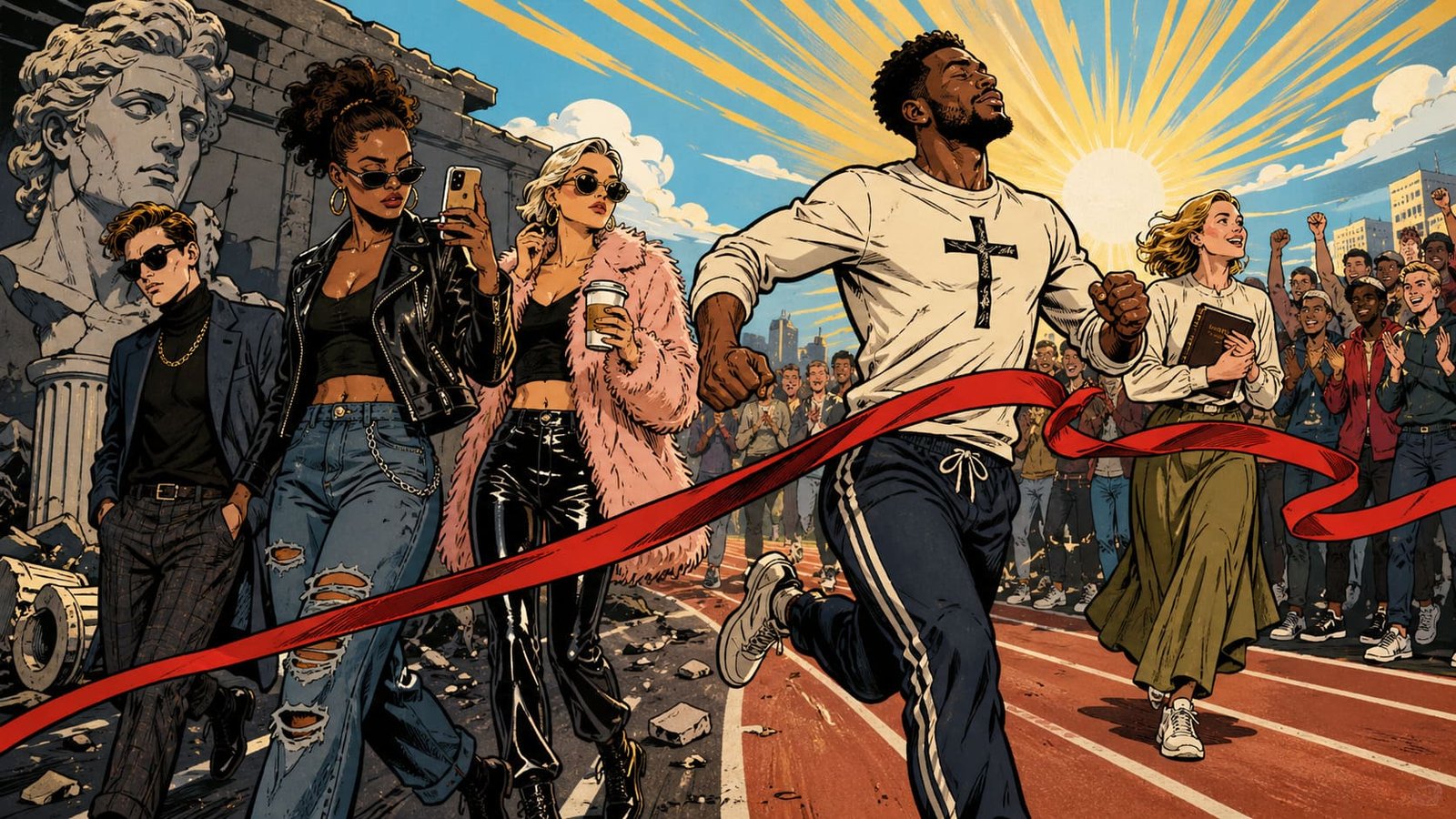
A quiet room glows under artificial light while a screen scrolls endlessly, each swipe offering a new belief, a new outrage, a new temporary god. No incense burns, no choir sings, yet something feels eerily familiar. The rituals have not disappeared. They have only changed costumes. In a world obsessed with progress, logic, and innovation, faith has been pronounced outdated more times than any trend cycle can count. Still, it refuses to die. It lingers in the background of every ambitious life, every cultural shift, every restless night when achievement fails to satisfy. The modern promise suggested that secular thinking would replace belief, that reason would outgrow ritual, that data would finally quiet the human hunger for meaning. It sounded clean, efficient, and inevitable. Yet something stubborn persists beneath all that sophistication. Faith, in its many forms, continues to outrun fashion, not because it resists change, but because it understands something deeper than trends ever could.
Culture loves to declare victory too early. Every decade produces confident voices claiming that humanity has matured beyond religion. The argument feels persuasive when wrapped in technology, science, and rational frameworks. But observe closely and a pattern emerges. People do not abandon belief, they simply relocate it. The same emotional energy once poured into temples now flows into ideologies, brands, movements, and even personal identity. Consider Elias, a product designer in a fast-growing tech company, who once dismissed religion as obsolete. He later found himself defending his company’s mission with a fervor that mirrored devotion. When the product failed, his crisis was not just professional, it was existential. The object changed, the structure remained. Faith had simply found a new container.
This persistence reveals an uncomfortable truth about human nature. Rationality answers questions, but it rarely satisfies longing. The modern world excels at explaining how things work, yet struggles to answer why they matter. That gap is where faith quietly re-enters the room. It does not always announce itself with doctrine or scripture. Sometimes it appears as belief in progress, in self-improvement, in the promise that tomorrow will justify today’s sacrifices. The language evolves, but the emotional architecture stays intact. Viktor Frankl once argued that humans are driven by a search for meaning, not just survival. That insight echoes across time because it describes something irreducible. Strip away symbols, and the need still stands.
There is also a cultural theater at play, one that rewards the appearance of detachment while quietly relying on deeper conviction. Public discourse often celebrates skepticism, treating belief as naive or unsophisticated. Yet behind closed doors, people construct private systems of meaning that guide their choices. A consultant named Amara built a career advising corporations on efficiency and growth. Outwardly, she championed data-driven decisions. Privately, she kept a handwritten journal where she tried to understand purpose, legacy, and what she owed to others. Her clients never saw that side. The world applauded her logic, but her life was shaped by something more intimate and less measurable.
The tension becomes sharper when success enters the picture. Achievement promises fulfillment, yet often delivers a quieter form of emptiness. The entrepreneur who reaches every milestone still asks the same question at the end of the day: what was it for? This is where secular narratives begin to strain. They offer frameworks for building, scaling, optimizing. They rarely offer a satisfying answer to the deeper question of meaning. Faith steps into that space not as a competitor to reason, but as a companion to the human condition. It addresses the emotional residue that logic leaves behind. It speaks to the part of life that cannot be quantified or optimized away.
History provides a steady reminder of this cycle. Societies swing between belief and skepticism, between reverence and doubt. The Enlightenment challenged religious authority with reason and science, reshaping institutions and ideas. Yet it did not eliminate faith. It transformed its expression. New forms of belief emerged, some centered on human progress, others on political ideology. The pattern repeated across cultures and eras. Each time, the language changed, the structure endured. This continuity suggests that faith is not a relic of ignorance but a response to something fundamental in human experience.
Modern life complicates the picture further by introducing constant distraction. Attention becomes fragmented, leaving little room for reflection. The pace accelerates, and with it comes a subtle anxiety. People feel busy, connected, informed, yet strangely untethered. In that environment, faith acts as an anchor. Not necessarily in a traditional sense, but as a stabilizing force that offers coherence. It provides a narrative that connects actions to meaning, effort to purpose. Without it, life risks becoming a series of disconnected tasks, impressive on the surface but hollow underneath.
There is also a social dimension that cannot be ignored. Belief systems create communities, shared rituals, and collective identity. They offer belonging in a way that purely individualistic frameworks struggle to replicate. A young strategist named Koen joined a global firm known for its high-performance culture. The work was intense, the rewards significant. Yet what kept him grounded was not the paycheck or the prestige. It was a small group within the company that met regularly to discuss values, purpose, and the impact of their decisions. Those conversations felt different from the rest of his work. They carried weight. They created connection. They hinted at something deeper than career advancement.
The quiet resilience of faith suggests that it operates on a different timeline than trends. Fashion moves quickly, driven by novelty and attention. Faith moves slowly, rooted in enduring questions about existence, purpose, and connection. It does not need to dominate headlines to remain influential. It persists in the background, shaping decisions, guiding behavior, offering comfort in moments of uncertainty. Its strength lies not in resisting change, but in adapting without losing its core function.
Somewhere beyond the noise of modern life, a figure stands at the edge of a crowded city, watching lights flicker in countless windows. Each window holds a story, a struggle, a quiet search for meaning. The skyline looks like progress, a testament to human achievement. Yet beneath that brilliance lies a familiar question that refuses to fade. What holds all of this together? The answer never arrives as a single, definitive statement. It emerges in fragments, in moments of clarity, in choices that reveal what people truly believe. Faith does not win by overpowering secularism. It wins by outlasting it, by speaking to a dimension of life that trends cannot touch. And in that quiet persistence, it reminds anyone paying attention that the search for meaning is not a phase, it is the story itself.
