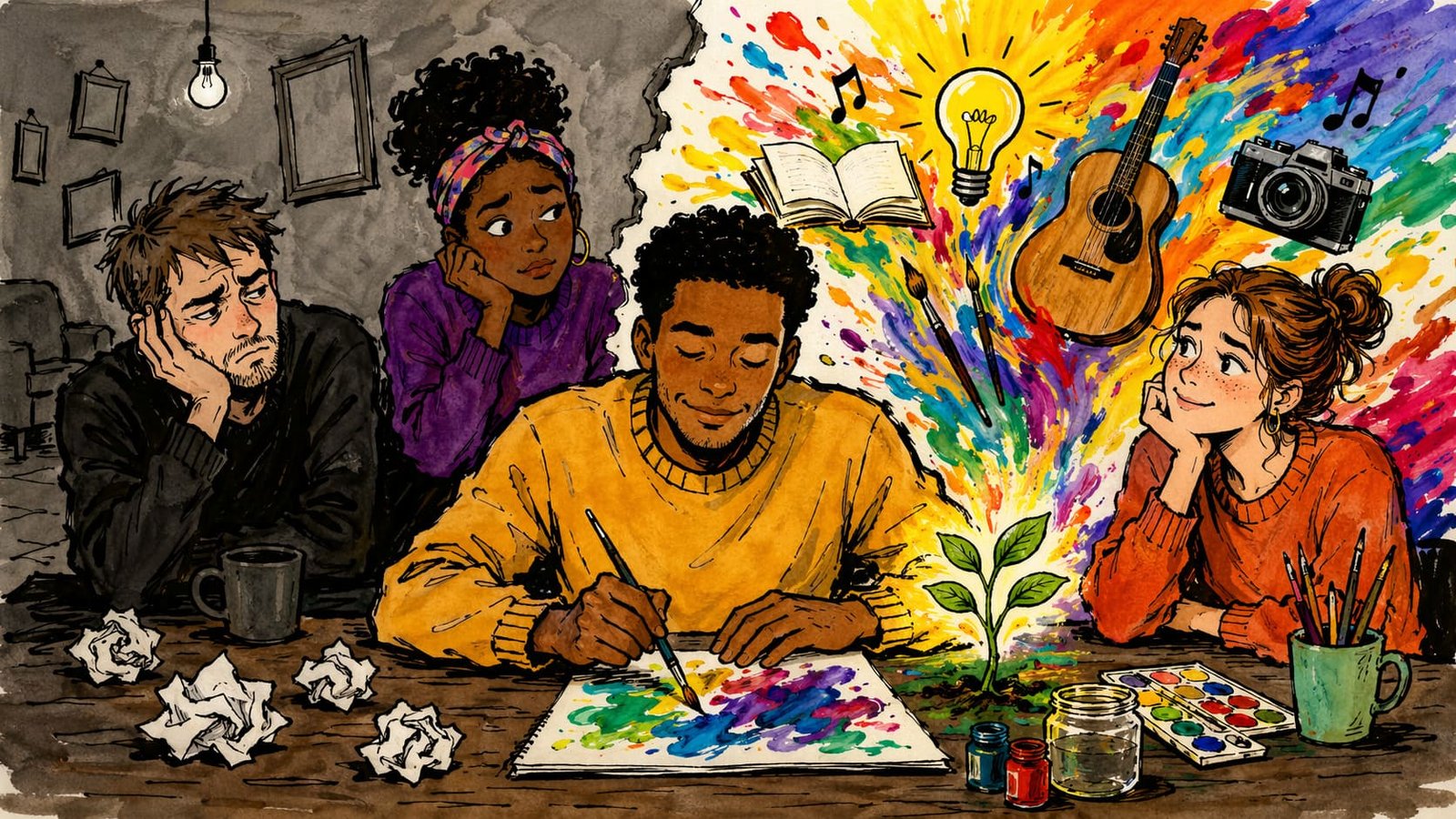
A blank canvas leans against a wall in a quiet room, untouched, almost accusatory. The air feels heavy, not with noise but with absence. A person sits nearby, scrolling without seeing, consuming without absorbing, surrounded by stimulation that somehow leaves no trace. Then, almost reluctantly, a hand reaches for a brush, a pen, a chord. Something begins, uneven, imperfect, barely intentional. The silence shifts. Not louder, just different. Something inside starts to move.
There is a particular kind of emptiness that does not announce itself with drama. It arrives quietly, disguised as boredom, fatigue, or restlessness. It lingers in moments that should feel satisfying but do not. The modern world offers endless content, yet very little participation. Platforms like YouTube and TikTok provide constant input, but they rarely ask anything in return. The imbalance grows. Consumption expands, expression contracts. The tension becomes subtle but persistent: intake versus creation.
Creative practice interrupts that imbalance. It does not begin with mastery. It begins with engagement. A musician sits with a simple progression, repeating it until something unexpected emerges. A writer fills a page with fragments, not yet knowing what they mean. A cook experiments with flavors, adjusting instinctively rather than following instruction. The act itself becomes the point, not the outcome. Something shifts from passive to active.
A designer named Mateo once described a period where nothing seemed to hold his attention. Work felt mechanical, leisure felt empty, time stretched without depth. On a quiet afternoon, he began sketching without intention, lines overlapping, shapes forming without plan. Hours passed without notice. When he stopped, he realized something had changed. “I wasn’t thinking about being productive,” he said. “I was just inside the process.” That feeling stayed with him longer than any completed project.
There is a neurological dimension to this experience that often goes unnoticed. Creative activity engages attention in a way that differs from passive consumption. It requires decision-making, even in small increments. Choice follows choice, building a sense of agency. The mind shifts from reacting to directing. This shift can feel subtle at first, then increasingly grounding.
Psychologist Mihaly Csikszentmihalyi described a state he called “flow,” where attention becomes fully absorbed in an activity. Time distorts, self-consciousness fades, the boundary between effort and ease softens. Creative practice often invites this state, not through intensity, but through immersion. The conditions do not need to be perfect. They need to be engaged.
A chef named Amina found this in her kitchen during a period of personal uncertainty. She began experimenting with small variations on familiar dishes, adjusting spices, altering textures, paying closer attention to each step. The process became a kind of dialogue, not with an audience, but with herself. “It gave me something to hold onto,” she said. “Not because it solved anything, but because it kept me present.”
The presence she describes is central. Emptiness often thrives in abstraction, in thoughts that drift without anchor. Creative work brings attention back to the tangible. The texture of paper, the sound of keys, the rhythm of breath. These details ground experience, offering a different kind of clarity. Not answers, but engagement.
There is also a cultural layer to consider. In many contexts, creativity has been positioned as secondary, something reserved for leisure or for those who pursue it professionally. Productivity is measured in output that can be quantified, scaled, evaluated. Creative practice resists that framework. Its value is often internal, difficult to measure, easy to overlook. Yet its impact can be profound.
A small story illustrates this tension. A corporate manager named Daniel began writing short pieces in the early morning, before the day’s demands took over. He did not share them widely, did not seek validation. The practice remained quiet, almost private. Over time, he noticed changes in how he approached his work. Decisions felt clearer, communication more precise, stress less consuming. The writing did not replace his job. It reshaped how he experienced it.
The idea that making things can influence other areas of life is not new, but it often remains underestimated. Creative practice builds habits of attention, patience, iteration. These habits extend beyond the activity itself. They influence how problems are approached, how challenges are perceived, how meaning is constructed.
There is also a social dimension that emerges when creativity is shared. Communities form around making, not just consuming. People exchange ideas, offer feedback, build on each other’s work. The interaction feels different from passive engagement. It carries a sense of participation, of contribution. The individual becomes part of a process rather than an observer of it.
A photographer named Leila joined a small group that met weekly to share work. The environment was informal, supportive, honest. Over time, the group became more than a space for critique. It became a structure for consistency, a reason to continue, a reminder that creation does not need to be perfect to be meaningful. “It kept me accountable to something that mattered,” she said.
Despite these benefits, starting or returning to creative practice can feel difficult. The barrier is rarely technical. It is psychological. Doubt, comparison, the expectation of quality. These factors create hesitation. The blank page, the empty canvas, the silent instrument, all seem to demand a level of readiness that may not exist. The solution, though simple in concept, requires a shift in perspective. Begin without certainty.
A quiet moment captures this shift. A person sits with a notebook, unsure of what to write. The first line feels forced, the second uncertain. Gradually, the rhythm changes. Words begin to connect, ideas take shape, the page fills. The initial resistance gives way to movement. The act of beginning dissolves the barrier that made it feel impossible.
The outcome of creative practice is not always visible. It does not always produce something that can be shared, sold, or recognized. Its value often lies in the process itself, in the way it engages attention, in the way it alters perception. It creates space where there was none, introduces movement where there was stillness.
As the day fades and the tools are set aside, a different kind of satisfaction lingers. Not the sharp satisfaction of completion, but a quieter sense of alignment. Something was made. Something moved. The emptiness, once heavy, feels less absolute.
In a room where the light softens and the noise of the day recedes, the traces of that practice remain, subtle but present, like a rhythm that continues even after the music stops.
Within that quiet, a thought emerges, not as a conclusion, but as an invitation that refuses to be ignored:
If creating something small can change how you experience everything else, what are you still waiting to begin?
