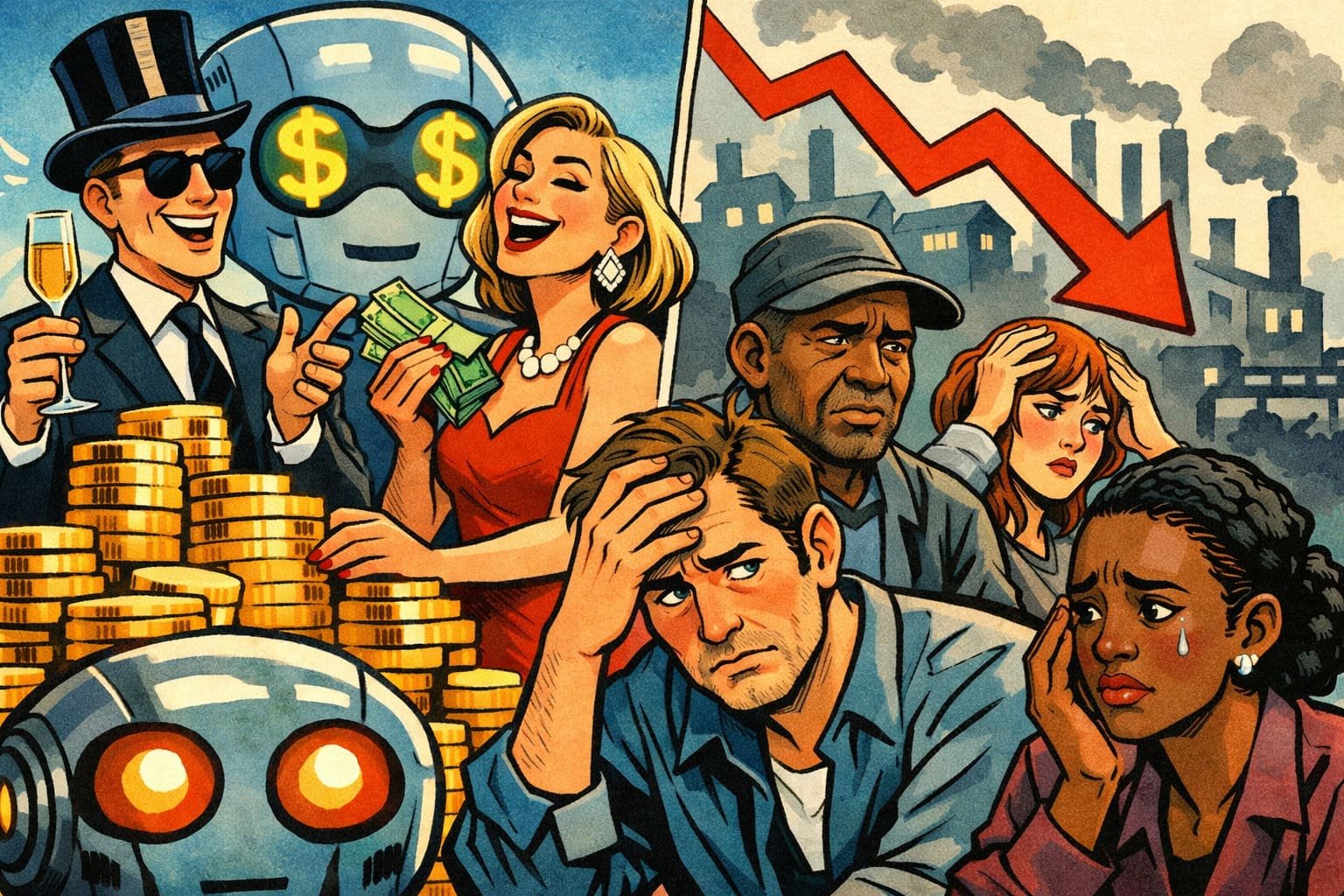
Spotlights bounced across a packed investor conference while applause erupted after another record-breaking earnings announcement. Screens glowed with rising valuations, executives exchanged confident smiles, and analysts hurried to revise optimistic forecasts before markets closed. Outside those polished halls, another conversation unfolded over packed commuter trains and modest kitchen tables. Families wondered why prosperity felt increasingly visible on financial news yet strangely absent from monthly bank balances.
Capital has always rewarded productivity, but artificial intelligence is accelerating a familiar economic pattern rather than inventing a new one. Organizations that deploy advanced automation successfully often generate stronger margins, faster decision making, and higher returns for investors. Workers, meanwhile, experience a slower adjustment. Wage growth depends on bargaining power, scarce skills, and labor demand, not simply on rising corporate profits. Wealth therefore accumulates unevenly, creating an uncomfortable gap between financial markets and everyday financial security.
Nvidia offers a striking illustration. As demand for artificial intelligence infrastructure expanded, investors celebrated extraordinary growth while businesses worldwide raced to secure computing capacity. That success created enormous shareholder wealth without producing equivalent income gains across every occupation connected to the technology. A procurement manager named Bianca watched software budgets expand dramatically inside her company while annual salary discussions remained cautious. “Business is booming,” colleagues joked during meetings, yet household budgets told a more restrained story after office lights dimmed.
Financial reporting helps explain this contradiction. Accounting rewards efficiency because lower operating expenses and stronger revenue frequently translate into healthier earnings. Investors purchase future cash flows rather than payroll optimism. When organizations automate repetitive work, savings often strengthen profitability long before employees negotiate higher compensation or transition into more valuable roles. Apple, Microsoft, and Meta all continue investing heavily in artificial intelligence because competitive advantage compounds over time, reinforcing a cycle where capital owners frequently benefit before labor markets fully adapt.
Economic history echoes this pattern across earlier waves of industrial change. Railways enriched financiers before entire regions experienced broader prosperity. Personal computing created immense fortunes while countless clerical roles quietly disappeared. Artificial intelligence follows a comparable trajectory, although at remarkable speed. Restaurant owner Hassan recently introduced automated inventory forecasting after years of waste and unpredictable purchasing. Profits improved almost immediately, yet longtime employees worried about reduced overtime despite helping build the business through difficult seasons. Success and insecurity occupied the same balance sheet.
City skylines shimmered beneath evening clouds, reflecting towers filled with remarkable wealth and streets carrying equally remarkable ambition. Neither image tells the complete story because economies are living systems shaped by choices as much as inventions. Prosperity becomes sustainable only when productivity gains translate into broader opportunity through investment, education, entrepreneurship, and meaningful career mobility instead of remaining concentrated within financial markets alone. Tomorrow’s economy will reward those who learn to own value, not merely provide labor.
