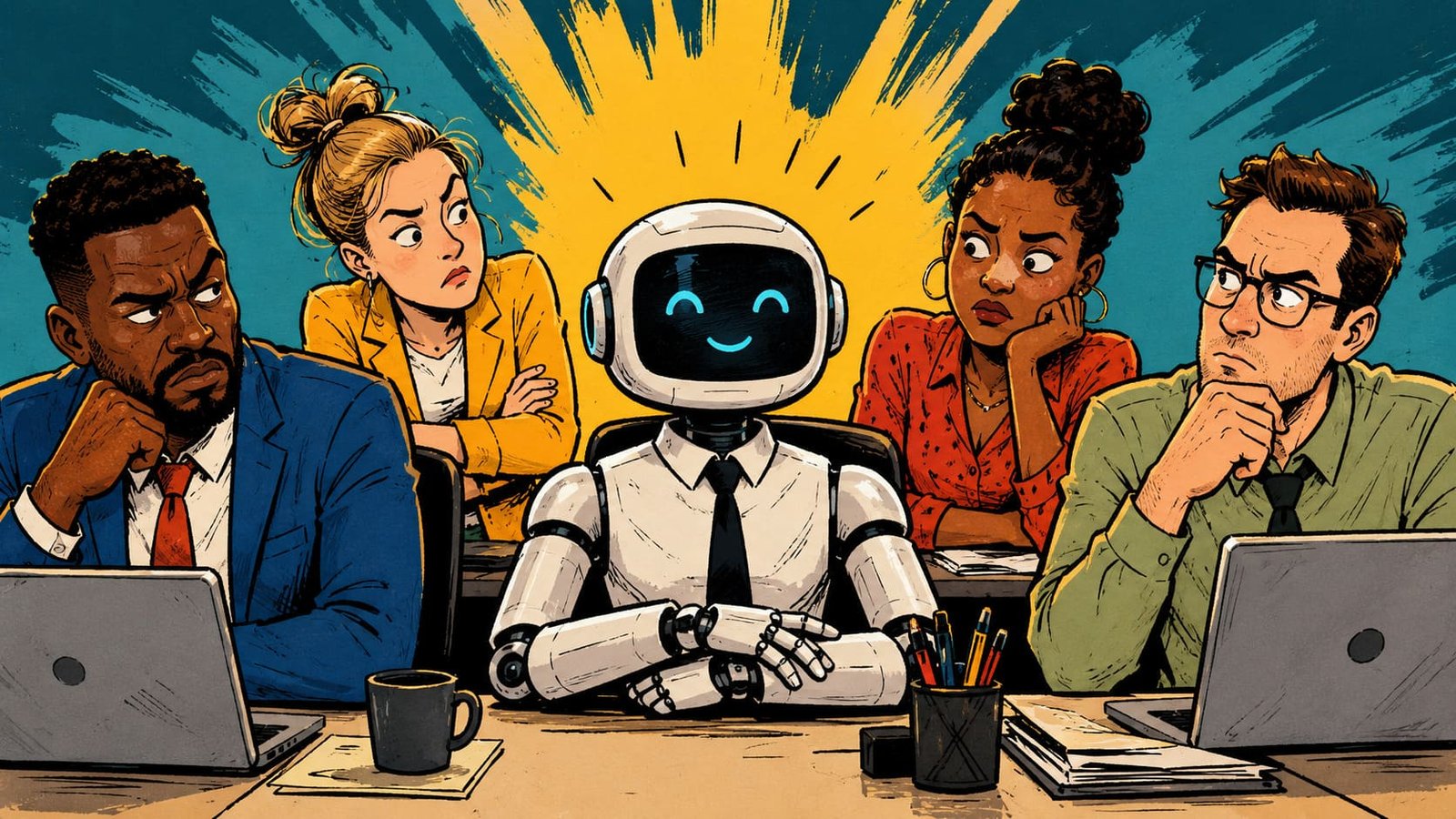
A customer-support desk hums while a strange new colleague answers questions without a chair, coffee cup, or surname. Its replies arrive instantly, its memory stretches across thousands of documents, and nobody has to invite it to lunch. Across the room, an employee watches a screen generate in seconds what once took an afternoon, feeling admiration followed by something sharper. AI has entered work not merely as software, but as a participant in everyday decisions. That changes the psychology of employment because competition now comes from a coworker who never gets tired, distracted, or promoted.
For managers, AI creates a peculiar leadership problem because productivity gains can coexist with human anxiety. A sales representative may use an AI assistant to summarize customer conversations, while a writer uses one to generate rough ideas, and an analyst uses another to examine patterns. The tool becomes valuable precisely because it removes portions of work people once considered proof of expertise. When routine competence becomes automated, status can become unstable. Employees may ask a question that sounds practical but carries emotional weight: “If the machine can do this, what exactly makes my contribution valuable?”
Consider Leila, a communications manager who discovers an AI system can draft campaign variations before her first coffee. Her instinct is to compete with the machine by working faster. That strategy fails because speed is the machine’s home territory. She changes approach, spending more time questioning assumptions, understanding customers, and deciding which ideas deserve a human voice. Her team begins using AI for rough production while reserving judgment, persuasion, taste, and accountability for people. The machine has not replaced Leila. It has forced her to become better at the parts of communication that cannot be reduced to typing.
A similar shift appears in software development. An engineer named Viktor watches an AI coding assistant produce functional code almost instantly, then notices a subtle security problem hidden inside the suggestion. The code looked impressive. It was also wrong for the system being built. That moment captures a crucial management truth: AI can compress execution without eliminating responsibility. Companies such as Microsoft have integrated AI assistants into workplace software, while developers across industries increasingly use coding tools to accelerate routine tasks. Productivity rises only when human judgment remains firmly attached to the output.
Leaders therefore should stop asking whether AI is replacing workers and start asking which parts of work should become machine-assisted. Tasks involving repetition, summarization, pattern recognition, drafting, and routine transformation may be strong candidates, while accountability, ethical judgment, relationship building, negotiation, leadership, and context often require deeper human involvement. Training must follow that logic. Employees need permission to experiment, but they also need standards for verification, privacy, security, and responsible use. Otherwise, organizations may automate mistakes faster, producing a remarkable machine for multiplying confidence without multiplying wisdom.
A new coworker has arrived, but rivalry is only part of the story. AI exposes an uncomfortable weakness in traditional careers: many roles were built around tasks rather than distinctive human judgment. Workers who respond by defending every routine task may lose ground, while those who learn to direct, challenge, verify, and improve machine output can become more valuable. Somewhere between fear and fascination sits a better question about work itself. If an artificial colleague can handle what once consumed most of a person’s day, what should that person become capable of doing with the time left?
