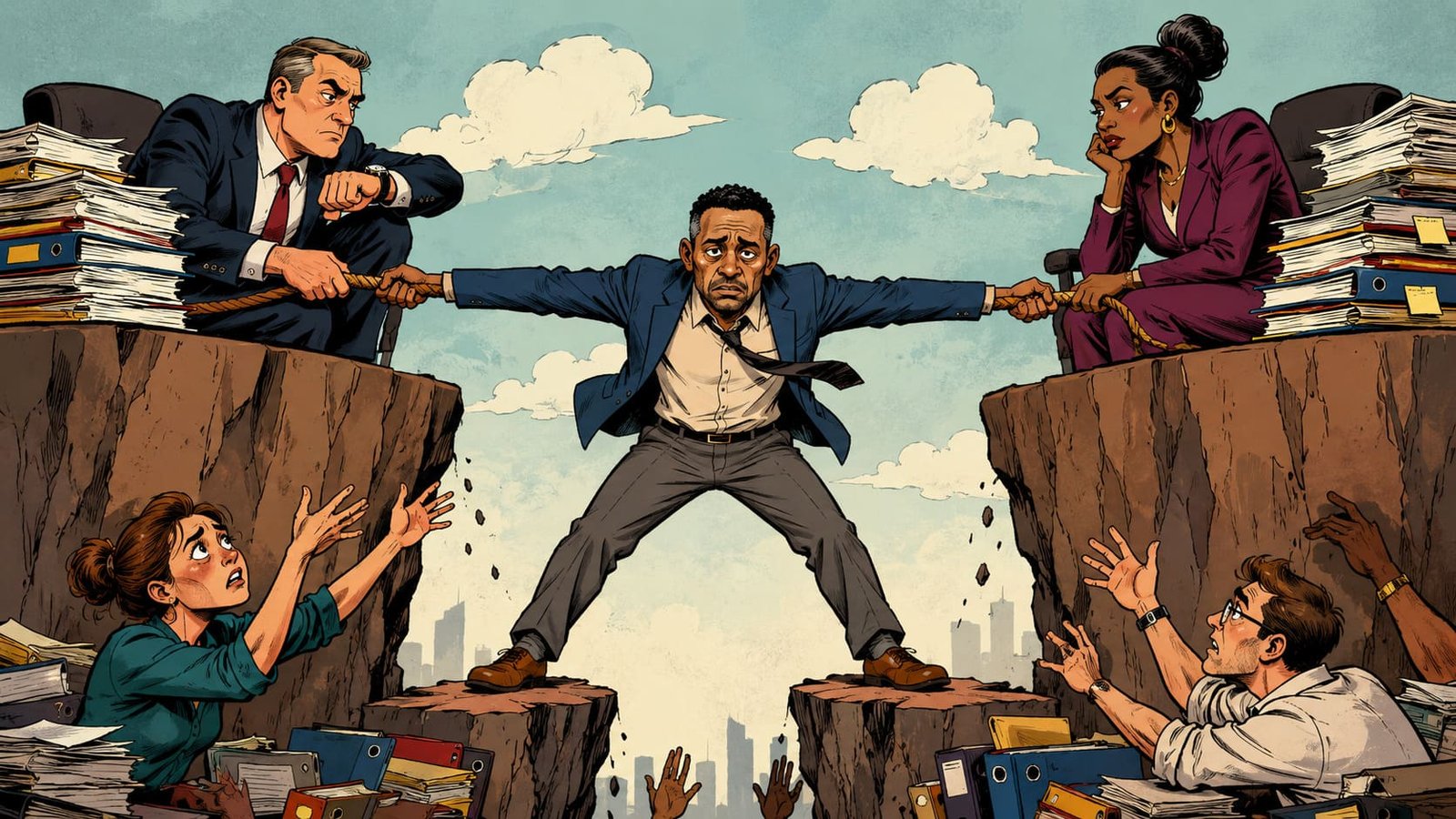
A middle manager sits between two calendars, one belonging to executives demanding speed, another belonging to employees demanding clarity. Her phone vibrates before the first meeting ends, a budget needs approval, a customer wants an answer, and someone has quietly asked whether headquarters actually understands what is happening downstairs. She has responsibility without complete authority, visibility without complete power. Middle management is where organizational pressure stops being an abstract strategy and becomes a human nervous system, absorbing every contradiction until even a strong manager begins wondering which direction counts as forward.
For years, organizations treated middle managers as transmission equipment. Strategy came down, performance information went up, and the person in between was expected to keep everything moving. Modern work has made that job much harder. Managers now translate strategy, coach employees, resolve conflict, interpret ambiguity, protect priorities, explain executive decisions, and absorb frustration from both directions. A restructuring announcement may take five minutes to deliver from headquarters and five weeks to make emotionally survivable for the people expected to implement it.
Microsoft’s transformation under Satya Nadella illustrates how a change in leadership philosophy can alter organizational expectations, but cultural change still has to travel through managers before employees experience it. Samuel, a warehouse manager, once received a new productivity target that his team considered impossible. Executives wanted enthusiasm. Employees wanted honesty. Samuel refused to pretend the target was easy, gathered operational evidence, and negotiated a phased approach. His value was not choosing between leadership and employees. It was translating ambition into a form the operation could actually carry.
That translation creates a peculiar emotional burden. Middle managers are frequently expected to defend decisions they did not make while answering for consequences they cannot fully control. Laila, a manager at a healthcare services company, spent weeks mediating after a scheduling change disrupted frontline routines. Finance wanted efficiency. Employees wanted workable shifts. Customers wanted consistency. Laila’s calendar filled with small conversations that produced no dramatic presentation and no heroic photograph, yet those conversations prevented a manageable disagreement from becoming a staff exodus.
The breaking point appears when responsibility consistently exceeds control. A manager can be accountable for retention without controlling compensation, responsible for productivity without controlling technology, and judged on morale while senior leaders continue creating uncertainty. That is not merely a resilience problem. It is an organizational design problem. Toyota’s emphasis on surfacing problems close to where work happens offers a useful counterpoint because knowledge and authority become more effective when they meet near the source of the problem instead of travelling through endless layers of approval.
Organizations should therefore stop asking only whether middle managers are resilient enough. A better question is what the organization is asking them to absorb. When one person becomes translator, coach, referee, compliance officer, therapist, crisis desk, and messenger, resilience eventually becomes another word for carrying an unreasonable load without complaint. Somewhere, a trusted manager is probably preparing to leave with years of institutional memory stored in a laptop and a tired head. Replacing the person may be easy. Rebuilding the invisible bridge they were holding together is not.
