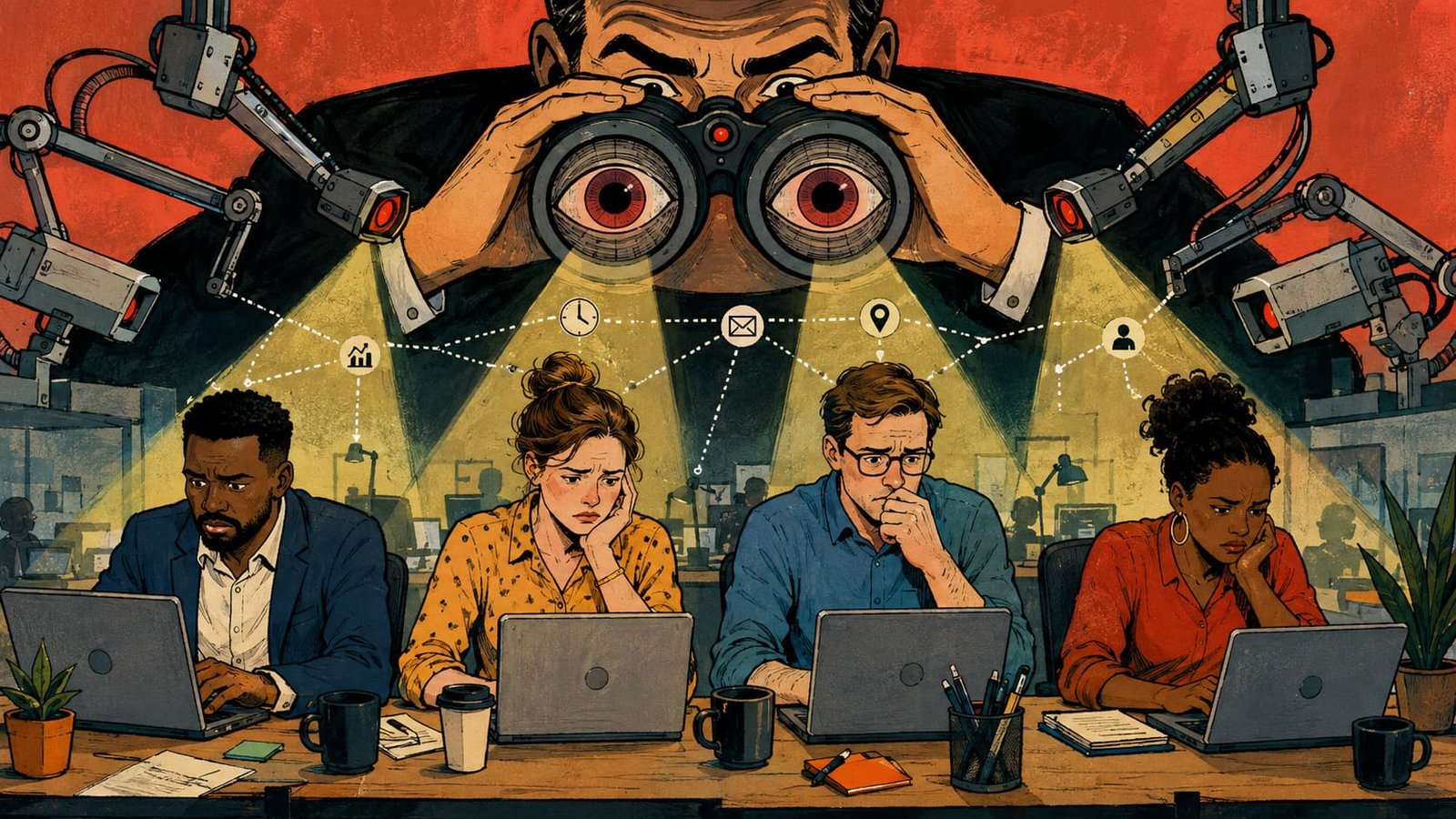
A manager watches a dashboard glow like an airport control tower, except every moving dot is a human being. One employee pauses too long, another answers messages after midnight, a third appears unusually productive, and an algorithm quietly turns these fragments into judgments. This is algorithmic management, where software can assign work, measure performance, schedule shifts, flag behavior, and sometimes influence discipline. The unsettling part is that modern organizations increasingly begin treating what is measurable as synonymous with what actually matters to people doing the work every day in practice.
For decades, managerial authority depended on proximity, memory, conversation, and interpretation. A supervisor could notice that a tired employee was struggling, hear frustration in a voice, or understand why a deadline slipped before reaching a conclusion. Algorithmic systems replace much of that messy context with signals, scores, rankings, and alerts. That can improve coordination, especially where repetitive work needs constant scheduling, yet research increasingly frames algorithmic management as a spectrum ranging from surveillance to more collaborative forms of human-machine coordination, where human judgment still has a seat at the table.
Picture a warehouse worker whose scanner records every movement while a system calculates pace against an expected rhythm. Picture a customer service agent whose screen time, response speed, and case volume become the raw material for a performance score. In both settings, software can help identify bottlenecks and distribute workloads, but measurement can quietly become pressure when workers feel unable to challenge the logic behind a score. One employee might whisper, “The system says I am slow,” while a manager replies, “Then work faster.” Somewhere between those sentences, judgment disappears.
Consider a delivery platform where software decides which worker receives the next assignment and evaluates performance through data generated during each job. Now place that logic inside an office, where calendars, messages, project systems, and productivity software create a trail of behavioral information. The workplace starts resembling a strange version of Moneyball, except employees are not baseball players and the statistics can affect livelihoods. A manager named Priya notices that her top-scoring worker has become exhausted, yet every dashboard still says excellent, and that contradiction becomes a warning worth noticing.
A healthier model treats algorithms as instruments rather than judges. Leaders can ask what a metric actually measures, what it misses, who can challenge an automated decision, and whether employees understand how their data affects evaluation. That sounds procedural until a disputed score lands in someone’s inbox and changes a promotion conversation, making the difference painfully human for everyone involved too. Good management has always involved context, coaching, trust, and accountability, and technology should strengthen those things rather than create a polished surveillance machine that nobody feels permitted to question.
Power changes character when nobody can point to the person holding it. A manager can explain a decision, apologize, reconsider, or simply admit, “That call was wrong,” while an algorithm cannot carry responsibility even when its recommendation shapes careers. Organizations face a choice that reaches beyond efficiency: build workplaces where data helps people understand work, or workplaces where people learn to perform for data. The boss may no longer sit across the desk, but authority remains present, so who gets to question the machine when it starts judging everyone?
