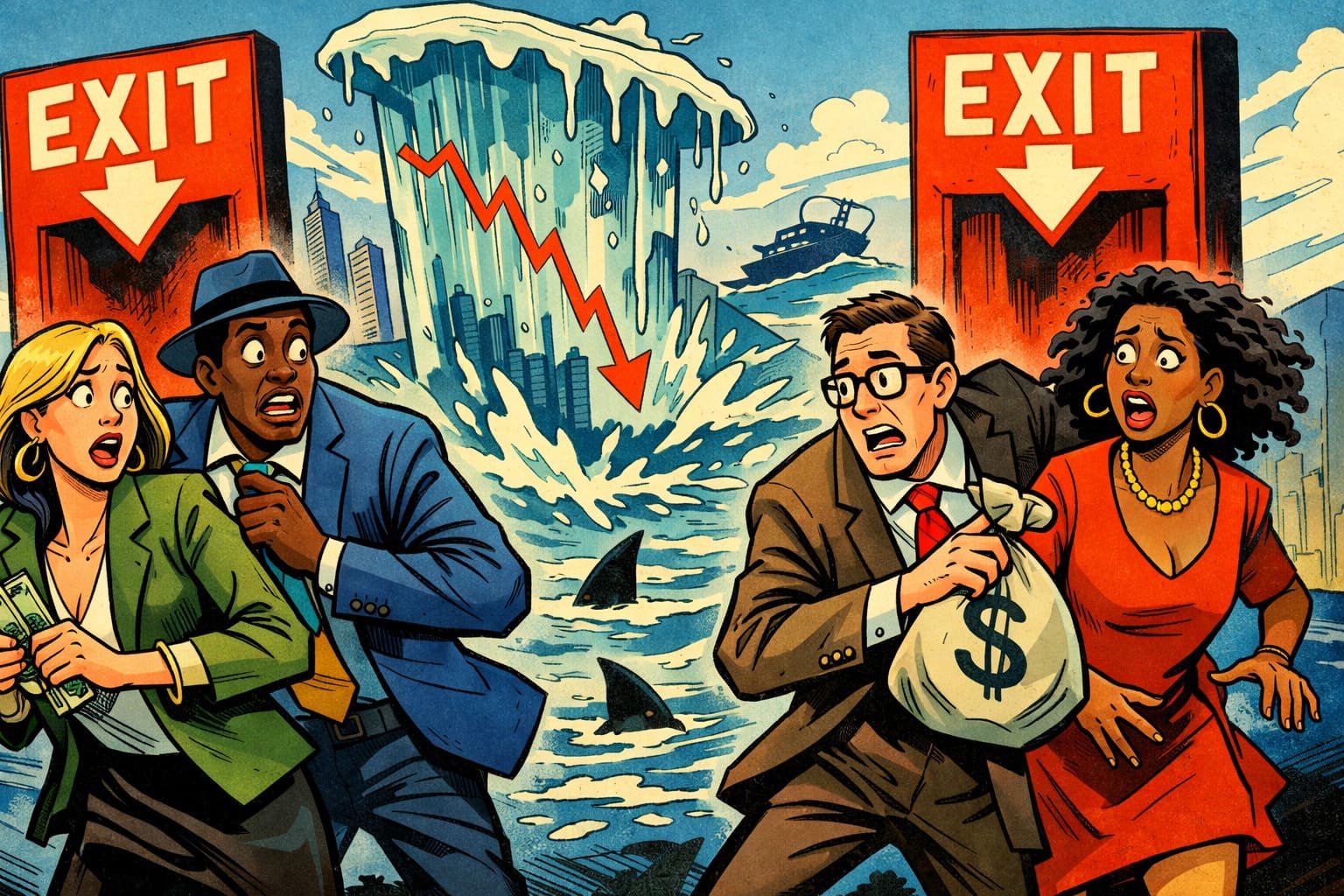
Champagne glasses still shimmered across a rooftop celebration while spreadsheets quietly whispered a different ending. Investors congratulated founders, lawyers exchanged polished smiles, and venture capital partners spoke confidently about exits waiting just ahead. Then markets changed direction with startling speed. Buyers disappeared. Public listings slowed. Acquisition conversations stretched into silence. Liquidity, once treated like a permanent feature of modern finance, revealed an uncomfortable truth. It exists only while enough people believe someone else will buy tomorrow.
Liquidity sounds technical, yet it shapes nearly every financial decision. A startup founder values shares differently when an acquisition feels likely. A pension fund manages risk differently when assets can be sold quickly. Private equity firms build entire investment models around predictable exit opportunities. Trouble begins when liquidity is mistaken for certainty rather than a market condition. Financial history repeatedly shows that buyers become cautious precisely when sellers become desperate, creating a painful imbalance that valuation models rarely anticipate.
Private equity experienced this reality as rising borrowing costs complicated acquisitions and strategic buyers became more selective. Many firms extended holding periods because expected exits no longer justified earlier valuations. Venture-backed technology companies faced similar pressure. Businesses once expected to list publicly instead focused on conserving cash, improving profitability, and delaying ambitious expansion plans. Howard Marks has long argued that risk is highest when investors believe risk has disappeared. Exit markets quietly prove that observation whenever optimism becomes crowded.
A healthcare software founder named Rina spent years preparing for a lucrative acquisition after receiving encouraging conversations from multiple buyers. Her board celebrated each meeting, assuming competition would naturally increase the final price. Weeks later financing conditions tightened across credit markets. Interest faded almost overnight. Rina abandoned expansion plans, redirected resources toward operational efficiency, and rebuilt the company around sustainable cash generation instead of anticipated sale proceeds. Ironically, that discipline attracted stronger buyers when markets stabilized because resilience replaced speculation.
Economic cycles expose a contradiction that rarely receives enough attention. Capital appears abundant during prosperous periods because investors expect smooth exits rather than permanent ownership. Once uncertainty rises, liquidity evaporates faster than underlying business quality. Strong companies often remain fundamentally healthy while their market values fluctuate dramatically simply because fewer participants are willing to transact. Accounting statements record assets at measurable values, yet genuine liquidity depends on confidence, financing conditions, regulatory environments, and collective psychology moving together.
Empty trading floors never appear on financial television, yet they reveal more about markets than crowded celebrations surrounding billion-dollar deals. Capital always seeks opportunity, but patience frequently earns higher returns than urgency. Every generation discovers that liquidity is not a promise embedded inside an investment. It is a privilege granted by functioning markets and willing counterparties. Perhaps the wisest investors never ask whether an exit exists today. They ask whether their business remains valuable if no exit arrives tomorrow.
