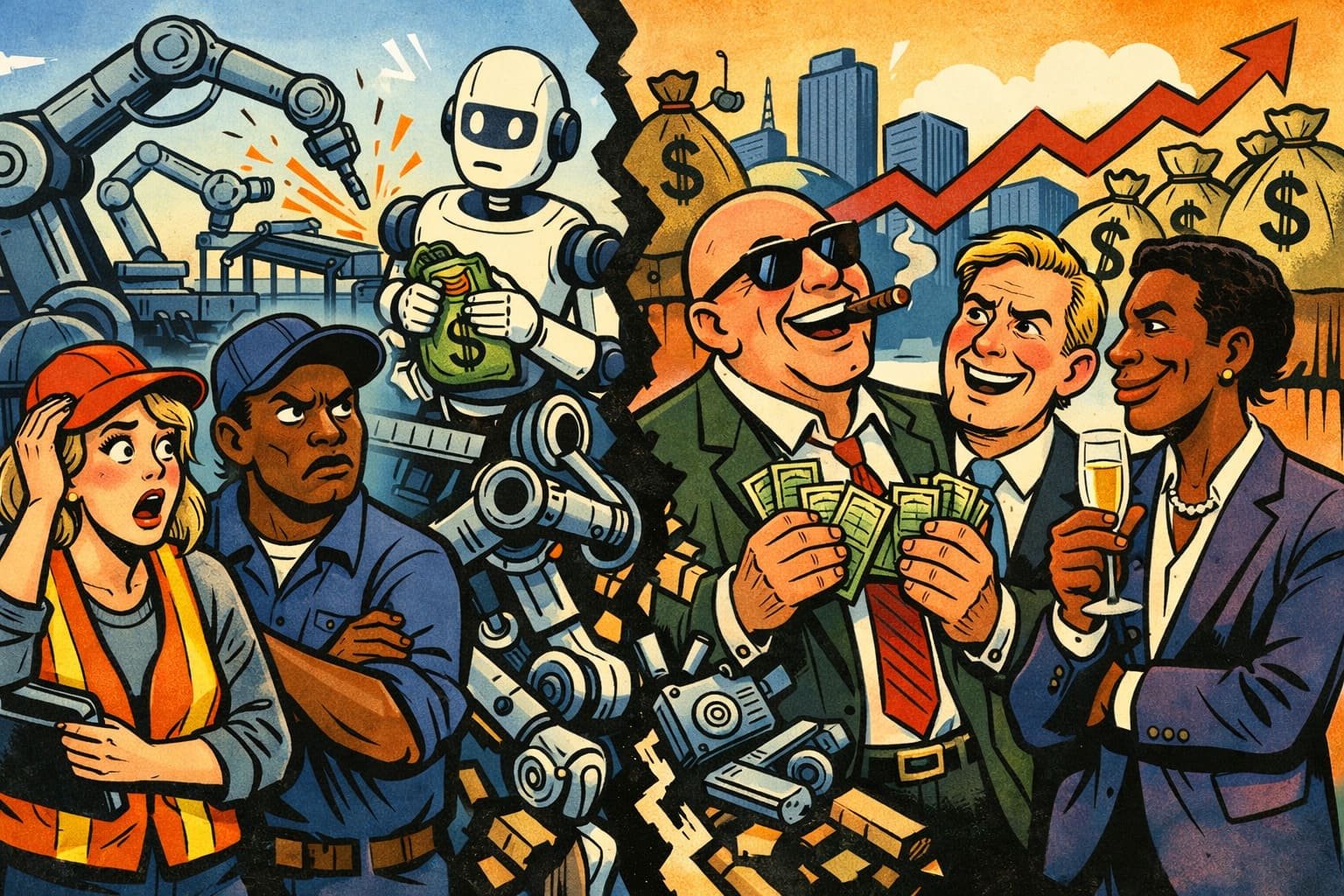
A trading floor never needs silence to feel unsettling. Screens glow, executives smile, shareholders applaud, yet an anxious warehouse supervisor studies a scheduling app that suddenly completes hours of planning before coffee cools. Prosperity has arrived wearing unfamiliar clothes. That contradiction defines a growing economic fault line. Productivity races ahead while confidence struggles to keep pace, creating a conversation that reaches factory gates, office towers, family kitchens, investment committees, and government chambers all at once, leaving millions wondering who truly benefits when efficiency becomes business’s most celebrated achievement.
Every technological leap has promised wider prosperity, yet financial rewards rarely arrive evenly. Automation lowers operating costs, raises margins, strengthens cash flow, and often delights investors because predictable earnings usually command stronger market valuations. Workers, meanwhile, face a different calculation. Skills that once guaranteed steady employment suddenly compete against software, robotics, and algorithms capable of performing repetitive tasks without fatigue, overtime, or holidays. Business history shows this pattern repeatedly, although each generation believes its disruption feels uniquely personal because livelihoods, not theories, stand directly in its path.
Consider Amazon’s relentless investment in warehouse robotics alongside JPMorgan Chase’s expanding use of artificial intelligence for financial analysis. Neither organization adopted automation simply to eliminate jobs. Both sought greater speed, accuracy, and scalability. Yet consequences ripple outward. Elena managed inventory for a regional distributor until automated forecasting reduced her department dramatically. She retrained in supply chain analytics, eventually earning greater responsibility. Marcus, operating a small printing company, ignored automation because loyal customers valued tradition. Costs climbed while competitors accelerated, forcing painful restructuring before survival became possible again.
Economic outcomes become clearer when viewed through capital allocation rather than emotion alone. Businesses invest where expected returns exceed financing costs, making automation attractive whenever productivity improvements outweigh implementation expenses. That logic explains why manufacturers continue modernizing despite public criticism. Kodak famously hesitated during digital disruption and paid dearly for delayed adaptation, while companies embracing operational change preserved stronger competitive positions. Markets reward future earnings, not nostalgia, even when communities experience difficult transitions that rarely appear inside quarterly financial statements.
Another story unfolds inside smaller enterprises rarely featured on television. Priya owned a neighborhood accounting practice where bookkeeping software completed work once handled manually by junior staff. Instead of shrinking permanently, she redirected employees toward financial advisory services that clients willingly paid premium fees to receive. Nearby, bakery owner Daniel installed automated mixing equipment after struggling with labor shortages and rising ingredient expenses. Bread still smelled wonderful each dawn, but profitability returned because repetitive production consumed fewer scarce resources without sacrificing quality.
Rain taps against office windows as another earnings season arrives, carrying celebration for investors and uncertainty for households reading identical headlines through entirely different lenses. Automation itself is neither hero nor villain. It simply magnifies preparation, adaptability, and financial discipline while exposing fragile business models built upon permanently inexpensive labor. Markets will keep rewarding productive enterprises, yet lasting prosperity depends upon helping people evolve alongside innovation rather than leaving them behind. Ask yourself which investment deserves greater attention today, faster machines or stronger human capability.
