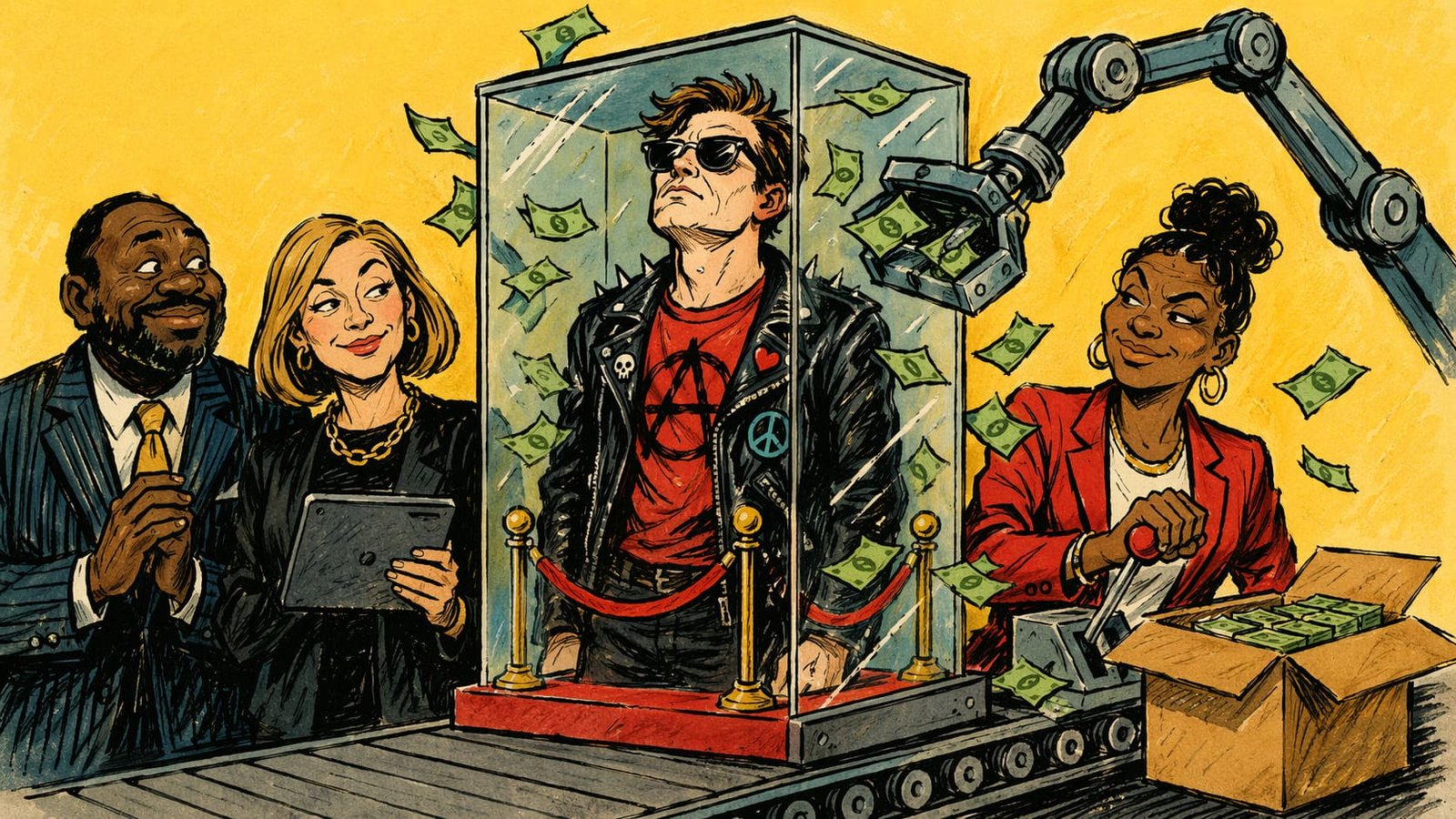
A cracked wall in a narrow street carries a spray-painted message that once felt dangerous. The letters are uneven, urgent, alive with defiance. Days later, the same phrase appears on a polished hoodie behind glass, priced high, folded neatly, stripped of risk. The street quiets. The store hums. What began as resistance now circulates as style, clean enough to wear, safe enough to sell. The message survives, but its teeth feel softer.
Rebellion has always carried energy. It disrupts, questions, refuses. Yet modern systems have learned a new skill. They do not only suppress dissent, they absorb it. They translate defiance into products, aesthetics, narratives. What once threatened structure becomes a layer within it. The system does not break. It adapts, often faster than the rebellion can evolve.
A brand strategist named Andre once noticed this shift during a campaign meeting. A junior designer proposed using protest-inspired visuals to signal authenticity. The room agreed quickly. The imagery felt current, charged, relevant. Andre hesitated. The symbols carried histories of struggle, yet here they were being repurposed for engagement metrics. The campaign launched successfully. Sales increased. The question lingered long after the numbers settled. What happens when resistance becomes a marketing asset?
Fashion offers some of the clearest examples. Countercultural styles often emerge as expressions of identity and refusal. Over time, they are adopted by mainstream brands, refined, distributed, normalized. The cycle repeats with remarkable consistency. Punk aesthetics, once rooted in rejection of conformity, now appear in curated collections. The visual language remains, but the context shifts. What once signaled opposition now signals awareness, sometimes even status.
Consider how movements are distilled into symbols that travel easily. A slogan, a color, a gesture. These elements simplify complex ideas into recognizable forms. This simplification allows them to spread, but it also makes them easier to appropriate. A symbol detached from its context can be reinterpreted, repackaged, and sold without carrying the full weight of its origin.
A startup founder named Lila built a platform centered on socially conscious products. Early traction came from aligning with emerging movements. Customers felt connected, not just to the products, but to the values they represented. Growth accelerated. Over time, Lila faced a dilemma. As the platform scaled, maintaining authenticity became harder. Suppliers varied. Messages broadened. The line between genuine support and strategic alignment blurred. The platform still spoke the language of change, but its operations began to resemble the systems it once critiqued.
Pop culture reflects this absorption with striking clarity. Films like The Matrix introduced the idea of questioning reality itself. The imagery of red pills and awakening entered mainstream discourse. Over time, the metaphor expanded, sometimes losing its original nuance, sometimes being used in ways that contradicted its intent. The symbol traveled far, but not always faithfully.
Music follows a similar path. Genres born from resistance often carry raw, unfiltered expression. As they gain popularity, production values shift, distribution expands, and the edges soften. Artists navigate a tension between maintaining authenticity and reaching wider audiences. Some manage the balance. Others feel the pull of adaptation more strongly.
A musician named Rafael built his early career on politically charged lyrics that resonated with a small but dedicated audience. As his visibility grew, labels encouraged broader themes to attract a larger market. Rafael adjusted slightly, then more significantly. His reach expanded, but longtime listeners sensed a change. The message remained present, but its intensity felt diluted. Rafael later described the experience as “learning how to be heard without being fully understood.”
There is a psychological comfort in consuming rebellion at a distance. Wearing a symbol, sharing a post, engaging with a narrative can create a sense of participation without requiring direct action. This is not inherently insincere. It reflects a human desire to align with values while navigating practical constraints. Yet it also creates a space where expression can replace engagement.
A marketing lead named Sofia once analyzed a campaign that encouraged users to share personal stories related to a social cause. Participation was high. Content spread widely. Sofia noticed that while awareness increased, measurable action remained limited. The campaign had created visibility, but translating that visibility into sustained change proved more complex. The system had amplified the message, but it had not necessarily advanced the outcome.
The tension lies in how rebellion interacts with scale. Small movements can maintain clarity and intensity. As they grow, they encounter structures that require adaptation. Messaging becomes more accessible. Strategies become more structured. The original edge can soften, not always by intention, but by necessity. Growth introduces compromise.
A cultural analyst named Noor once described this process as “the market’s ability to metabolize dissent.” The phrase captures a quiet truth. Systems do not always resist change directly. They absorb it, process it, and reintroduce it in forms that align with existing structures. The result feels like progress, but it often maintains continuity beneath the surface.
In a quiet workshop filled with unfinished designs, a creator pauses over a sketch that carries a message meant to challenge, not decorate. The choice ahead is subtle but significant. Refine it for broader appeal or preserve its roughness and risk being overlooked. The decision does not announce itself as a moral dilemma, yet it carries weight.
And in that still moment, where intention meets possibility, a question begins to take shape with quiet persistence: when resistance becomes something to consume, what remains of its power to change anything at all?
