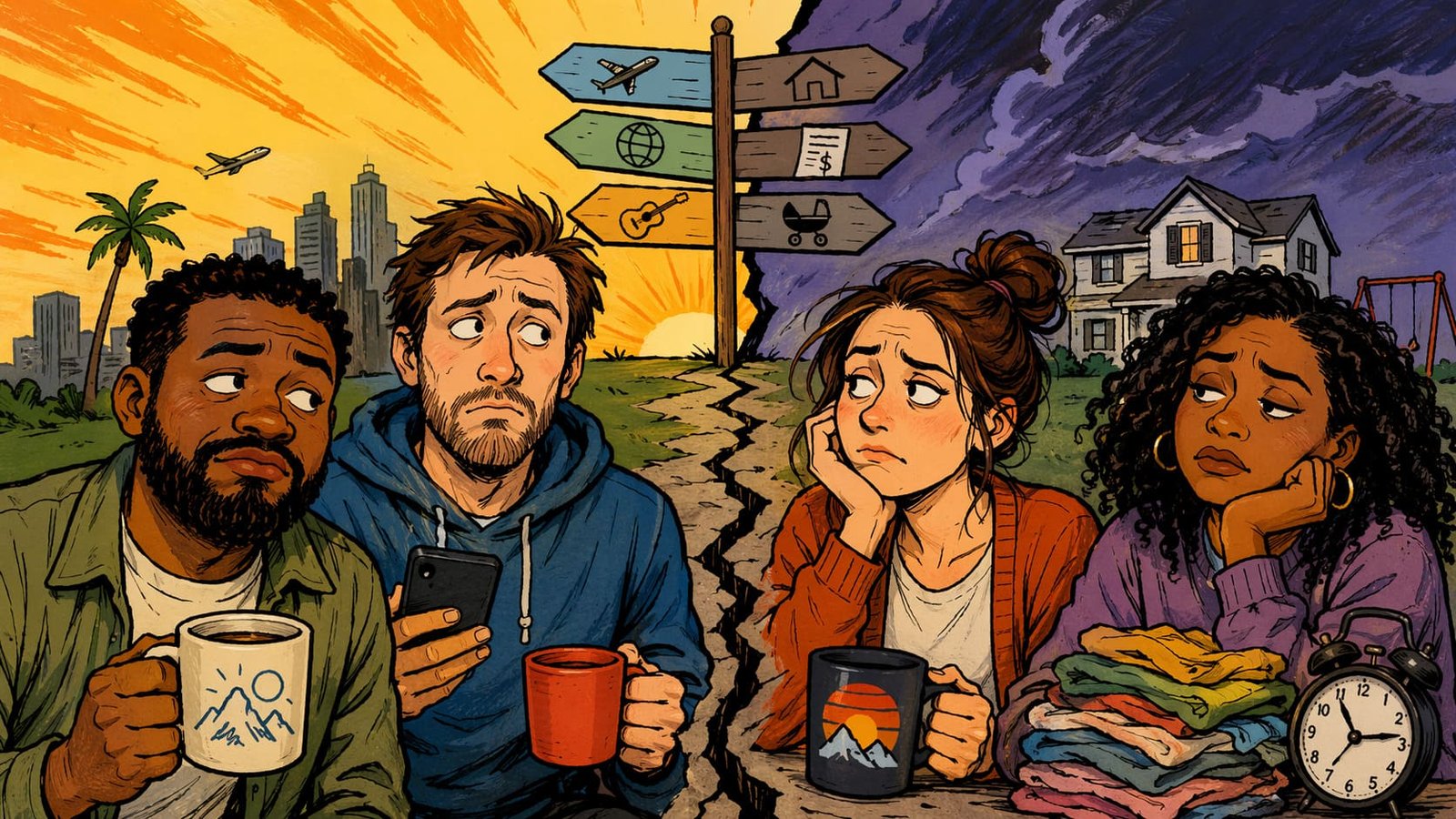
The room feels oddly suspended, like a party that forgot to end. The music is familiar, the jokes land softer now, and the glow from screens replaces the old neon buzz of possibility. A generation once fluent in reinvention stands quietly at the edge of a realization it tried to outrun. The myth was simple and seductive: stay young by staying in motion. Pivot careers, remix identity, chase experiences, and treat permanence like a design flaw. For years, it worked. Then something subtle shifted. Time did not break down the door. It waited politely, then took a seat.
Millennials were raised on a script that promised infinite elasticity. The internet offered a second life, then a third. The gig economy whispered freedom while quietly dissolving stability. Social media turned identity into a living draft, endlessly editable. This generation learned to delay definition, to resist the finality their parents accepted early. It looked like progress, even courage. But midlife does not negotiate with flexibility. It asks a different question. Not who are you becoming, but what have you become.
There is a particular kind of shock that arrives without drama. It shows up in small, almost trivial moments. A conversation about health becomes more detailed than one about dreams. A birthday feels less like expansion and more like inventory. A familiar song from youth plays, and instead of nostalgia, there is a quiet recognition that it belongs to another era entirely. This is not failure. It is a fracture in the illusion of endless becoming.
Consider Daniel, who built a reputation as a digital strategist, moving from startup to startup with the ease of someone who believed momentum was a substitute for direction. His LinkedIn profile read like a highlight reel. Each role sharper, each company more impressive. At thirty-nine, he sat in a glass office overlooking a city he once felt he owned, realizing he could not explain what he actually wanted anymore. His success had outrun his sense of self. The question was no longer how to grow, but whether growth had been mistaken for meaning.
The culture around this generation played its part. Silicon Valley celebrated disruption with a near-religious fervor. Figures like Mark Zuckerberg embodied the idea that youth was not a phase but an advantage, even a credential. The workplace flattened hierarchies, blurred boundaries, and replaced tenure with relevance. Everything was optimized for speed, iteration, and scale. Aging did not fit neatly into that system. It could not be hacked, automated, or outsourced. It simply accumulated.
There is also a quieter, more personal tension unfolding. Many millennials delayed traditional milestones, not out of rebellion but out of recalibration. Marriage, homeownership, and long-term commitments were postponed in favor of exploration and self-definition. That delay created space, but it also compressed timelines. Now, decisions that were once spaced over decades arrive all at once. Career stability, family planning, financial security, personal identity. The pressure is not just external. It is existential.
Aisha, a marketing director in Toronto, once described it over coffee that had gone cold long before the conversation ended. She had spent her twenties traveling, freelancing, and building a portfolio that felt like a passport. At forty, she found herself calculating retirement savings while also wondering if she had postponed certain choices beyond recovery. Her voice carried no regret, only a kind of quiet astonishment. Life had not gone wrong. It had simply moved faster than expected.
The deeper conflict is not about age itself. It is about the story this generation told itself about time. Millennials believed they could outmaneuver it, reshape it, even ignore it. That belief was not entirely misguided. It produced creativity, resilience, and a willingness to challenge outdated systems. But it also created a blind spot. Time is not just a constraint. It is a structure. Without it, meaning becomes diffuse.
Pop culture reflects this tension with uncomfortable clarity. Shows like BoJack Horseman captured the quiet despair of a generation that achieved visibility without fulfillment. Characters drift through success, haunted by the absence of grounding. The humor lands because it feels true. The sadness lingers because it is familiar. This is not a crisis of failure. It is a crisis of coherence.
There is something almost tender in this moment of recognition. The generation that refused to be defined now faces the necessity of definition. Not as a limitation, but as a form of clarity. The endless horizon of possibility narrows, but in that narrowing, something sharper emerges. Choice gains weight. Commitment gains meaning. Identity stops being a project and starts becoming a place.
The cultural conversation often frames this as a loss. Youth fading, options closing, energy declining. That framing misses the deeper shift. What is actually happening is a transition from expansion to integration. The scattered pieces of experience begin to form a pattern. The noise quiets enough for signal to appear. It is less dramatic than the mythology of youth, but far more substantial.
There is also a subtle rebellion embedded in this stage. Refusing to panic. Refusing to perform youth as a brand. Refusing to treat aging as a problem to be solved. Some are choosing to lean into the gravity of midlife, to treat it not as an endpoint but as a recalibration. It is quieter work. Less visible. More honest.
The paradox is almost poetic. The generation that spent years resisting definition may find its most authentic expression in accepting it. Not the rigid definitions of the past, but a self-chosen structure. A deliberate narrowing. A conscious commitment. It is not as flashy as reinvention. It does not trend. But it holds.
Somewhere, the music from that suspended party finally fades. Not abruptly, not with a dramatic cut, but with a gentle lowering of volume until conversation becomes possible again. The room is still there. The people are still there. The difference is the attention. It shifts inward, then outward in a more deliberate way.
And in that quieter space, a different kind of question begins to form, one that does not chase endless possibility but sits with something more unsettling and more real: when the performance of youth ends, what remains is the life that was actually built, so what, exactly, have you chosen to build?
