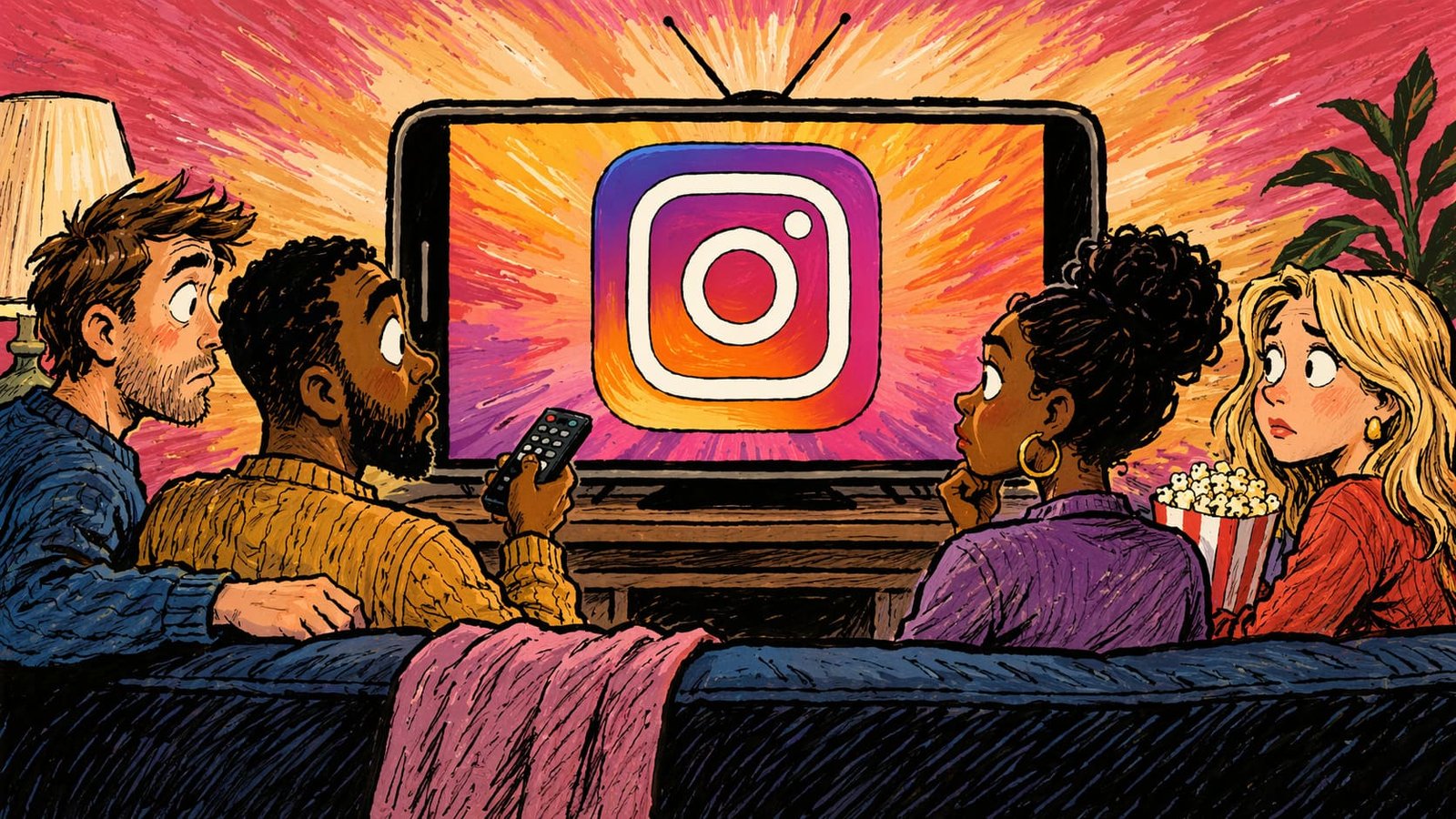
The feed scrolls, but it no longer feels like movement. It feels like programming. A sequence of clips stitched together with invisible intent, each one timed, shaped, and delivered with the quiet precision of a broadcast schedule that never admits it exists. A person opens the app expecting to see people. Instead, a stream appears, polished, continuous, strangely impersonal. The faces change. The tone stays the same. Somewhere between connection and consumption, the platform has rewritten its purpose. It no longer asks what you want to see. It decides what will keep you watching.
The transformation did not arrive with a loud announcement. It slipped in through features that felt optional at first. Reels, suggested posts, algorithmic recommendations, all framed as enhancements, as ways to discover more, to stay entertained. Over time, those additions became the experience itself. The original premise of the platform, a space to follow friends and share moments, began to recede. In its place, something more familiar emerged. A channel, not a network. A flow of content designed less for relationship and more for retention.
This shift mirrors a broader pattern in media. Platforms that begin as social spaces often evolve into distribution engines. The logic is simple. Human connection is valuable, but attention is monetizable. When attention becomes the primary currency, the system optimizes for whatever holds it longest. That often means content that is immediately engaging, visually striking, emotionally charged. It does not require context. It does not require familiarity. It simply needs to work, instantly, on anyone who encounters it.
A creator named Sienna built her following through personal storytelling, sharing fragments of her daily life with a small but loyal audience. Her posts felt intimate, almost conversational. As the platform evolved, her reach began to fluctuate. Posts that once performed consistently started to disappear into the void. She adapted, experimenting with short-form video, trending formats, faster pacing. The results were immediate. Views increased. New followers arrived. Yet something shifted in the relationship. Her audience grew, but it no longer felt like an audience she knew. It felt like a crowd passing through.
This is the quiet trade-off at the heart of the platform’s evolution. Reach expands. Connection thins. The system rewards content that can travel, not content that can stay. Stories become snippets. Moments become loops. The emphasis moves from depth to repeatability. What matters is not whether a piece of content resonates deeply with a specific group, but whether it can capture attention across a broad, shifting audience. The feed becomes less personal, more universal, yet paradoxically less meaningful.
There is also a structural resemblance to television that is difficult to ignore. Traditional TV relied on programming blocks, curated sequences designed to keep viewers engaged over time. Instagram now operates with a similar logic, but at a much finer scale. Each scroll reveals a new segment, selected based on past behavior, optimized for maximum engagement. The difference is subtle but significant. You are not choosing a channel. The channel is choosing you, moment by moment, adapting in real time.
A media strategist named Daniel described it with a clarity that lingered. “The platform stopped being a mirror,” he said. “It became a stage.” The distinction matters. A mirror reflects what exists. A stage presents what is designed. When a platform becomes a stage, authenticity becomes secondary to performance. Creators learn quickly what works, what travels, what holds attention. They adjust accordingly. The result is a feedback loop where content becomes increasingly tailored to the system’s preferences, not the audience’s needs.
You can see this in the way trends propagate. A format emerges, spreads rapidly, saturates the feed, then disappears, replaced by the next iteration. The cycle repeats with mechanical efficiency. Each trend carries its own aesthetic, its own rhythm, its own expectations. Creators who adopt it gain visibility. Those who resist it risk invisibility. The platform rewards conformity, even as it celebrates creativity. It is a paradox that shapes the entire ecosystem.
Meanwhile, users adapt in quieter ways. The act of scrolling becomes less about catching up and more about tuning in. The feed fills moments of idle time, offering a steady stream of stimulation that requires little effort to process. It becomes background and foreground at the same time, a constant presence that blends into daily life. The line between social interaction and passive consumption blurs, then disappears entirely.
In a dimly lit room, a phone screen glows with endless motion. Clip after clip flows without interruption, each one precise, calibrated, designed to hold attention for just long enough before giving way to the next. There is no clear beginning, no defined end, just a continuous sequence that feels both infinite and controlled. The user scrolls, pauses, scrolls again, unaware of the structure guiding the experience. It feels natural. It is anything but.
Somewhere inside that endless stream, the idea of social connection quietly steps aside, replaced by something smoother, more efficient, and far less personal, leaving behind a question that lingers long after the screen goes dark: when every moment is programmed to keep you watching, will you still recognize the difference between choosing what you see and being shaped by it?
