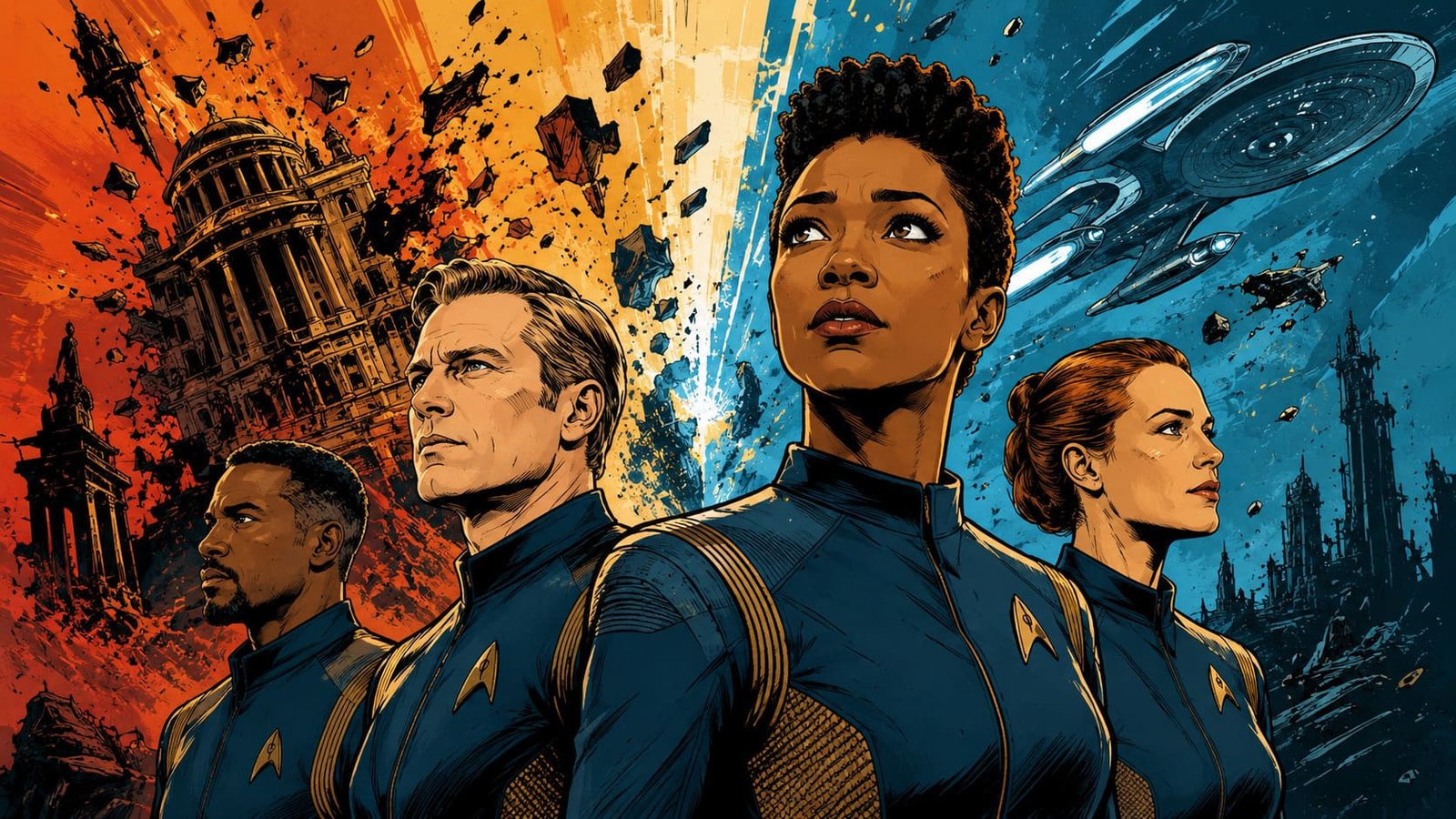
The room looked expensive enough to hide corruption beautifully. Frosted glass walls. Whispering touchscreens. Executives speaking in calm voices while entire systems trembled beneath them like cracked ice under polished shoes. Modern civilization has mastered the art of appearing stable seconds before collapse. That is the emotional frequency Star Trek: Discovery understands better than almost any science fiction series of its generation. Beneath the warp drives and interstellar diplomacy sits a brutally contemporary story about institutions under psychological siege. This is not the optimistic architecture of earlier Star Trek eras where competence quietly held civilization together like invisible scaffolding. Discovery enters the room after the scaffolding has already started snapping. The result feels less like traditional space exploration and more like a corporate empire trying to survive a nervous breakdown while cameras continue rolling.
Michael Burnham stands at the center of that emotional storm like a living contradiction. She is disciplined yet impulsive, intellectually brilliant yet emotionally volatile, loyal yet dangerous when conviction outruns restraint. That complexity gives the series its heartbeat. Burnham is not designed to comfort viewers. She reflects the modern professional class itself: hyper-educated, morally ambitious, psychologically overloaded, permanently navigating systems too unstable for certainty. Her mutiny in the opening storyline lands with startling philosophical weight because it touches a forbidden truth about leadership. Institutions often punish disobedience publicly while privately benefiting from the courage behind it. Countless companies celebrate innovation in keynote speeches while quietly suffocating employees who challenge authority in real rooms with fluorescent lights and nervous silence.
The series thrives on tension between order and identity. Every corridor aboard Discovery feels charged with emotional static. Characters carry trauma openly. Grief leaks into decision-making. Loyalty becomes transactional under pressure. Even conversations sound exhausted in a distinctly twenty-first-century way, as though everyone aboard the ship has survived three economic crashes and two existential crises before breakfast. That emotional density unsettled many longtime fans expecting cleaner optimism. Yet that discomfort is precisely what makes the show culturally fascinating. Discovery understands that modern audiences no longer trust polished systems automatically. Trust now has to be earned scene by scene, relationship by relationship, scar by scar.
A revealing moment arrives through Saru, one of the most emotionally intelligent characters in contemporary science fiction. His species evolved as prey, shaped by fear so deeply that danger became biological instinct. That premise sounds fantastical until compared with modern workplace psychology. Many professionals now operate inside permanent anticipatory anxiety. Emails feel like alarms. Meetings resemble controlled interrogations. Career survival depends on reading invisible emotional weather before speaking. Tariq, an operations director at a telecommunications firm in Dubai, once confessed during a leadership retreat that he checked Slack messages the way ancient villagers once scanned forests for predators. The room laughed nervously because everyone understood the metaphor immediately. Discovery taps into that same exhausted survival instinct running beneath modern ambition.
The show’s visual language reinforces its philosophical aggression. Unlike the warm composure of older Star Trek worlds, Discovery often feels sharp-edged and overstimulated. Lights flicker against metallic surfaces. Consoles pulse like agitated nervous systems. Even the ship itself appears alive in an uneasy way, less like a sanctuary and more like an organism under stress. The famous spore drive becomes an especially potent metaphor. Here is a machine capable of unimaginable breakthroughs, powered through systems barely understood by the people operating it. That sounds suspiciously similar to modern artificial intelligence, social media infrastructure, and financial algorithms reshaping civilization faster than human ethics can process consequences. Progress in Discovery never feels clean. It feels expensive.
One of the series’ greatest strengths is its willingness to explore emotional vulnerability without softening its intellectual edge. Burnham cries. Leaders hesitate. Officers collapse under moral strain. Yet none of that weakens the storytelling. It deepens it. The series quietly demolishes the outdated myth that emotional suppression equals strength. In older corporate cultures, executives often performed invulnerability like theater. The modern world has exposed the cost of that performance. Burnout spreads. Isolation deepens. Entire industries quietly drown in emotional illiteracy while pretending productivity alone can save them. Discovery keeps returning to one difficult insight: systems fail when human beings become emotionally disconnected from the consequences of their decisions.
The political subtext grows sharper with every season. The Federation itself increasingly resembles a civilization struggling against fragmentation, paranoia, and institutional fatigue. That reflection feels painfully current. Democracies across the world now wrestle with polarization, misinformation, distrust, and cultural exhaustion. Technology promised connection while quietly accelerating alienation. Leaders promise stability while managing permanent crisis. In that environment, Discovery becomes more than entertainment. It becomes diagnostic. A media scholar from São Paulo once described the series as “science fiction for people surviving the emotional economics of collapse.” That observation lingers because it feels true. The show understands that the real danger to civilizations is rarely external invasion alone. Collapse often begins internally, through fear, ego, tribalism, and the slow erosion of shared meaning.
Then comes the strange emotional aftertaste that makes the series unforgettable. Beneath all the warfare, temporal distortions, and cosmic spectacle sits a stubborn belief that fractured people can still build fragile forms of trust together. That belief never arrives wrapped in sentimental speeches. It emerges painfully, through sacrifice, apology, and repeated failure. Somewhere inside the noise of collapsing timelines and political chaos, the series keeps asking whether humanity can evolve emotionally at the same speed as its technology. That question reaches far beyond science fiction. It follows modern viewers into offices glowing at midnight, into relationships strained by ambition, into societies addicted to acceleration without reflection. A civilization can survive external enemies for centuries. The deeper threat appears when people lose the ability to recognize each other beneath performance, fear, and noise. And perhaps that is why Star Trek: Discovery feels so unsettlingly alive. It does not simply imagine the future. It recognizes the psychological temperature of the present before most people are willing to admit how hot the room has become.
Editorial Disclaimer: Whether a TV Show is rooted in fiction or inspired by real events, the actions, decisions, and behaviors portrayed within are not intended to be encouraged, replicated, or endorsed in real-world settings. This review exists solely to analyze the storytelling, characters, themes, and business dynamics presented in the TV Show for educational, analytical, and entertainment purposes. Any ethical or unethical conduct depicted in the TV Show does not reflect the views, values, or endorsements of ESYRITE.
