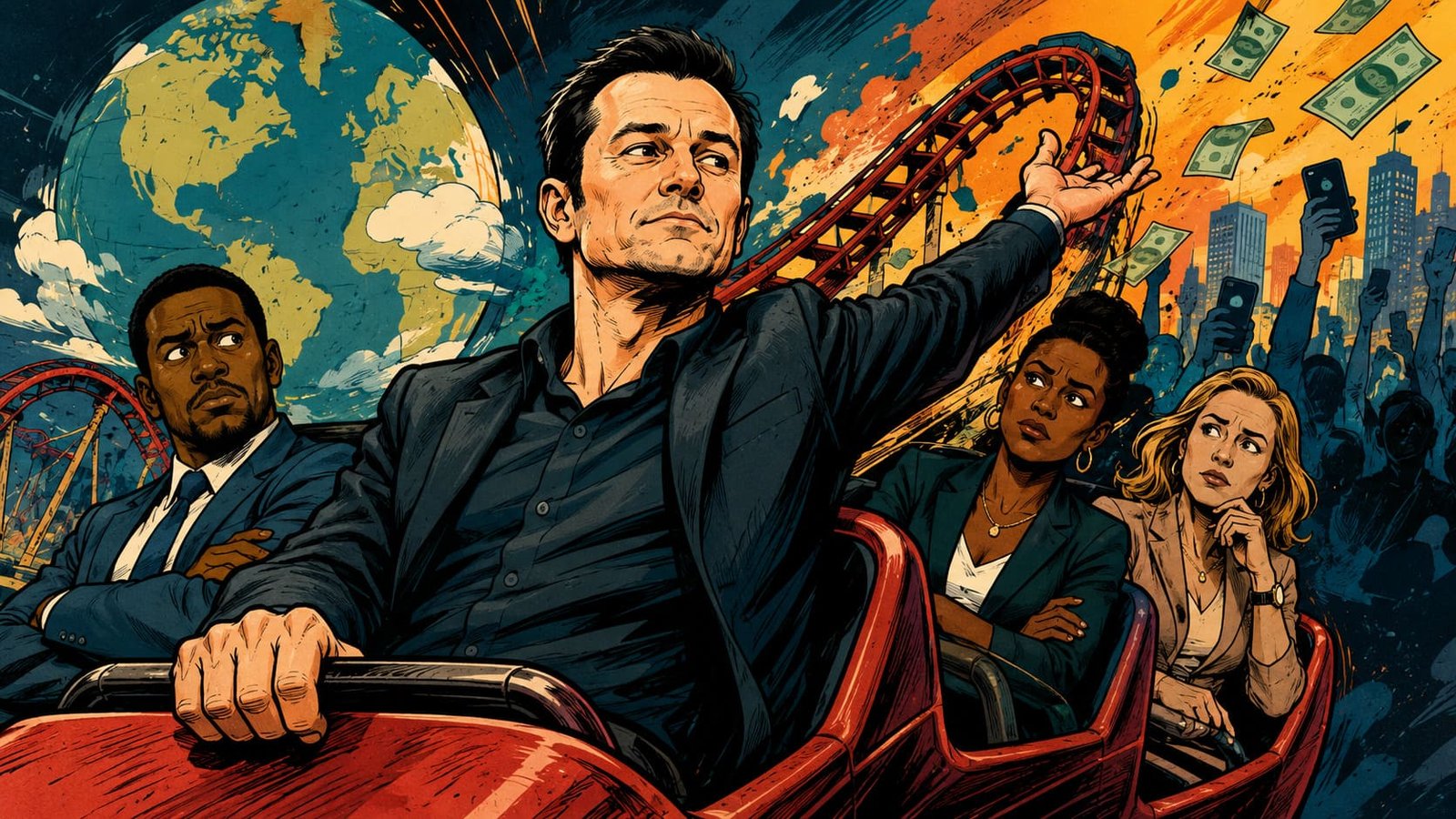
The city shimmered like a machine refusing sleep. Black cars sliced through rain-soaked streets. Venture capitalists floated through rooftop parties speaking in the language of disruption as though ordinary morality had become obsolete software. Somewhere inside that electric fever dream, Super Pumped arrived not as a business drama, but as a psychological crime scene disguised as innovation mythology. The series studies modern capitalism with the cold fascination of someone examining fingerprints left on broken glass. It understands a brutal truth many executives secretly know but rarely confess aloud: the startup economy does not merely reward ambition, it industrializes obsession until entire identities become collateral damage.
Travis Kalanick storms through the story with volcanic intensity, played by Joseph Gordon-Levitt as a man who treats limits like personal insults. He does not enter rooms. He invades them. That energy explains both Uber’s explosive ascent and the emotional destruction orbiting it. Kalanick represents a distinctly modern archetype, the founder who confuses relentless aggression with visionary leadership because Silicon Valley spent years romanticizing emotional detachment as strategic brilliance. The show never reduces him to simple villainy. That would be too easy. Instead, it reveals how charisma, insecurity, innovation, and ego can fuse into something both magnetic and catastrophic. Watching him negotiate feels less like observing business strategy and more like witnessing a casino gambler convince himself probability no longer applies.
The series becomes especially sharp when examining organizational culture. Uber’s internal environment resembles a battlefield disguised as a workplace. Loyalty matters until growth metrics demand sacrifice. Employees absorb the psychological logic of the company itself: accelerate harder, apologize later, dominate before competitors breathe. That atmosphere mirrors countless real-world startup ecosystems where exhaustion gets mistaken for purpose. During the peak of tech hypergrowth culture, founders proudly described sleeping beneath desks as though burnout were a spiritual achievement rather than a warning sign. Super Pumped captures that madness with painful accuracy. The offices pulse with caffeine, adrenaline, and low-grade emotional panic. Everyone behaves like history is watching. Most are simply trying not to drown.
A revealing thread emerges through Arianna Huffington’s interactions with Kalanick. She operates like someone attempting to install emotional intelligence inside a machine addicted to velocity. Their conversations expose one of the central tensions of modern leadership: can systems built entirely around expansion ever develop moral restraint without threatening their own momentum? Elena, a former product strategist at a fintech company in Madrid, once described attending executive meetings where “culture” only became important after public scandal threatened investor confidence. Before that moment, growth excused everything. Super Pumped keeps returning to that contradiction. Ethics inside hypergrowth environments often function like decorative plants in luxury hotel lobbies, visually reassuring until actual structural pressure arrives.
The storytelling gains additional power through its understanding of power psychology. Success changes perception before it changes reality. Once Uber became culturally dominant, ordinary resistance began collapsing around it. Regulators hesitated. Investors rationalized behavior they once criticized. Consumers tolerated chaos because convenience arrived wrapped in technological glamour. The series quietly exposes how societies repeatedly surrender moral clarity when innovation promises status, speed, or emotional stimulation. That pattern stretches far beyond Silicon Valley. Political movements, entertainment empires, even celebrity culture often follow identical emotional mechanics. Humans remain strangely vulnerable to confidence performed at scale.
What separates Super Pumped from ordinary corporate storytelling is its refusal to worship disruption automatically. Modern business culture often treats disruption as sacred vocabulary, a kind of secular religion for ambitious professionals seeking transcendence through market domination. The series punctures that mythology repeatedly. Innovation here creates undeniable value while simultaneously amplifying exploitation, paranoia, and emotional fragmentation. Drivers become disposable infrastructure. Employees become exhausted apostles serving a growth narrative larger than themselves. Even success feels strangely hollow because the machine never stops demanding more fuel. There is a haunting familiarity in that dynamic. Many professionals today quietly suspect they are sacrificing psychological stability for systems incapable of genuine satisfaction.
The visual texture of the series intensifies this emotional exhaustion beautifully. Neon lights flicker against expensive interiors. Conversations happen in black SUVs, luxury restaurants, sterile conference rooms glowing with technological confidence. Yet beneath the polished surfaces sits constant instability. The pacing mirrors startup culture itself, frantic, seductive, permanently one crisis away from combustion. A small scene involving a tense boardroom negotiation captures this perfectly. Nobody raises their voice initially. The danger lives in smiles, pauses, strategic silences. Modern power rarely announces itself dramatically anymore. It arrives through polished language, investor confidence, and the subtle threat of exclusion from the next great opportunity.
Near its emotional core, Super Pumped leaves behind a difficult question about ambition itself. At what point does visionary thinking mutate into emotional illiteracy wearing designer sneakers? The series never offers clean answers because real systems rarely produce them. Kalanick is both builder and destroyer, admired and feared, brilliant and catastrophically blind to consequences unfolding around him. That complexity gives the show its lingering power. Somewhere beyond the IPO dreams, media scandals, and corporate warfare sits a deeper warning about civilizations increasingly confusing scale with wisdom. The towers keep rising. The apps keep downloading. The valuations keep expanding like digital empires racing toward immortality. Still, beneath every glowing screen and triumphant earnings call waits an older human truth that technology alone cannot rewrite: unchecked ambition eventually stops building the future and starts consuming the people who believed they controlled it.
Editorial Disclaimer: Whether a TV Show is rooted in fiction or inspired by real events, the actions, decisions, and behaviors portrayed within are not intended to be encouraged, replicated, or endorsed in real-world settings. This review exists solely to analyze the storytelling, characters, themes, and business dynamics presented in the TV Show for educational, analytical, and entertainment purposes. Any ethical or unethical conduct depicted in the TV Show does not reflect the views, values, or endorsements of ESYRITE.
