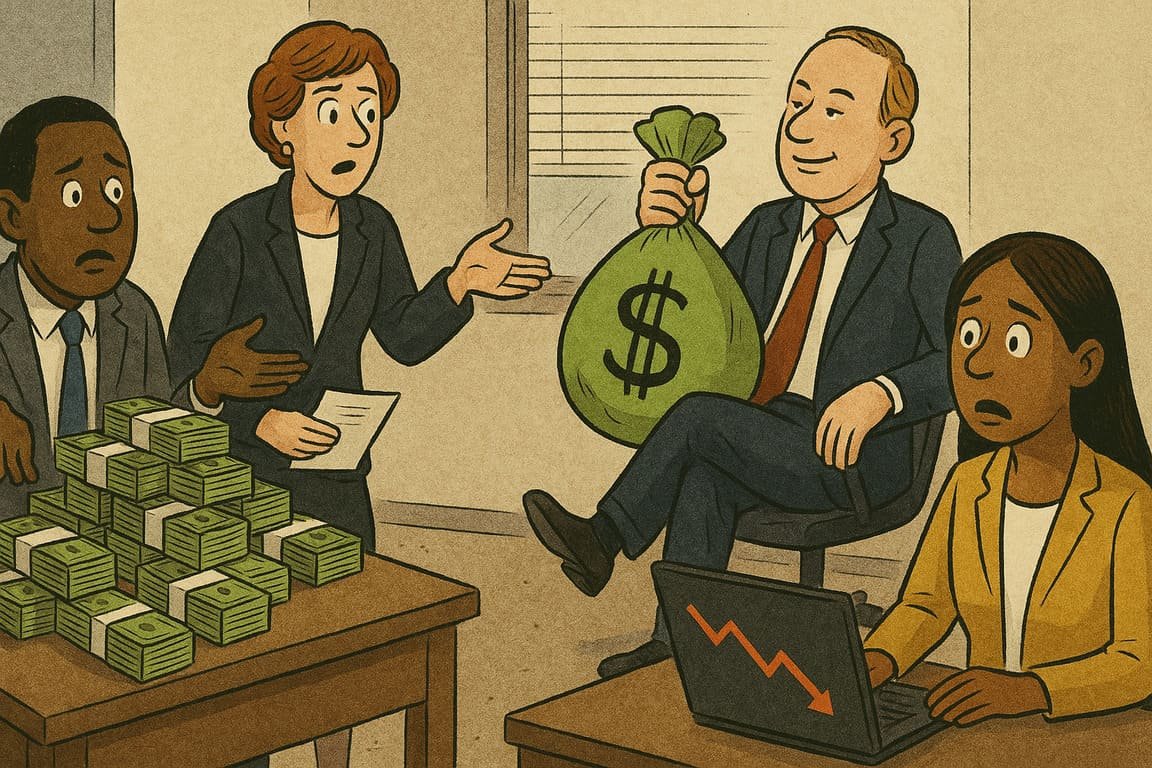
A luxury boutique can smell faintly of expensive leather and perfect climate control while the economy beneath it quietly starts cracking. That contrast is the whole story. Income inequality rarely announces itself in ways executives find operationally convenient. It appears instead in smaller behavioral distortions that look harmless until they become structural. A customer buys premium coffee but delays paying utility bills. A delivery worker handles products they will never own. A high-performing employee smiles through a team lunch while calculating rent in the back of their mind. Business leaders often file inequality under politics, sociology, or philanthropy. That categorization is comforting, and profoundly wrong. Inequality changes how people buy, work, trust, and imagine the future. That makes it a business issue whether boardrooms enjoy the framing or not.
The old growth gospel insists prosperity eventually reaches everyone if markets remain energetic enough. That story has aged badly. Growth can create wealth while concentrating insecurity with astonishing efficiency. Platform businesses proved this contradiction beautifully. Convenience improved. Valuations soared. Consumers celebrated frictionless access. Yet many workers discovered that flexibility sometimes meant economic uncertainty wrapped in elegant interface design. A retail strategist named Paloma noticed something revealing during shopper interviews. Customers still desired aspirational brands, but increasingly bought them in fragments, travel sizes, installment plans, occasional symbolic splurges. Desire remained emotionally intact. Purchasing power had changed shape. Markets misread this at their own expense.
Executive detachment makes the problem worse. This is less accusation than geometry. Leadership teams often live inside economic conditions radically different from frontline staff and broad consumer bases. A compensation discussion that feels mathematically reasonable at senior levels can feel surreal elsewhere in the organization. That disconnect produces strategic blindness. When decision-makers describe consumers as irrational, what they often mean is consumers are adapting to constraints leadership does not personally inhabit. A junior employee skipping lunch to manage commuting costs interprets corporate wellness messaging differently than the executive approving the campaign budget. That emotional asymmetry matters because businesses operate on perception as much as spreadsheets.
History offers embarrassingly simple lessons. Henry Ford understood that workers needed enough income to participate meaningfully in the economy they sustained. That was not sentimental generosity. It was commercial logic. Stable purchasing classes create durable demand ecosystems. Extreme inequality creates strange consumption landscapes where luxury thrives beside fragility. A hospitality operator named Dorian expanded aggressively into ultra-premium experiences while dismissing mainstream affordability pressures as irrelevant noise. For a season, margins looked beautiful. Then supplier instability worsened, staffing became harder, customer confidence softened across adjacent categories, and local political tensions began shaping regulatory risk. He had mistaken altitude for insulation.
Inside organizations, inequality corrodes culture in subtle, humiliating ways. Employers speak passionately about belonging while compensation realities tell harsher stories. Team retreats happen while side hustles quietly multiply. Employee recognition programs land awkwardly when basic financial stress remains unresolved. Even sincere leadership can appear emotionally tone-deaf if structural inequities go unaddressed. A software architect named Isolde once described her company’s culture manifesto as “beautiful interior decorating over a cracked foundation.” Sharp line. Hard to dismiss. Workers can tolerate demanding environments. What they struggle with is performative empathy paired with persistent economic asymmetry that feels invisible to those in charge.
Consumer behavior under inequality becomes psychologically fascinating. People do not simply spend less. They spend differently. Shame enters purchasing decisions. Credit becomes emotional camouflage. Luxury becomes identity defense rather than abundance expression. This helps explain why prestige categories sometimes remain resilient during broader economic strain. Not all aspirational buying signals prosperity. Some of it signals insecurity seeking visible armor. Popular culture has understood this for decades. Music, television, fashion symbolism, all repeatedly tie consumption to recognition, dignity, escape. Businesses ignoring that emotional layer reduce markets to arithmetic and miss the human engine driving demand.
The firms responding intelligently are not merely raising wages because public relations consultants suggested moral optics. They are redesigning systems around economic realism. Flexible pricing. Clear advancement pathways. Better benefits. Product design that preserves dignity instead of exploiting desperation. Costco’s reputation for employee treatment is not accidental sentimentality. It reflects management choices with operational consequences. Patagonia’s coherence between declared values and visible decisions built trust because alignment matters. Businesses that frame fairness as softness are misreading both economics and human psychology. Respect scales better than condescension.
At night, from the glass height of executive towers, city lights can make inequality look abstract, almost beautiful. Down below, those same lights reflect in bus windows carrying workers who kept the machinery alive all day. Markets cannot remain healthy forever if too many participants are surviving rather than progressing. Commerce eventually absorbs the emotional consequences of economic imbalance. Every hiring decision, pricing strategy, compensation framework, and product launch contributes to the shape of that future. The uncomfortable truth is brutally simple: if a business ecosystem keeps extracting from the very people expected to sustain demand, the crisis eventually stops being theirs and becomes yours.
