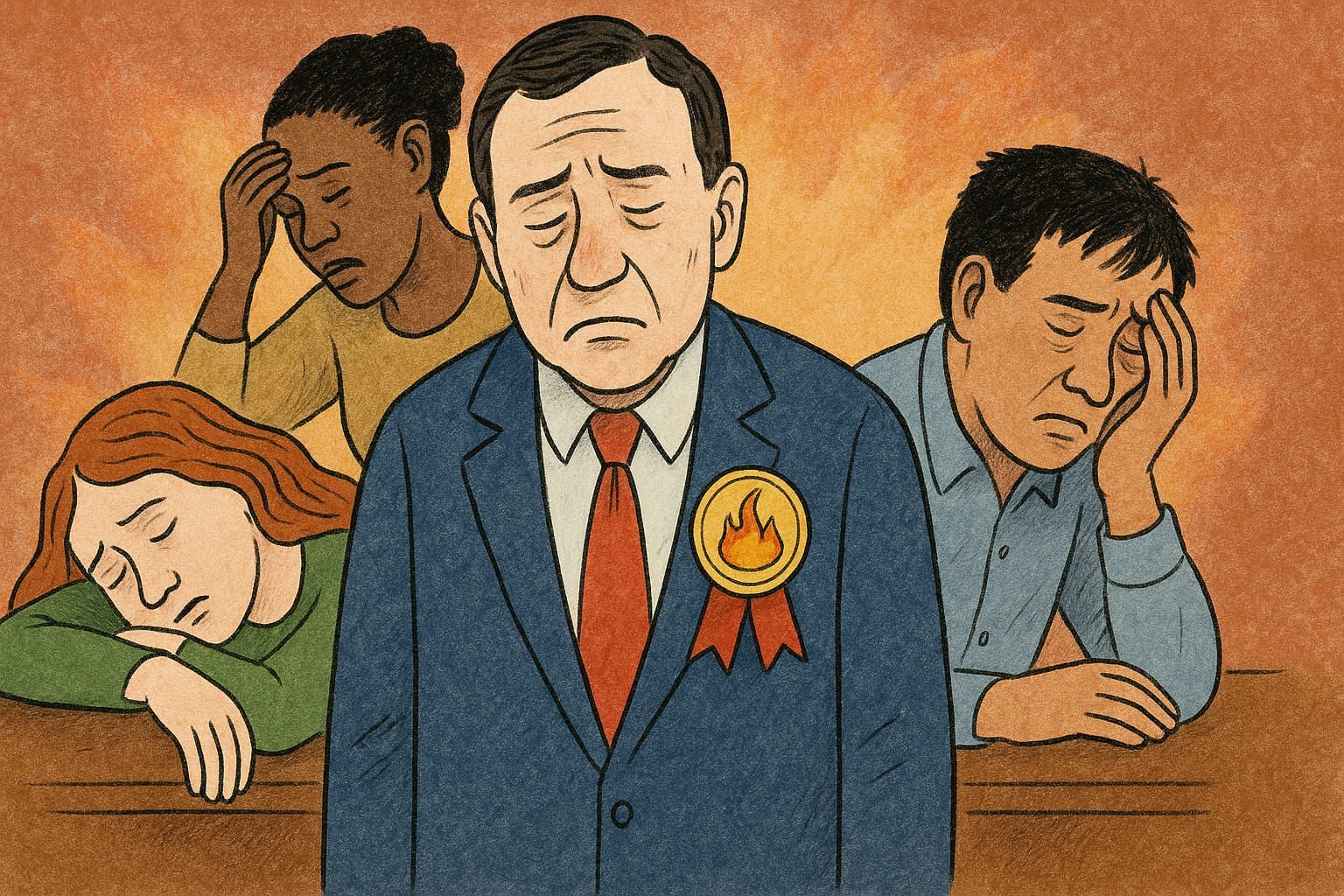
The overhead lights hum, indifferent and sterile, as another morning spills over the endless cubicle maze. Coffee machines hiss in corners, masking the low mutter of early arrivals already hunched before glowing screens. Here, in this modern coliseum, weary eyes flick between Slack notifications and calendar invites, each one a subtle test of resilience. Nobody cheers, but the stakes feel gladiatorial. Whispers of admiration swirl around those who never log off, their names recited with something between envy and awe.
Somewhere a manager drops his bag, glancing at a wall of sticky notes, his hands already trembling with anticipation and fatigue. The office anthem is the rapid tap of keyboards, a symphony of digital ambition. Around every corner, the mythology of hustle is alive: stories of a director who didn’t miss a day for five years, a new hire who slept under her desk to finish a launch. People chase these legends, breathless and desperate to join the pantheon of tireless heroes.
If you could eavesdrop on the company all-hands, you’d catch the irony; executives praising “balance” while celebrating the all-nighters that “saved the quarter.” The performance review becomes a theatre of invisible scars, with battle stories told as confessions: skipped meals, canceled birthdays, the thrill of collapsing into bed just before sunrise. The message glitters with false promise: burn bright, earn your badge, be remembered.
You might spot one woman, a team lead, clutching a mug with the faded words, “Rise & Grind.” She laughs a little too loudly at jokes about caffeine IVs. Later, in the empty stairwell, she presses her forehead to the cold wall, breathing in the silence, wondering if anyone else feels so small inside this pursuit. Every badge of honor has a cost, even when it’s invisible.
Inside this arena, the air tastes of burnt toast and ambition. By midnight, the chairs are empty, but the glory echoes. The myth endures: if you haven’t broken, you haven’t really tried. And in the harsh glow of the morning, the exhausted gladiators return, ready to fight for their place in the lore.
Quick Notes
- The Badge Is a Trap: Chasing burnout is glorified as a mark of loyalty and strength, but it’s a rigged game where the reward is often just more exhaustion. Companies quietly encourage it, even when pretending to care about balance.
- Modern Work Worships Sacrifice: You’re surrounded by stories of “heroes” who never unplug. The myth of overwork as virtue is deep, seductive, and rarely questioned.
- Real People Break: Behind the bravado, employees like Tessa (who fainted after 36 hours awake) or Dev (who missed his daughter’s recital for a “critical” update) pay the real price.
- Burnout Backfires: The productivity boost is a mirage. Burnout eats creativity, dulls problem-solving, and spreads toxic resentment; no company wins in the long run.
- Flip the Script: The true badge of honor isn’t collapse, but building systems that let humans thrive and create without losing themselves to the myth of glorious exhaustion.
The Burnout Hall of Fame: Why Sacrifice Became a Status Symbol
Glory clings to the edge of exhaustion like sweat on a brow. In today’s workplace, stories of all-night coding marathons or last-minute pitch decks have become the gold standard for ambition. Nobody talks about boundaries with the same reverence reserved for burnout. The culture quietly rewards those who answer emails at midnight and punish those who value weekends.
The myth grew with Silicon Valley, where founders boasted of sleeping under their desks as proof of vision. This narrative filtered down through LinkedIn posts and viral TED Talks until it became a universal expectation. Even in traditional industries, you’re told to “go above and beyond,” but rarely where the line should be drawn. The heroes of this story are always tired, always “on,” and always a little bit haunted.
During her rise at a fintech startup, Alicia Ramirez built a reputation for “always delivering” and wore her exhaustion like a designer jacket. She was praised by senior leaders who envied her drive, but privately, she confessed to a friend, “I haven’t felt joy in two years.” Her story is repeated every day by workers caught in the paradox of wanting to belong yet knowing the cost.
Management textbooks and motivational posters rarely warn about this danger. Instead, they ask for grit, hustle, and “skin in the game,” selling glory while ignoring the silent epidemics of anxiety and insomnia. Even wellness programs sometimes reinforce the badge: meditation apps prescribed as a way to power through more hours, not to restore real balance.
The irony isn’t lost on the keen observer: as technology promised freedom, it chained workers to infinite expectation. You’re no longer competing with the person next to you, but with an impossible ideal of relentless productivity. In the end, the badge is an illusion; every winner in this game is also a casualty.
Rituals of Exhaustion: How the Cult of Busy Became Our Religion
You know the drill. Early alarms, triple espressos, and schedules packed so tight that lunch is eaten in sips between video calls. The language of fatigue creeps into every conversation: “Crushing it,” “Killing deadlines,” “Living on caffeine.” If you don’t join the chorus, you risk being labeled uncommitted or, worse, irrelevant. Busy is the new holy.
The rituals have become oddly sacred. There’s the Sunday night panic where you realize the week’s already lost, and the Monday morning humblebrag about working through the weekend. Some workers even invent extra tasks to appear indispensable, padding their calendars with “strategic meetings” and “critical syncs.” Productivity is worshipped, but rest is quietly shamed.
Organizations love to showcase their “hardest workers” at town halls. Consider Simon, a mid-level product manager at a global tech firm, who won Employee of the Month after clocking in 100-hour weeks. The prize: more responsibility and a gift card to the same café where he’d spent his nights. Simon later told a colleague, “The best reward would’ve been a nap.”
The pressure doesn’t stop at the office door. Social media is littered with #Hustle and #RiseAndGrind hashtags, glorifying the lifestyle of exhaustion as a path to success. Each post reinforces the idea that true achievement demands personal sacrifice, and those who question it are simply not hungry enough. It’s a psychological game, and everyone plays to avoid being left behind.
Meanwhile, the casualties of this cult pile up quietly. Studies from the World Health Organization and countless HR surveys confirm what people whisper in hallways: burnout is everywhere, morale is falling, and companies lose their best people to silent attrition. The rituals keep going, but fewer believe in the gospel of busyness.
Human Cost: The Stories Nobody Tells at Happy Hour
Peel back the curtain, and the reality of burnout becomes painfully personal. There’s a difference between working hard and losing yourself. For every executive who “made partner” on three hours’ sleep, there’s an engineer who quietly left after migraines became her only constant. The celebration of endurance blinds companies to the slow leak of humanity from their teams.
You might know someone like Jamal, an operations lead at a logistics firm. He once organized a holiday shipment that saved the company’s reputation but collapsed in the parking lot the next day. His manager sent flowers and a get-well card, but nothing changed in the workflow. Jamal recovered, but his faith in the company never did. The lesson: when glory comes at the expense of health, loyalty dissolves.
Across industries, stories repeat. Tech support teams sleeping in conference rooms during product launches. Account executives missing the birth of their child for a contract signing. The mythology promises transformation, but often delivers regret. When exhaustion is a prerequisite for recognition, people either burn out or burn bridges.
Organizations occasionally launch wellness campaigns, promising flexible hours or “mental health days,” but these gestures can feel empty without structural change. A weekly yoga session doesn’t offset a culture that rewards all-nighters. Real transformation comes when leaders model boundaries and prioritize sustainable work, not just peak performance.
The most haunting truth: many who wear the burnout badge don’t see themselves as victims, but as chosen. It’s a subtle form of gaslighting where suffering is reframed as strength and questioning the culture is seen as weakness. The cycle continues until someone breaks it, or breaks down.
The Mirage of Productivity: When Burnout Backfires on Everyone
It’s tempting to believe that pushing harder yields better results. For a short while, productivity surges. People deliver impossible outcomes, and leaders toast to their team’s “unparalleled dedication.” But the high never lasts. Like an overclocked engine, the human mind and body eventually sputter. Creative thinking dies, errors multiply, and resentment festers in silence.
The data quietly supports what intuition already knows: teams running on empty make worse decisions. Meetings stretch longer, innovation stalls, and trust erodes as people become defensive and territorial. Even the loudest “winners” become fragile, fearing that one slip will expose the truth that nobody can sustain the myth forever.
Case in point: Zena, a creative director at a major agency, launched three viral campaigns in one year while secretly battling chronic insomnia. She once joked that she was “hallucinating logos” by the end of the third pitch. Her company celebrated her with a company-wide shout-out. Two weeks later, she checked herself into a clinic. Her team struggled for months without her spark.
The cult of productivity creates more losers than winners. High turnover, disengagement, and quiet quitting are the real costs; harder to measure, but devastating to morale and reputation. HR departments scramble to patch the holes, but culture always trumps policy. Until the narrative shifts, companies will keep losing their brightest minds to the myth of burnout glory.
The hardest pill to swallow: every system is perfectly designed to get the results it gets. If burnout is common, the company is choosing it, even if unconsciously. The mirage of endless productivity is just that; a fantasy that evaporates when the cost comes due.
Breaking the Badge: Reimagining Glory in Human Terms
If the badge of exhaustion is a lie, what should replace it? The world is hungry for a new kind of hero; one who sets limits, fosters trust, and leaves work at work. This shift begins when leaders share stories of recovery, not just conquest, and celebrate those who create space for others to grow. The goal is no longer to win by breaking, but to build by balancing.
Organizations that thrive in the long run are those that reject the false binary of hustle versus laziness. They see creativity as a renewable resource, not a candle to be burned at both ends. When teams are given permission to pause, reflect, and renew, they deliver more value with less pain. The badge of honor becomes sustainability, not self-destruction.
Consider the story of Rooted & Ready, a design firm founded by ex-corporate survivors who’d had enough. They implemented a policy: no emails after 6 p.m., unlimited mental health days, and leadership by vulnerability. Their reputation soared as a haven for “brilliant minds with real lives.” Clients noticed. Projects finished faster, with less drama, and employees stayed.
This isn’t a fairy tale. There’s resistance from old-school thinkers who conflate boundaries with mediocrity. But the new playbook proves that well-rested teams innovate better, attract top talent, and adapt faster in crisis. The badge of glory shifts from surviving chaos to mastering the art of the comeback.
True glory, it turns out, isn’t about who can endure the most pain. It’s about who can create the most meaning, together, without burning out along the way.
Shattered Crowns and Quiet Revolutions
As dusk settles over the empty floors, the myth of the burnout badge shivers in the fluorescent gloom. Desks still hold the imprint of restless hands, coffee rings mark forgotten ambitions, and the silence is thick with everything unsaid. Somewhere, a half-eaten sandwich wilts beside a list of unfinished dreams. A janitor pauses, eyes lingering on a motivational poster peeling from the wall, before sweeping away the debris of another glorious battle.
Glass doors reflect the image of a night security guard scrolling through messages from her children, a quiet rebellion against the promise that sacrifice equals legacy. On a distant monitor, the company’s vision statement loops, unblinking and unfulfilled. The badge of honor glitters; broken, shining in the memory of those who once believed in it.
Somewhere else, a founder writes a new policy, pen scratching in the hush, daring to trade the old crown for a gentler one. The revolution doesn’t come with drums, but with quiet choices that echo through every hallway. Glory is redefined in whispered goodnights, shared laughter at lunch, and dreams unscarred by exhaustion.
You stand at the threshold: will you trade your peace for a myth, or break the cycle and write a new story?