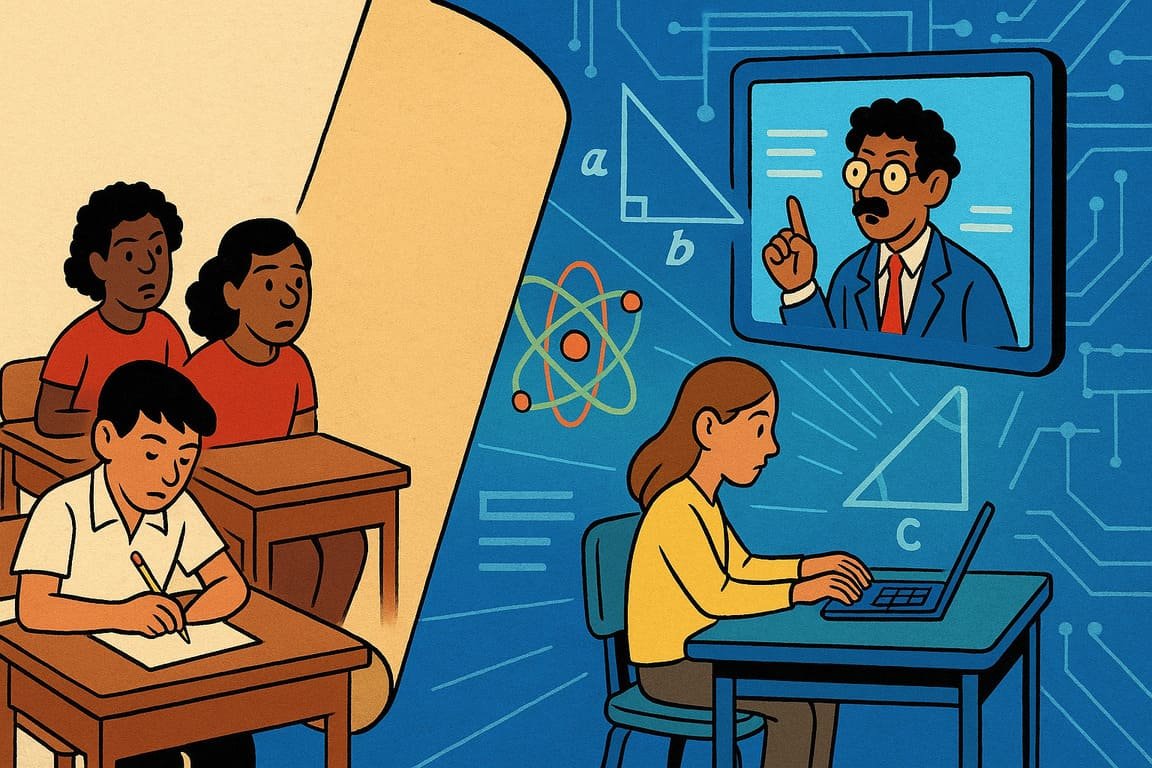
Chalk dust once settled slowly in the golden light of late afternoon. Desks scratched with secret initials, windows fogged by morning breath, and the distant echo of a bell marked the boundaries of school. All at once, that world shatters. Tablets flicker to life in living rooms, AI proctors blink on with zero patience, and classrooms stretch across continents with the click of a button. The scent of markers is replaced by the faint ozone buzz of charging cables, and teachers no longer stand tall at the front but compete with YouTube stars and holographic tutors for a moment of attention.
Everywhere, the old guard holds its breath. The comforting ritual of roll call becomes a guessing game of avatars and muted microphones. Somewhere in Nairobi, a girl named Amina balances her mother’s phone against a cracked cup so she can join a coding class hosted by a teacher she has never met. In San Francisco, a boy named Theo spins between lessons led by an AI that adjusts math problems to match his mood. Teachers trade war stories on social media, swapping tales of virtual reality field trips gone awry and surprise homework submitted by chatbots. The familiar pulse of learning—the glance, the whisper, the collective hush—fades beneath the algorithm’s roar.
A principal in Seoul scrolls through a dashboard filled with red flags and green checks, her heart thumping to the rhythm of data points. Each student is now a constellation of metrics, each lesson a battleground for engagement. Edtech companies promise revolution. Parents demand miracles. The ground shifts so quickly that no one feels safe, yet everyone senses opportunity. The very meaning of “school” has split open. Inside the chaos, something wild and thrilling takes root.
Education’s ancient drama plays out in new forms. The wise sage is now a moderator. The troublemaker hacks the system with memes. Even the quiet kid in the back row finds a voice, his question broadcast across thousands of screens at once. On some days, the future looks cold and mechanical. On others, it feels as if anything is possible. The curtains have been ripped away, and the whole world has a front-row seat.
Quick Notes
- The Old Classroom Dies, the New One Emerges: Traditional classrooms dissolve into digital landscapes. Lessons unfold across borders, blurring the line between school and life.
- Learning Is Personal, Messy, and Digital: Students drive their own learning journeys. AI customizes content, but emotional connection remains the secret ingredient.
- Teachers Become Guides, Not Gatekeepers: Authority shifts. The best teachers orchestrate, inspire, and empower, blending high-tech tools with old-school wisdom.
- Equity and Access Remain the Battle: Technology unlocks possibilities but risks deepening divides. Visionary schools and startups fight to keep education human and fair.
- The Soul of Learning Survives the Tech Storm: What endures is curiosity, courage, and the stubborn need to connect. The real revolution isn’t digital—it’s human.
Classrooms Without Borders: The Global Learning Game
You sit in your kitchen, pajamas still warm from sleep, eyes adjusting to the blue glow of your tablet. Your “class” is a chatroom packed with faces from Manila to Madrid, all blinking at the same pixelated math teacher. Somewhere, your classmate Amina battles slow WiFi, desperate to answer before the screen freezes. Suddenly, a teacher’s voice breaks the silence: “Anyone want to take the lead on this?” You hesitate, then unmute. The old nerves rise, but so does something else—a strange new confidence, born of distance and anonymity.
This is school, but it’s not the one your parents remember. Homework isn’t just a worksheet—it’s a TikTok explainer, a Minecraft build, a podcast recorded on a borrowed phone. Your teacher, Mrs. Patel, brags that her dog appears in more science videos than she does. Across the world, Theo learns calculus by solving real problems for a nonprofit, his progress tracked by an algorithm that cares only about results.
Learning gets personal. No two journeys are the same. The AI watching your progress nudges you gently, offering harder puzzles when you’re bored and reminders when you drift. You crave human feedback, though. The “aha” moment still comes when a real teacher notices your spark, when a classmate drops a funny comment in the chat, or when your voice cracks with pride after nailing a group presentation in front of invisible peers.
Yet not all is smooth. Some classmates disappear for weeks, only to pop back in with wild stories of power cuts or family emergencies. Frustrations boil over. Sometimes the screen feels like a cage, other times a window wide open to the world. Your school has become both bigger and lonelier, a paradox the old world never warned you about.
Learning in this wild new era demands grit and flexibility. Algorithms are clever, but you still need resilience, empathy, and creativity to survive. The real lessons come not from quizzes but from the way you pick yourself up after tech fails, reach out to a struggling friend, or invent a shortcut nobody has ever tried. The future classroom is everywhere, but the heart of learning is still up for grabs.
Teaching Rewired: When Algorithms and Empathy Collide
Teachers who once guarded the chalkboard like knights now find themselves in a very different game. You watch them hustle. They master Google Classroom, try VR lessons, even dabble in TikTok to explain tough topics in thirty seconds or less. Sometimes it works—kids cheer, questions flood in, and the energy buzzes. Other days, tech crashes or a bot takes over, and the room goes silent except for the click of keys and the soft sigh of frustration.
You notice the shift in power. A veteran teacher named Mrs. Gutierrez at a Brooklyn middle school jokes that she’s “part human, part YouTube playlist.” She knows her value isn’t just in what she teaches but in how she makes students feel. She calls out kids by name, tracks their birthdays, and remembers who won the poetry slam last year. Her lessons aren’t perfect, but her classes stick, long after the devices shut down.
Meanwhile, some teachers feel left behind. A tech-averse history teacher gets reassigned to monitor online exams. He misses the classroom noise, the chaos, and the messy debates. Students miss him, too. They say learning isn’t just content—it’s the feeling that someone is rooting for you.
Across the globe, schools test wild experiments. A London school hires AI “tutors” to help with reading, but pairs them with “empathy coaches” who spot when kids feel lost. A startup in Lagos trains local women to run hybrid classes, blending WhatsApp study groups with in-person storytelling. In both places, tech is a partner, not a replacement.
Your teachers are still heroes, but they’re more like guides in a maze than gatekeepers of hidden knowledge. They adapt, improvise, and sometimes fail spectacularly. Their secret weapon isn’t code or bandwidth—it’s the courage to stay curious, learn alongside students, and keep fighting for every kid’s spark. The greatest teachers blend the best of both worlds, using technology to break down barriers while never letting go of the power of a well-timed smile or a gentle nudge.
The Equity Paradox: Who Wins When Tech Runs the Show?
Technology promises miracles. You hear stories about a boy in Mumbai learning quantum physics on his grandfather’s smartphone and a girl in Cape Town building robots from scavenged parts. But you also see the shadows. In your city, not every kid has fast WiFi, a quiet place to study, or a device that works after dark. The digital divide yawns wider with every “innovation.”
Your friend Carlos spends afternoons in the library, waiting for a free computer. He’s brilliant but falls behind when the network goes down. A rural teacher named Ms. Wang holds class outside under a tree, phone propped up by a stack of bricks so everyone can see. Her students ace national exams, not because of tech, but because she finds a way to make learning real.
Edtech startups claim to have the answer. Some offer free platforms or donate tablets to underserved schools. Others create low-bandwidth solutions for places with spotty connections. A famous foundation in Silicon Valley partners with NGOs to build “solar classrooms” in remote villages. Progress is real, but so is the risk of leaving millions behind.
You learn quickly that technology is never neutral. Every app, every platform, every shiny device reflects someone’s priorities. Sometimes those priorities clash with what you or your classmates really need. Equity becomes the battleground. The real winners aren’t the ones with the newest gear, but the ones who find ways to lift each other up—sharing passwords, pooling resources, and demanding better from leaders and companies.
The future of learning isn’t just about bandwidth or data. It’s about stubborn hope and shared struggle. The smartest schools fight for inclusion, empathy, and justice, even when the odds look impossible. Every time you help a friend log in or organize a study circle, you become part of that revolution. The next big leap in education won’t come from Silicon Valley. It will come from students and teachers who refuse to let anyone be left behind.
Human Lessons in a Digital World: Grit, Growth, and the Unseen Curriculum
You quickly realize that the most important lessons aren’t found on any screen. Algorithms adapt to your pace, but they can’t teach you how to bounce back after failing a test, or how to resolve an argument in a group project gone sideways. Emotional intelligence, self-discipline, and courage become as essential as reading or coding.
You remember how Maya, a shy classmate, transformed during online debates. Behind her avatar, she grew bold, challenging even the toughest teachers. By year’s end, she led a student podcast interviewing local activists about climate change. Technology gave her a voice, but it was grit and curiosity that helped her own the stage.
Classrooms fill with micro-dramas. Two friends fall out over a game, then patch things up over shared jokes in the chat. A group of students launches a fundraiser for a classmate whose house flooded, coordinating everything online. These moments matter more than any grade. Teachers see it too. They say the future belongs to those who can adapt, connect, and lead when no one is watching.
Research shows that resilience and empathy drive success long after you forget the periodic table. Famous entrepreneurs and thought leaders credit their breakthroughs to failure, persistence, and community, not perfect grades. The world’s best schools now teach meditation, emotional check-ins, and collaborative projects alongside coding and calculus. The new curriculum rewards imagination, compassion, and the willingness to question everything.
You face real tests: How do you stay motivated when no one is watching? How do you balance freedom and responsibility when your classroom has no walls? These are the questions that define your generation. In this world, tech is a tool, not a finish line. What matters is the story you write with it.
Echoes in the Halls: The Soul of Learning Remains
A storm batters the city, thunder rolling above silent towers, while inside a dimly lit apartment, a teenage girl stares at the glow of a borrowed tablet. Her family whispers in the next room, her classmates exist only as pixels on a cracked screen, and the lesson of the day blurs with the news outside. Still, she scribbles down an answer, biting her lip, chasing understanding in the blue light.
Down the block, a teacher sits alone, grading digital assignments long after midnight, her mug cold, her shoulders tense from hours hunched in a plastic chair. She wonders if her words matter, if her students feel seen, if any of this can last. A message pings: “Thank you, miss, for believing in me.” Tears gather, quiet and unplanned, as she remembers why she began.
Beyond the chaos, a boy stands in an empty schoolyard, tracing the ghost of a chalk line on the pavement. He dreams of future classrooms filled with wild debate, deep laughter, and friendships forged in the crucible of challenge. Around him, the city pulses with the electricity of a million ambitions, each one burning against the darkness.
Somewhere in that maze, the promise of education endures. It’s the hope in every late-night whisper, every shared answer, every hand raised in defiance or wonder. The world will spin faster. Algorithms will grow sharper. But the soul of learning will always belong to those who refuse to let go of curiosity, courage, and the wild magic of connection. The real classroom is the one you build every day, even when nobody is watching.
Partnered. Provocative. Worth Your Scroll.
This is a Promoted Post by ESYRITE—yes, it’s paid, but never filtered. Our voice stays raw, real, and razor-sharp. We team up with bold ideas, game-changers, and stories that spark something real. If it’s here, it earned its place—no fluff, just impact. We don’t just promote—we provoke. Stay sharp. Dive deeper.
