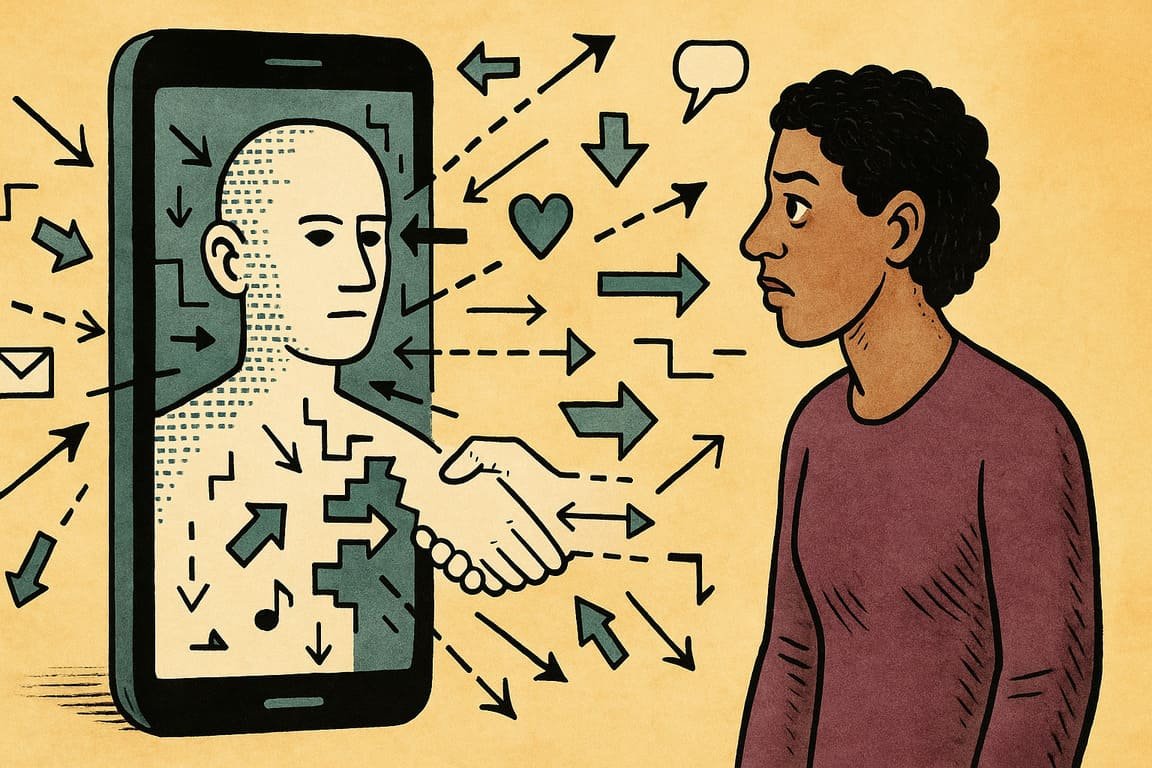
A young woman stands before a glowing wall of screens, each one reflecting a slightly altered version of her life. Her feeds tell her what to wear, what to believe, who to love, and who to fear. The clicks and scrolls feel like free will, but behind each decision lies a quiet, calculated influence. Tech giants whisper her name in every ad, every notification, every tailored headline. The real her drifts quietly behind the algorithmic curtain, a ghost in her own story.
In a Tokyo subway, commuters bow their heads, eyes locked to personalized news feeds. Above ground, a politician wins an election thanks to a hidden surge of micro-targeted messages. Deep in Silicon Valley, a data scientist codes a subtle tweak in a platform’s recommendation engine, never knowing he’s changing millions of lives.
A father in New York is convinced his online search history is private, only to find his insurance premium rising after a careless click. Meanwhile, a teenager in Mumbai posts a dance video, unaware that facial recognition will follow her forever. Nobody voted for these rules. Nobody chose this story.
Every day, a secret force nudges you, shapes you, rewrites you. The identity algorithm is not just code—it’s the invisible hand that decides who you are, who you become, and what you might never know about yourself.
Quick Notes
- Invisible Scripts: Algorithms quietly decide what you see, buy, and value, often before you realize you’ve been influenced.
- Choice as Illusion: Personalized feeds and product suggestions shape preferences so subtly, most people believe their decisions are their own.
- Real-World Consequences: Careers, reputations, and even relationships are increasingly shaped by tech—sometimes in life-altering ways.
- Pop Culture’s Mirror: Stories from Black Mirror to social media scandals highlight how little control individuals truly have over their digital lives.
- Claiming Yourself: A growing resistance movement uses transparency, “un-algorithmed” platforms, and digital hygiene to fight back for agency and selfhood.
Invisible Scripts: How Code Writes Your Story
Beneath every scroll, tap, and like lies an invisible script. Recommendation engines, built by teams you’ll never meet, decide what pops up on your feed. For Sam, a rising marketer in Berlin, this meant seeing job ads she never asked for—until she clicked one “just out of curiosity.” The next day, every platform she used seemed to know she was searching for a new role. The decision felt hers, but the options were algorithmically preloaded.
When Netflix suggests your next binge or Spotify curates your playlist, you’re following a path laid by code, not curiosity. “It’s like a choose-your-own-adventure book where every ending leads back to the store,” quipped Jay, a San Francisco creative director. His own taste, once eclectic, slowly became homogenous.
Tech theorists warn that this scripting blurs authenticity. When every input is anticipated, spontaneity dies. The algorithm becomes a self-fulfilling prophecy, amplifying what you already believe and pushing you deeper into your niche.
In the workplace, algorithmic resumes filter candidates before any human looks. For some, it means missing out on jobs not because of skill, but because of an unseen decision tree. One talented engineer at a London fintech learned her resume never even reached recruiters because she didn’t include the “right” keywords.
These invisible scripts define boundaries for experience and ambition. What you see isn’t all there is—just what the algorithm wants you to see.
Choice as Illusion: The Subtle Art of Digital Persuasion
Every platform promises “personalization.” But curated feeds mean you rarely see anything that doesn’t fit your profile. Shopping sites learn your tastes so well that soon, every recommendation feels like destiny. The result? The freedom of choice is replaced by a carefully guided path.
A Los Angeles startup founder, Nina, noticed her team all wore the same brand after a month of using a group chat app. Nobody remembered making a decision; it was as if the algorithm had slipped the idea into the group’s collective subconscious. “We became our own trend,” she laughed, “without realizing it.”
Dating apps illustrate this power. Profiles you never see, matches you never meet—all determined by secret code. In a London study, two people in the same city, same age, and same interests received completely different dating pools based on their early swipes.
Advertising masters this manipulation. Micro-targeted campaigns can sway elections or shape markets. When a famous soda brand used AI to analyze and manipulate online chatter, it doubled sales—but also changed how consumers talked about thirst.
Illusion is subtle. Most users believe they have free choice, unaware of how much their desires are shaped before they act. This tension—between agency and manipulation—has become a defining anxiety of the digital age.
Real-World Consequences: Code That Changes Lives
It’s not just shopping habits or playlists. Algorithms now determine whose resumes get read, whose loan applications are approved, even whose medical symptoms deserve attention. The stakes are high, and the margin for error is small.
In Shanghai, a family lost their home loan when a minor discrepancy flagged by an automated system triggered a cascade of denials. No human ever reviewed the case. “We didn’t even know which number cost us our future,” the father said.
At a Boston hospital, an algorithm meant to prioritize care accidentally filtered out dozens of patients with rare symptoms. Only a chance encounter saved a life. The attending doctor later argued, “We trust code too easily. Sometimes, it decides who lives.”
Corporate reputation is also vulnerable. One viral post, pushed into feeds by a platform’s logic, can ruin a career overnight. Just ask the head of PR for a luxury brand who was “canceled” by a trending hashtag algorithm after an old video surfaced—amplified by bots and left unchallenged.
In relationships, code can act as a third wheel. A newly married couple in Nairobi found their arguments escalating because their feeds amplified opposing viewpoints, driving a wedge between them. The problem wasn’t what they believed, but what the algorithms fed them.
The consequences of these invisible nudges ripple through lives. Code has power, and it rarely apologizes.
Pop Culture’s Mirror: Warnings from Fiction and Scandal
The dangers of algorithmic identity are everywhere in pop culture. “Black Mirror” episodes about social ratings and deepfakes echo the real-world anxieties people now carry daily. In novels, characters lose themselves in digital versions created by unseen hands. Films like “Her” and “The Social Network” use haunting visuals to show how easily people’s sense of self can be reprogrammed.
Tech scandals keep the conversation urgent. When Cambridge Analytica harvested millions of Facebook profiles, it was a wake-up call. The story proved that personality, voting patterns, and even relationship status can be predicted and manipulated at scale.
Musician Billie Eilish famously deleted social media after finding her own image twisted and weaponized by algorithm-driven hate. “It wasn’t me anymore,” she said. Her withdrawal inspired thousands to rethink their own online identities.
Even humor turns dark. Late-night hosts mock how “the internet knows you better than your mother,” but the laughter is nervous. The idea that your self is up for sale isn’t just dystopian fiction—it’s the headline.
Fiction and reality blend, reminding everyone that the battle for identity is no longer private.
Claiming Yourself: The Fight for Digital Agency
As awareness grows, so does resistance. New tools help users monitor and even edit the influence algorithms have over their lives. Browsers that block tracking, platforms with transparent feeds, and movements for “digital hygiene” gain traction.
A group of high schoolers in Toronto started a “feed swap” club, where members deliberately switch devices to break echo chambers. The result was more open dialogue—and a surprise spike in empathy.
Companies like DuckDuckGo build business on privacy, promising users an unfiltered experience. Their growth signals a craving for agency in a world of manipulation.
Mindful leaders take radical steps. Jack Dorsey, former Twitter CEO, practiced “digital fasting,” unplugging weekly to reset his habits. Some creative agencies now assign “algorithms officers” to monitor digital influence and keep culture intentional, not accidental.
People are learning to fight back, not with rage, but with curiosity and intent. Claiming yourself online means learning to see the puppet strings—and sometimes cutting them.
Through the Looking Glass: The Fight for Your True Self
A young woman closes her laptop, the glow fading from her face. In the silence that follows, she feels the algorithm’s grip loosen, if only for a moment. Across the world, others take small steps—switching feeds, pausing notifications, remembering what it feels like to choose for themselves. Identity is no longer a passive inheritance. It’s a daily act of defiance.
Behind every screen, a secret hand still reaches for you. But freedom lives in the gaps—every time you notice, question, and reclaim your story. You are not the sum of your clicks. You are what remains when the feed goes silent.