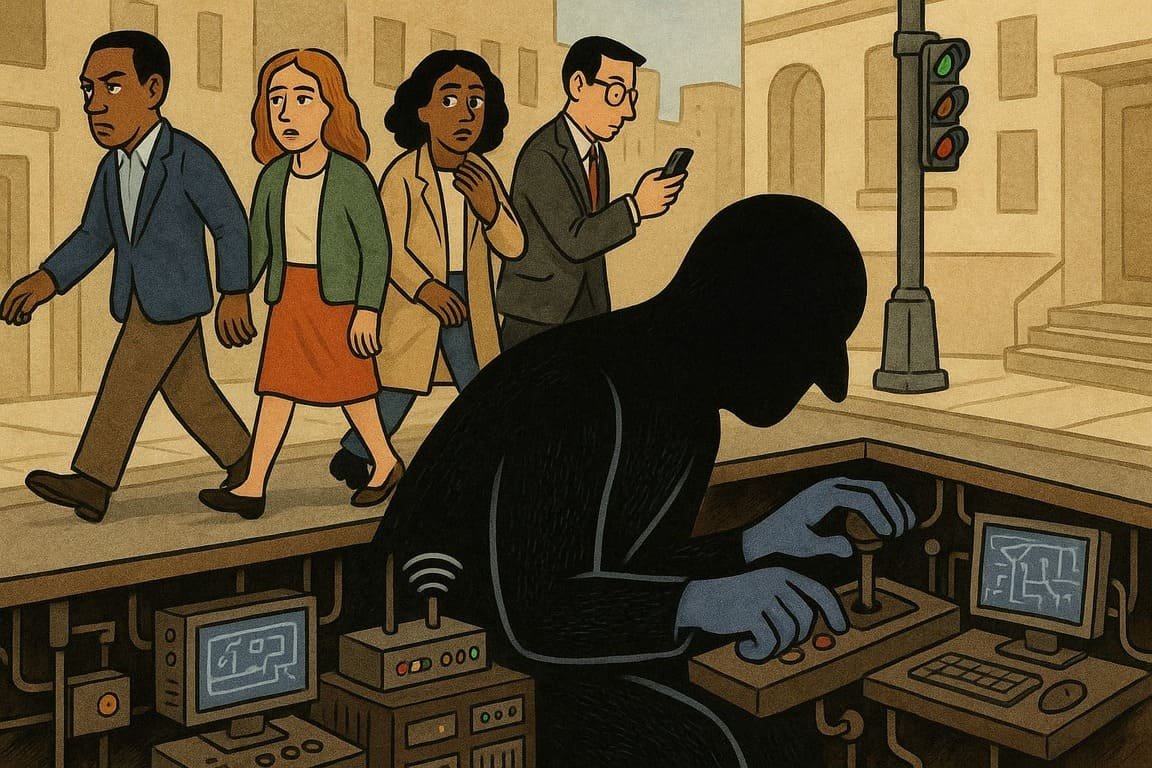
Rain slicked the empty boulevard, neon signs reflecting off the puddles like coded messages no one quite understood. Beneath the surface, tunnels laced with humming cables, silent routers, and blinking sensor arrays kept the city breathing. Above, streetlights flickered on schedule, elevators glided without complaint, and payment terminals never missed a beat. No one paused to question what kept it all synchronized, but the truth was buried far below, where human eyes rarely wandered.
In the control room of a sprawling data hub, an operator named Miguel tapped through his shift, his gaze dancing over silent alarms and status screens. Around him, racks of blinking servers whispered secrets into the veins of the metropolis. A low vibration—felt only by those who listened—hinted at power struggles playing out in the fiber-optic dark. Somewhere, an algorithm rerouted a bus, a hospital switched to backup, and a warehouse door unlocked itself for a delivery. No applause, no fanfare; just the city, stitched together by hands nobody would ever meet.
A leak sprung in the old subway, and engineers aboveground received an alert before water even hit the tracks. An online order zipped across the city, passing from drone to bike messenger, coordinated by networks that read traffic patterns like prophecy. The world ran smooth, efficient, and eerily quiet, orchestrated by an invisible hand that never asked for thanks.
Miguel yawned, logged a minor anomaly, and glanced at the ceiling. The city slept peacefully, never suspecting that the real guardians never saw daylight. In this hidden symphony, technology conducted the music—and the audience, lost in their routines, never heard a note.
Quick Notes
- Unseen Networks Rule Life: Modern existence relies on invisible digital scaffolding, from transit to energy grids, that quietly shapes daily experience.
- Control Without Consent: People rarely notice, but invisible infrastructure often makes autonomous decisions that affect safety, convenience, and even business survival.
- Secret Gatekeepers: A handful of engineers, like Miguel, hold the keys to entire cities, balancing innovation and risk behind closed doors.
- Vulnerability Beneath Convenience: When invisible systems falter—whether in hospitals or supply chains—the fallout can be sudden, severe, and often misunderstood.
- Hidden Power, Real Stakes: The future belongs to those who understand and influence these secret systems, as control moves further from public view.
Ghosts in the Machine Room
Every city hides a parallel world, pulsing with digital arteries and silent guardians. Most never see the rooms stacked with server racks, backup batteries, and tangled cables. At Midtown Logistics, the facility manager, Jasmine, often told her team, “If you do your job right, nobody even knows you exist.” She took pride in being invisible, but the responsibility was immense.
A power outage in San Francisco once left thousands stranded, but for Jasmine’s crew, the blackout became a puzzle to solve before dawn. While news outlets speculated about hackers or storms, it was a misconfigured router buried under a river of email alerts that almost took down the port. No one outside the room ever heard how close disaster crept.
On quieter days, the job felt like ghost-hunting: scanning for anomalies, fixing faults before anyone noticed. Engineers joke about “cursed” data centers where gremlins hide in legacy code, but each odd spike or unexplained alert tells a story. Real life rarely matches the neat diagrams in glossy brochures.
As companies like UrbanPulse expand their reach, urban infrastructure grows more interconnected, yet less understood. Their CTO, Rina, once quipped, “Our smartest systems make the best decisions—until the day they don’t, and we pray we can still override.” The uneasy laughter that followed spoke volumes about how fragile this invisible world can be.
Yet the city marches on, trusting the ghosts to keep the lights on. The deeper you look, the more you realize: invisible infrastructure isn’t just a convenience. It’s the quiet backbone of civilization.
Decisions Without Witnesses
Invisible infrastructure now makes choices faster than any human, but not always in ways people expect. At SmartGrid, a utilities startup, customers once complained about rolling brownouts that arrived without warning. The cause was a networked AI optimizing energy distribution—improving efficiency, but neglecting to warn families who depended on steady power for medical equipment.
The company scrambled to adjust. Their lead engineer, Marlon, admitted, “We never planned for every edge case. The machine learned what we told it, not what people actually need.” It was a lesson learned at the cost of angry calls and one hospital’s close call.
Retailers experience this too. A global chain found its shelves empty in three cities, even as inventory looked healthy on screens. Their algorithm, seeking cost savings, rerouted deliveries away from higher-risk areas, leaving communities stranded. The oversight came to light only after a local manager, Priya, drove the route herself and documented the gaps.
The rise of “infrastructure as a service” companies adds another twist. Now, third parties control critical digital arteries, making decisions without direct oversight from those they serve. A municipal IT head in Chicago recalled how a minor API update from a vendor cascaded into gridlock for the city’s parking meters. “We weren’t just customers; we were hostages for an afternoon.”
This shift to silent, invisible control upends traditional ideas of responsibility. When decisions have no witness, accountability evaporates, replaced by a fog of technical jargon and plausible deniability. Only those willing to look behind the curtain see how deeply the puppet strings run.
The New Gatekeepers
In this hidden realm, power concentrates in the hands of a few—engineers, architects, and system admins who shape reality for millions. At ConnectFlow, a European tech giant, the head of security, Gianni, famously stopped a city-wide ransomware attack with a phone call and an improvised firewall rule. His team worked unnoticed in a basement suite, saving businesses from ruin while the world above went about its day.
Stories like Gianni’s are rarely told, but every city has its own cast of unsung guardians. At MetroRail, the night shift’s chief operator, Lara, quietly reprogrammed transit routes during a snowstorm, preventing a catastrophic pile-up. She watched from a control booth, face aglow in blue monitor light, as trains glided home and commuters remained blissfully ignorant.
Yet this concentration of authority also brings risk. In 2021, an engineer at a major cloud provider accidentally took down thousands of websites with a single mistaken command. The fallout sparked calls for new oversight, but the temptation of speed and efficiency keeps pushing power toward the shadows.
Business theorists now warn of “digital fiefdoms”—domains where single points of failure can trigger disaster. The solution isn’t obvious. Some advocate for radical transparency, others for slow, deliberate reform. The stakes are clear: in the hands of the gatekeepers, civilization’s quietest machinery can either save or sink the world.
What’s left for the rest? A choice: trust blindly, or demand a seat at the console.
When Infrastructure Fails
Most people only notice invisible infrastructure when it shatters. At Central Medical, a routine software patch corrupted the scheduling system, sending doctors into a frantic search for missing patients. Nurses swapped stories of handwritten charts and hallway triage, while IT teams worked through the night to patch the code.
The hospital’s CEO, Ms. Reilly, later told an interviewer, “That week, technology was a villain, not a savior. But we learned humility and built new safeguards.” Their crisis response became a business school case study on resilience and recovery.
Supply chains suffer similar drama. During a major holiday, a global e-commerce platform froze deliveries across two continents after a data center power surge. The error started with a faulty temperature sensor, ignored for weeks until the system buckled under peak demand. Managers watched as customer complaints flooded social media, helpless to fix a problem buried six layers deep.
These stories fuel an old truth: invisible systems are only invisible when they work. The moment they fail, the world notices—and demands answers. Accountability rushes in after the fact, often too late to undo the damage.
Lessons linger, though. Companies now rehearse “tabletop disasters,” testing their response to sudden failure. They empower cross-functional teams to question the system, simulate the unthinkable, and build muscle memory for chaos. This new vigilance reflects a single, vital lesson: the invisible must be made visible—before crisis strikes.
Taking Back the Narrative
For those willing to challenge the quiet supremacy of invisible infrastructure, opportunity awaits. At UrbanLogic, a civic startup, engineers designed an open dashboard that let citizens watch—and influence—traffic flows in real time. The project won awards for transparency, but more importantly, it gave people a sense of agency in a city that often felt impersonal.
Other pioneers follow suit. A utility in Finland now invites neighborhood representatives to monthly “infrastructure councils,” where community voices shape maintenance priorities and digital upgrades. The meetings are sometimes heated, always lively, and have become a model for participatory tech governance.
In business, a handful of visionary leaders demand radical openness. At PulseBank, the CIO publishes network logs and outage reports, building trust and resilience even when problems arise. Employees know how the system works, where it fails, and how they can help.
Yet, for every beacon, a dozen black boxes persist. The lesson: transparency is a choice, not a given. Those who lift the curtain earn loyalty and innovation; those who hide invite suspicion and decline.
The world is changing. As more people wake up to the reality of invisible infrastructure, the demand for control, agency, and understanding grows. The quiet power that once ran unchecked is now a battleground for the future of trust and leadership.
Power Unseen: When Control Is Just Out of Reach
In the twilight before dawn, the control room hummed with steady blue light. Miguel leaned back, staring at the city’s grid, every square pulsing with the invisible decisions of the night. His hand hovered above a single key—one that could redirect the city’s morning commute or plunge it into confusion. No one else would ever know how close chaos came, how many times disaster knocked and was turned away by a tired, unseen hand.
He sighed, thinking of the millions who would wake to perfect order, never knowing the cost of silence. Shadows lengthened behind him, quiet and watchful. Tomorrow, the system would run again, and the world above would trust its luck.
You know now what lies beneath the comfort—what will you do with that truth?