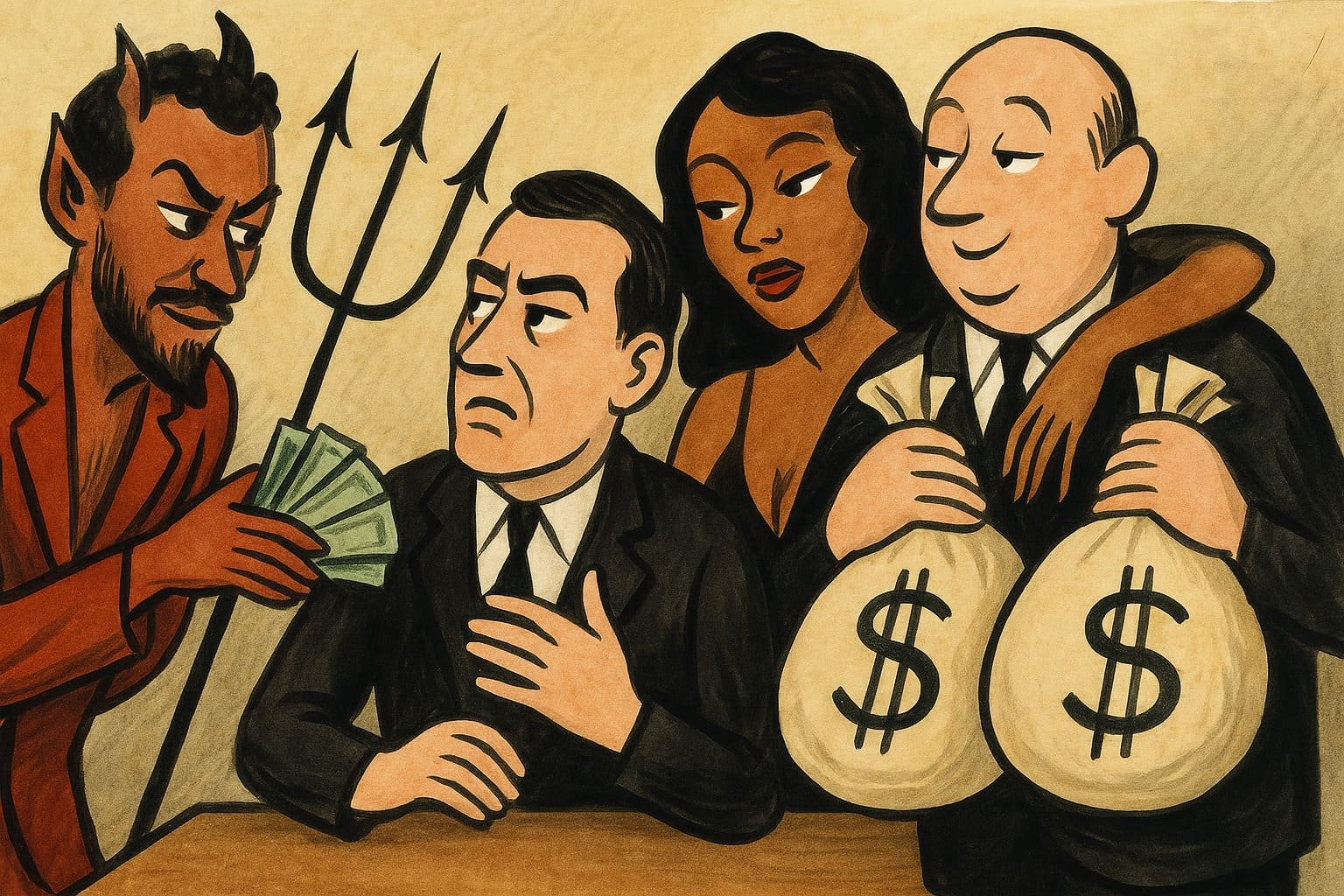
Red velvet curtains hang heavy in the flickering light, a boardroom dressed up as a cabaret. Here, high heels click against marble and neckties swing like nooses, but the real performance is silent; a dance of glances, nods, and handshakes slick with sweat. In this room, nobody shouts about values, yet every eye measures worth with a hungry gleam. Somewhere between champagne flutes and shadowed corners, deals are struck with the kind of passion reserved for forbidden romance: urgent, risky, deliciously reckless. The air smells faintly of cologne and old money, thick with secrets that no one admits to knowing.
One chair sits slightly apart, always reserved for the newest darling; the startup prodigy with eyes bright from sleepless nights. He’s greeted with applause, a glass of gold-tinged wine, and a question that cuts deeper than any pitch: “What are you willing to trade for a shot at the crown?” Sometimes, the currency isn’t cash or shares. Sometimes, it’s silence, or turning away when numbers don’t add up. Behind every handshake is the soft, invisible grip of ambition pressed against morality’s throat.
Phones light up beneath the table, messages darting between conspirators and rivals alike. Every notification is a cue, every reply a gamble. Outside, city lights flicker, blurring into a skyline that hides more than it reveals. The mood teeters between anticipation and dread, as if the entire empire could collapse with one misplaced secret.
Every empire, it seems, has its own dark theater; a place where desire for more is staged as strategy, and the cast pretends the script was written in clean ink. Yet no amount of polish hides the stains left by hidden motives, or the way profit can make even the sharpest minds lose their way. Down the corridor, the janitor hums an old tune, sweeping up confetti from a celebration that nobody wants to talk about in daylight.
Beyond the doors, the world applauds every headline: stock surges, bonuses, flashy launches. But beneath the surface, a shadow play continues, drawing in believers and cynics alike. The real drama isn’t played out in quarterly reports, but in the tiny betrayals, secret favors, and silent costs traded behind the velvet curtain. Welcome to the show.
Quick Notes
1. The Hidden Stage: Every company boasts values, but real decisions unfold in shadows, where unspoken deals and moral compromises shape success.
2. The Siren Song of Success: Profit seduces like a forbidden lover, drawing leaders into risky liaisons and dangerous shortcuts that eventually reveal a steep hidden cost.
3. The Double-Edged Motive: Ambition fuels greatness, yet unchecked, it morphs into cunning schemes that can topple empires from within.
4. Human Stories, Human Failings: Real life isn’t a TED Talk; companies crumble, heroes fall, and the “right thing” often gets rewritten in the chaos of survival.
5. The Final Curtain: When the lights go out, what lingers isn’t applause or profit, but the echo of choices made in secret; reminding you, the hero of this tale, that every motive leaves a mark.
The Siren Song of Profit—Why Ambition Turns Risky
It starts with a dream: build something lasting, make a mark, rewrite the rules. You’re not chasing greed, you tell yourself; only greatness. But the moment the market applauds, desire swells into hunger, and ambition sharpens its claws. Soon, you feel a pulse quicken when an opportunity appears that nobody else has spotted. The thrill isn’t just about winning, it’s about outsmarting the odds and everyone else in the room.
The line between clever strategy and moral compromise blurs so gradually you hardly notice. Your team praises innovation, but “move fast and break things” quietly shifts into “bend rules if you must.” Suddenly, what started as a harmless shortcut becomes the new way to play. The excitement of beating a rival outweighs the nagging doubt that flickers in the back of your mind.
Story: In Silicon Valley, the ghost of Theranos still haunts every pitch deck. Elizabeth Holmes didn’t set out to deceive; she wanted to be the next Steve Jobs. Investors fell for the promise, blinded by their own lust for the next unicorn. Her team rationalized every half-truth as a means to an end, until the house of cards collapsed with a whisper, not a bang.
Pop-culture loves a rebel, but rarely tells what happens when rebellion loses its way. Movies like “The Wolf of Wall Street” glamorize the hustle, ignoring the wreckage left behind. That seductive promise; get rich, get famous, be the one they remember drowns out quieter voices urging caution. You feel it in every high-pressure meeting, every late-night email asking you to “find a way, no matter what.”
The world worships winners, not worriers. So you keep moving, keep closing, keep cashing in. The cost? Sometimes it’s trust, sometimes it’s friendships, sometimes it’s sleep. But nobody wants to look at that bill until it arrives, late, with a penalty you can’t afford to pay.
The Double Life—When Values Collide with the Bottom Line
You pride yourself on having a mission: building something that matters, making the world better. But every mission faces a moment of reckoning; the investor who wants faster results, the competitor who plays dirty, the market shift that threatens survival. Suddenly, you find yourself juggling two scripts: the one you perform for the world, and the one you whisper to yourself at 2 a.m. when nobody’s watching.
It’s easy to preach ethics in a conference keynote, harder when a lucrative contract lands on your desk with fine print that makes you flinch. You see other companies cheating and thriving, their founders lauded as geniuses. The temptation creeps in: why play fair if fairness feels like losing? One decision at a time, your values get compromised, not with a crash, but with a thousand tiny cuts.
Mini-case: At a global consulting firm, a manager named Priya faced a dilemma. Her team uncovered data showing their client’s ad campaign targeted vulnerable consumers, exploiting fear and insecurity. The right thing? Speak up and risk losing a million-dollar contract, or stay quiet and celebrate the campaign’s “success.” Priya chose silence, later admitting, “I convinced myself it was someone else’s responsibility.” The regret lingered long after the bonus check cleared.
The “everyone does it” chorus is intoxicating. You rationalize small lapses by comparing yourself to bigger offenders. Your conscience whispers, but the applause drowns it out. Only later do you realize the applause isn’t for you, but for the mask you wore to win it.
A manager once told his team, “If you want to succeed here, don’t ask too many questions.” The advice got a laugh, but nobody forgot it. Cultures like these reward complicity, not courage, and soon the company’s soul is traded away, one overlooked detail at a time.
Case Studies in Seduction—How Good People Go Rogue
You might imagine that only the greedy fall for the lure of hidden profits. But history shows otherwise. The most dangerous corruption starts not with villains, but with heroes who lose their bearings. People who once swore never to compromise find themselves bending just a little, believing they can stop anytime they want.
Story: At Enron, the “smartest guys in the room” didn’t start as criminals. They wanted to beat the market, out-innovate competitors, and impress Wall Street. Jeff Skilling and his team gamed the numbers, convinced they were building something revolutionary. Their pride blinded them to the warning signs, until the company imploded and thousands lost their livelihoods.
In politics, Watergate showed how ambition warps judgment. The Nixon administration justified break-ins and cover-ups as necessary for the greater good. “If the president does it, it’s not illegal,” became a mantra of self-deception. Eventually, truth broke through the lies, but not before careers and reputations were scorched.
Even in startups, the culture of “fake it till you make it” tempts founders to overpromise and underdeliver. Investors reward bold claims, not boring honesty. When the pressure mounts, teams fudge milestones or quietly hide failures, convinced the next breakthrough will make it all right. More often, the truth leaks out in damaging ways.
Pop-culture reinforces the idea that rules are for the mediocre. TV shows like “Succession” paint ruthless cunning as a virtue, making backstabbing look glamorous. But for every on-screen antihero, real-world casualties pile up: employees burned out, customers misled, shareholders betrayed.
Every business hides a file drawer of secrets: deals that should never have closed, expenses never disclosed, partnerships forged for convenience, not conviction. When you look closely, it’s rarely the “bad guys” running the show, but good people seduced by a system that rewards results above all else.
The Human Cost—What Lustful Profits Steal from the Soul
Money can buy influence, comfort, even a version of happiness, but it can’t buy back integrity. When profit trumps principle, something essential is lost; not just in organizations, but in the people who run them. The price is rarely paid in public. Instead, it arrives privately, through stress, anxiety, and the slow erosion of meaning.
Story: At a hotshot marketing agency, a rising star named Lila landed a massive client by agreeing to an aggressive social media blitz that bent privacy rules. The campaign won awards, and her boss called her “a genius of the digital age.” But a year later, she confessed to a friend, “I can’t look at my work without feeling sick.” Lila’s insomnia grew worse, relationships suffered, and the agency quietly paid a settlement after a consumer lawsuit.
Burnout often hides where success shines brightest. Ambitious leaders may drive growth at any cost, ignoring warning signs until the damage can’t be undone. Teams under relentless pressure cut corners, morale drops, and creativity dries up. Eventually, people leave; not for better jobs, but for a chance to recover their self-respect.
Research shows that employees who feel forced to compromise values become less engaged, less innovative, and more likely to quit. Leaders who ignore ethics in pursuit of targets end up losing the loyalty and trust that made their companies great in the first place. The irony is that short-term gains almost always result in long-term decline.
Pop culture’s most memorable antiheroes (think Tony Soprano or Walter White) show that winning the game often means losing yourself. The business world has its own tragic figures; CEOs who went from adored to despised, startups that burned out in a blaze of hype and lawsuits. Every one of them started with hope, not malice.
The real casualties aren’t the headlines or lost fortunes, but the ordinary people caught in the fallout: families disrupted, communities hurt, dreams abandoned. The cost of lustful profits is always higher than it first appears, and the tab is rarely paid by those who benefit most.
Breaking the Cycle—Lessons in Redemption and Renewal
It doesn’t have to end in scandal or regret. The most inspiring turnarounds come when leaders stop pretending and start owning the consequences of their choices. Redemption isn’t about erasing the past, but about changing the future; one honest action at a time.
Story: Satya Nadella took over Microsoft at a time when the company’s culture had grown toxic with infighting and ego. He made humility and empathy central to the company’s new playbook. Profits soared, but more importantly, people started caring again. Employees described feeling “safe to speak up,” and customers noticed the change in tone.
Organizations like Patagonia have built cult-like followings by making ethics as important as earnings. Founder Yvon Chouinard famously prioritized sustainability over short-term gains, saying, “Doing good is good business.” The company’s loyal customers became evangelists, not just buyers.
Not every business has a headline-making crisis, but every leader faces moments where easy profit tempts them to take shortcuts. The bravest confront these crossroads openly, admitting mistakes, apologizing when necessary, and setting new standards. When leaders do this, they give others permission to do the same.
Philosophers from Aristotle to Simone Weil have argued that true success means living with integrity, not just accomplishment. Modern research backs this up, showing that companies with strong ethical cultures outperform peers over the long run. It isn’t magic; it’s the compound interest of trust, earned day by day.
The lesson is clear: you are not just a player in someone else’s morality play. Every choice leaves a trace. When the spotlight swings your way, will you dazzle with brilliance, or with honesty? The answer shapes more than your resume; it writes your legacy.
The Last Motive Standing
Smoke hangs in the rafters of a darkened theater, the velvet seats now empty, save for one lone figure. She watches the ghost light flicker on stage, where echoes of laughter and applause still haunt the wings. No cameras roll, no audience cheers. Instead, she sits in silence, replaying the choices made and roles played under hungry spotlights. A single coin spins on the floor, its edge catching the light; reminder of every wager placed, every risk justified as necessary.
Outside, rain beats against stained glass, streaking colors across a world that has already moved on. The show ended long ago, but the script remains unfinished, its lines etched in memory. Regret and pride mingle in the quiet, each demanding the last word. Somewhere in the silence, a whisper: was the price worth it, or did the game outplay the player?
You stand at the edge of your own stage, the curtain waiting. What script will you write when nobody’s watching?