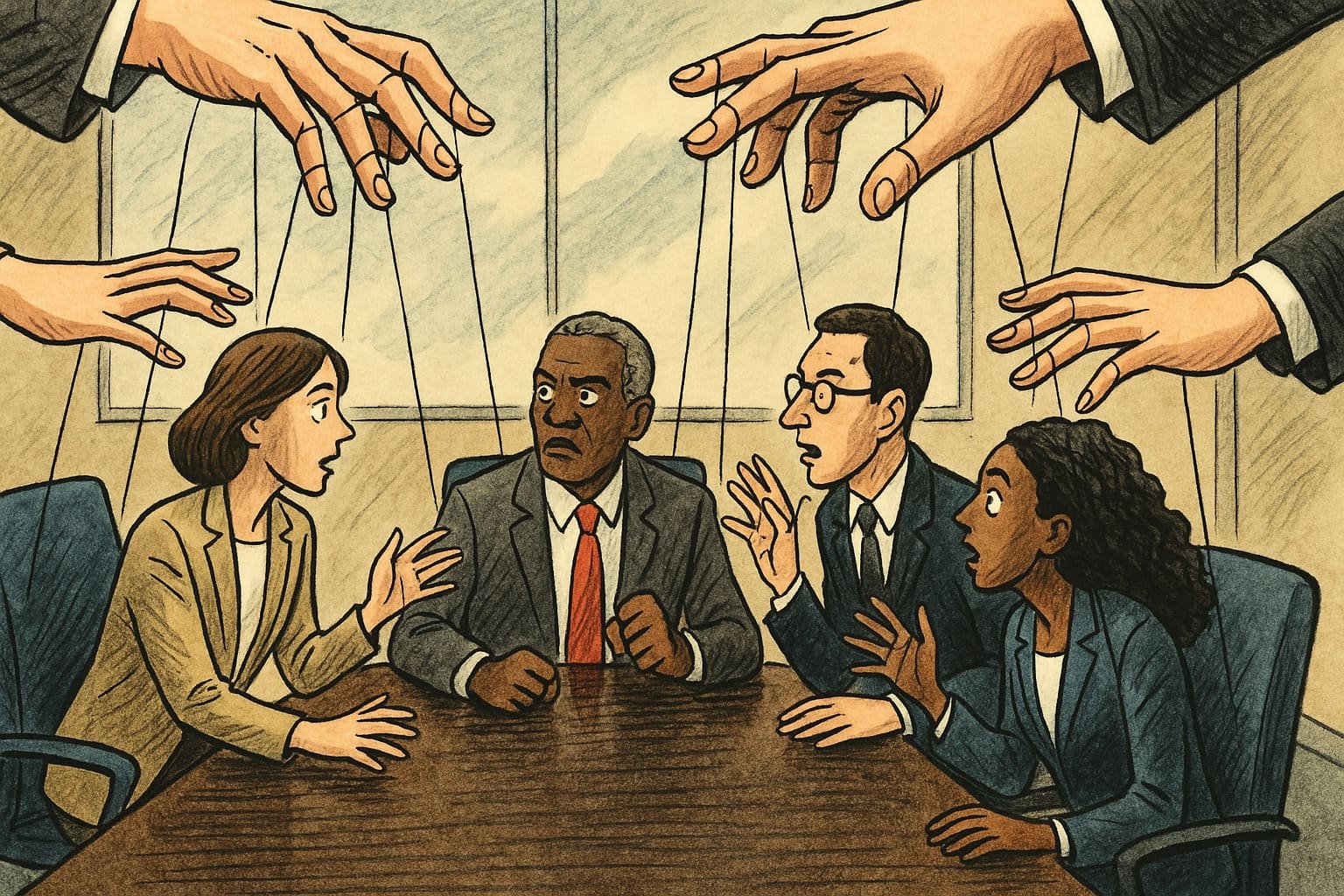
Every skyscraper has a story written in invisible ink. Past midnight, the boardroom lies still, yet something lingers: the echo of a thousand unspoken moves. Outside, rain paints fractured shadows on polished glass, while inside, the air vibrates with secrets too heavy for daylight. Every leather chair seems to remember battles, every sleek table hides the scratch marks of ambition, betrayal, and quiet victories. This is where ordinary handshakes become weapons, and the next kingpin of industry is crowned without applause, only silence and the cold confidence of the victor.
Under the soft hum of recessed lighting, senior executives stage their own version of chess. Each pawn is a person, each queen a hidden agenda. A junior manager steps into the room, armed with numbers and hope, unaware that the real contest isn’t about revenue forecasts or growth projections. Power flows here like electricity; unseen, deadly, and impossible to contain. The real game is never on the agenda. It’s in the glances, the jokes that double as warnings, and the alliances forged in elevator rides. Nothing gets written down. Everything is understood.
Stories of legendary showdowns travel faster than quarterly earnings. There’s the whispered legend of Ava, the CFO who turned a hostile takeover into a bidding war simply by not blinking when the room expected her to fold. Or the cautionary tale of Mark, a star product manager who learned the hard way that loyalty is a currency in short supply when bonuses depend on sacrifice. In these rooms, facts bend, time dilates, and careers evaporate before sunrise.
Imagine a boardroom where the only constant is change; sometimes, it’s sudden like a blackout, sometimes slow as moss growing on concrete. The stakes are measured not just in billions, but in trust and the quiet knowledge that nobody wins forever. Here, power never walks alone. It arrives disguised as humor, generosity, or even resignation, only to reveal its claws when the last slide fades from the projector.
Beyond every dramatic exit, behind each “no comment” to the press, a story unspools in private. It’s a drama that leaves fingerprints on mergers, product launches, or the naming of a new CEO. Every company, no matter how sanitized for public consumption, pulses with this secret current. For those who can read between the lines, the real playbook isn’t on paper. It’s written in the choreography of fear and hope, ambition and surrender. If you want to see the future of your company or your own ambition this is where to look first.
Quick Notes
- Power rarely looks like power: In boardrooms, the most influential voices often speak least, choosing silence over volume, with body language that signals threat or invitation. Sensing who truly runs the room is a test that few pass on their first try.
- Alliances are currency: Deals are brokered over coffee, not conference calls. A casual lunch can shift millions, and knowing when to listen versus when to speak determines your survival rate.
- Victims become villains: Today’s scapegoat can be tomorrow’s mastermind. Roles reverse with dizzying speed, and the only rule is adaptability. Anecdotes abound of fired executives launching rival empires or orchestrating stunning comebacks.
- Decisions disguise motives: Not every “strategic pivot” is about market trends. Behind every bold shift, someone’s reputation, bonus, or legacy is in play. True power brokers move pieces for reasons that will never make it into official memos.
- The boardroom remembers everything: Every misstep, betrayal, or flash of brilliance is catalogued. The stories aren’t forgotten; they’re ammunition for the next round. If you want to win, start listening to the stories people don’t tell.
Kingmakers and Pawns: The Unseen Operators Behind Every Throne
Power in the boardroom rarely arrives with trumpets or fanfare. More often, it enters quietly, tucked into the agenda as “other business.” A company’s fate can hinge on a single, subtle nod from someone who never signs the final paperwork. Real authority lives in the silences, in the way people defer or resist, in who people call after hours when the formal meeting has ended. Many discover too late that the loudest voices seldom hold the sharpest knives.
Take the story of Nina Patel, who started as a back-office analyst at a consumer tech giant. She spent years quietly mapping the lines of influence, learning which team leads were “untouchable” and which seemed destined for the chopping block. When a company-wide restructuring was announced, Nina didn’t just survive; she was promoted, bypassing more experienced managers. Her secret wasn’t a better resume, but a deeper map of hidden alliances.
Sometimes, those with the official titles are just pawns dressed as kings. A famous automaker once bet its future on a charismatic CEO, only to learn that real decisions were made by the finance chief and the legal counsel over weekly poker games. When scandal erupted, it wasn’t the CEO who orchestrated the damage control, but these two unseen strategists who quietly maneuvered the board to safety. The public never knew their names, but their fingerprints were everywhere.
Human nature craves recognition, yet the shrewdest players operate in the margins, trading visibility for leverage. In boardrooms, those who speak last often decide most. A micro-story: A new marketing VP, eager to impress, championed a bold ad campaign. During deliberation, the company’s most reserved director simply asked if the numbers supported the risk. The silence that followed shifted the entire conversation. The campaign was scrapped, and months later, the company avoided a brand disaster that would have cost millions.
Many theorists call this the “shadow hierarchy” a network more potent than any org chart. It’s not always sinister; sometimes, it’s a system that keeps businesses sane, ensuring wisdom prevails over ego. Yet it means that every move, from layoffs to product pivots, is shaped by hands you never see in the headlines. Knowing who truly holds the cards is the first lesson in survival.
Silent Wars: The Art of Subtle Sabotage and Strategic Betrayal
Corporate warfare rarely plays out with raised voices or slammed doors. Instead, it’s the slow erosion of trust, a well-placed rumor, or the strategic leaking of a confidential memo. There’s artistry in knowing how to damage without leaving evidence, to cut down rivals with a smile and a shared joke. For every public ouster, there are dozens of quiet character assassinations that never see daylight.
Real battles are waged in unseen places. Take the fictional tale of Elena Rivas, a rising star at a global consultancy. She lost a major client after a “mistaken” calendar invite sent her to the wrong meeting. Later, a trusted colleague confided that a rival had orchestrated the entire blunder to eliminate her from contention for a promotion. Elena didn’t quit; she adapted, eventually learning to “lose” the right battles and win bigger ones down the line. Her rival? Gone in a round of “cost-cutting” months later.
These games are as old as commerce itself. The modern boardroom simply gives them more sophisticated camouflage. In a famous retail conglomerate, an ambitious executive launched an anonymous tip to HR about a rival’s supposed conflict of interest. The investigation went nowhere, but the rival’s prospects withered as the rumor spread, costing him a shot at CEO. Years later, the tipster’s identity remains unproven, but everyone remembers who benefited from the fallout.
Strategy books call this “competitive intelligence,” but on the ground, it’s war. Alliances shift, backs are scratched, and sometimes stabbed, in the same afternoon. In one micro-story, a product launch derails after a key engineer suddenly takes leave, citing burnout. Only later does the team realize he was lured by a competitor. The sabotage wasn’t the engineer’s departure, but the delay it caused, allowing rivals to steal market share.
Watching from the sidelines, new hires quickly learn: loyalty is conditional, trust is rationed, and the price of naivety is exile. Yet for every fall, there is a rise. A fired executive who lost everything to office politics rebounds as the founder of a breakout startup, vowing never to play by old rules again. The scars of betrayal, ironically, become the armor of future kings and queens.
The Power Pivot: How Empires Are Built (or Broken) Overnight
One evening, the company’s direction is certain; by sunrise, everything is upside down. These pivots aren’t always accidents or responses to market trends. They’re often engineered by those who understand that chaos is opportunity. When the ground shifts, some fall, but others find a foothold where nobody expected.
The most agile players sense when to jump ship and when to double down. During the infamous fall of a major online retailer, the CFO saw the writing on the wall before the press caught wind. She quietly transferred her best talent to an “experimental” division, protecting them from the layoffs that gutted the rest of the company. Six months later, that division launched the company’s most profitable product in years. Her story became legend, whispered as a warning and an inspiration.
Rapid change tests the soul of a business. At a family-run food empire, the founder’s illness forced his children to choose sides in a public succession battle. The eldest, favored by tradition, assumed control; only to be outmaneuvered by a younger sibling who had forged quiet alliances across the supply chain. The lesson for every entrepreneur: success depends less on your title than on who will go to war for you when everything falls apart.
A popular theory, “disrupt or be disrupted,” ignores the human element. Change is personal. It cuts deeper than balance sheets or share prices. Micro-story: A celebrated design firm announced a merger, touting “synergy” and “efficiency.” Behind the scenes, longtime partners mourned the culture they’d built, knowing the new regime valued growth over creativity. Months later, several defected, starting a rival firm that quickly poached half the original client list.
Power pivots are rarely fair, often brutal, and always revealing. Those who adapt survive. Those who cling to old maps lose their place. In these moments, hidden hands script the next act, unseen but not unfelt.
Everyday Espionage: Surveillance, Leverage, and the Ethics of Manipulation
Surveillance used to mean locked doors and secret files. Now, it’s everything: from casual eavesdropping at the water cooler to monitoring Slack messages for signs of disloyalty. Today’s power plays are fueled by data; who knows what, when, and how to use it. This is less James Bond, more Black Mirror: the tools are digital, the wounds psychological.
Consider the story of Roy Tran, who managed operations for a sprawling logistics firm. He noticed patterns in late-night email chains and cross-referenced them with key project delays. A picture emerged: his main competitor was quietly building support for a leadership challenge. Roy didn’t confront or accuse. Instead, he reassigned projects, isolating the rival’s allies, while publicly commending them for “collaborative spirit.” By the next review cycle, the challenger had lost his power base, and Roy’s position was secure.
Data-driven manipulation isn’t limited to tech giants. In an old-school manufacturing firm, a senior VP kept a detailed notebook tracking every favor, promise, and slight. She could quote exact moments when rivals failed to deliver or when a promised handshake turned into a hollow gesture. When asked about her “strategy,” she’d smile and say, “I never forget a kindness or a betrayal.” Her uncanny recall became both her shield and her sword.
This surveillance isn’t always sinister. Sometimes, it’s self-defense. A young HR lead once recorded late-night rants from a volatile CEO, not for blackmail, but as a safeguard should she be scapegoated for his mistakes. Years later, those recordings quietly prevented a lawsuit and earned her a discreet promotion. The ethics remain muddy, the reality unavoidable.
Micro-story: A supply chain manager uses WhatsApp chats to map informal networks in a rival company, accurately predicting their next move. When her forecast proves true, the sales team pivots instantly, capturing a major contract. It isn’t luck. It’s intelligence, harvested from the ordinary, weaponized for survival.
What’s legal isn’t always right, and what’s ethical is rarely profitable. In these blurred lines, every professional faces a choice: watch or be watched, manipulate or be manipulated. Some win, others learn, but all are changed.
Legacy or Liability? When Power Plays Outlive Their Players
Every boardroom drama eventually fades. Yet the impact lingers; sometimes as innovation, sometimes as dysfunction. Power, once tasted, rarely lets go without a fight. The choices made in private rooms echo for generations, shaping the culture and future of entire industries.
The case of Marcus Green, a founding CEO turned philanthropist, offers a cautionary tale. After years of building a world-renowned brand, he was ousted in a surprise coup led by his closest protégés. The board justified the move as “future-focused,” yet employees still whisper about the day their hero was escorted out. Years later, the company remains profitable, but its soul; its sense of mission never quite recovered. Marcus went on to launch a nonprofit that now outshines his old firm in purpose and loyalty.
Sometimes, the legacy is resilience. In a storied media empire, a succession of ruthless editors produced a cutthroat culture. One young reporter, fired for “insubordination,” later won a Pulitzer for exposing corruption at her former employer. Her story became a rallying cry for a new generation of journalists who now demand transparency and fairness in leadership.
The cycle repeats: the tactics that win today can become liabilities tomorrow. Startups born in rebellion may calcify into bureaucracies, losing the very edge that made them great. Culture, like power, is a double-edged sword. Every manipulation, every secret deal, seeds the next revolution.
Micro-story: A family business collapses after decades of internal feuding, only to be reborn as a cooperative owned by former employees. The new leaders vow to keep meetings open, agendas transparent, and decisions democratic. For a while, it works, until the next generation invents new power games.
The question remains: does power serve the mission, or does the mission serve power? Every company must answer, knowing the future is watching.
Shadows Never Leave
At dawn, the boardroom sits empty, but the game is not over. Chairs stand as silent witnesses, the conference phone still glowing faintly from last night’s battle. Outside, a janitor sweeps away crumbs and coffee stains, but not the memories. The ghosts of former giants linger, whispering warnings to anyone willing to listen. Those who survive understand that every decision plants seeds, and every winner owes debts the world will never see repaid.
The rain slows, but inside, ambition still pulses like electricity behind the glass. A new player will soon walk in, feeling invincible. The game will change. The rules will stay the same. No handshake is ever innocent. No victory is ever complete.
In the end, legacy is not what you build, but what you leave behind in the hearts—and fears—of those who remain.
You now stand at the door. What will you carry forward: their shadows, or your own new light?
Why scroll… When you can rocket into Adventure?
Ready to ditch the boring side of Life? Blast off with ESYRITE, a Premier Management Journal & Professional Services Haus—where every click is an adventure and every experience is enchanting. The ESYRITE Journal fuels your curiosity to another dimension. Need life upgrades? ESYRITE Services are basically superpowers in disguise. Crave epic sagas? ESYRITE Stories are so wild, your grandkids will meme them. Want star power? ESYRITE Promoted turns your brand cosmic among the stars. Tired of surface-level noise? ESYRITE Insights delivers mind-bending ideas, and galactic-level clarity straight to your inbox. Cruise the galaxy with the ESYRITE Store —a treasure chest for interstellar dreamers. Join now and let curiosity guide your course.