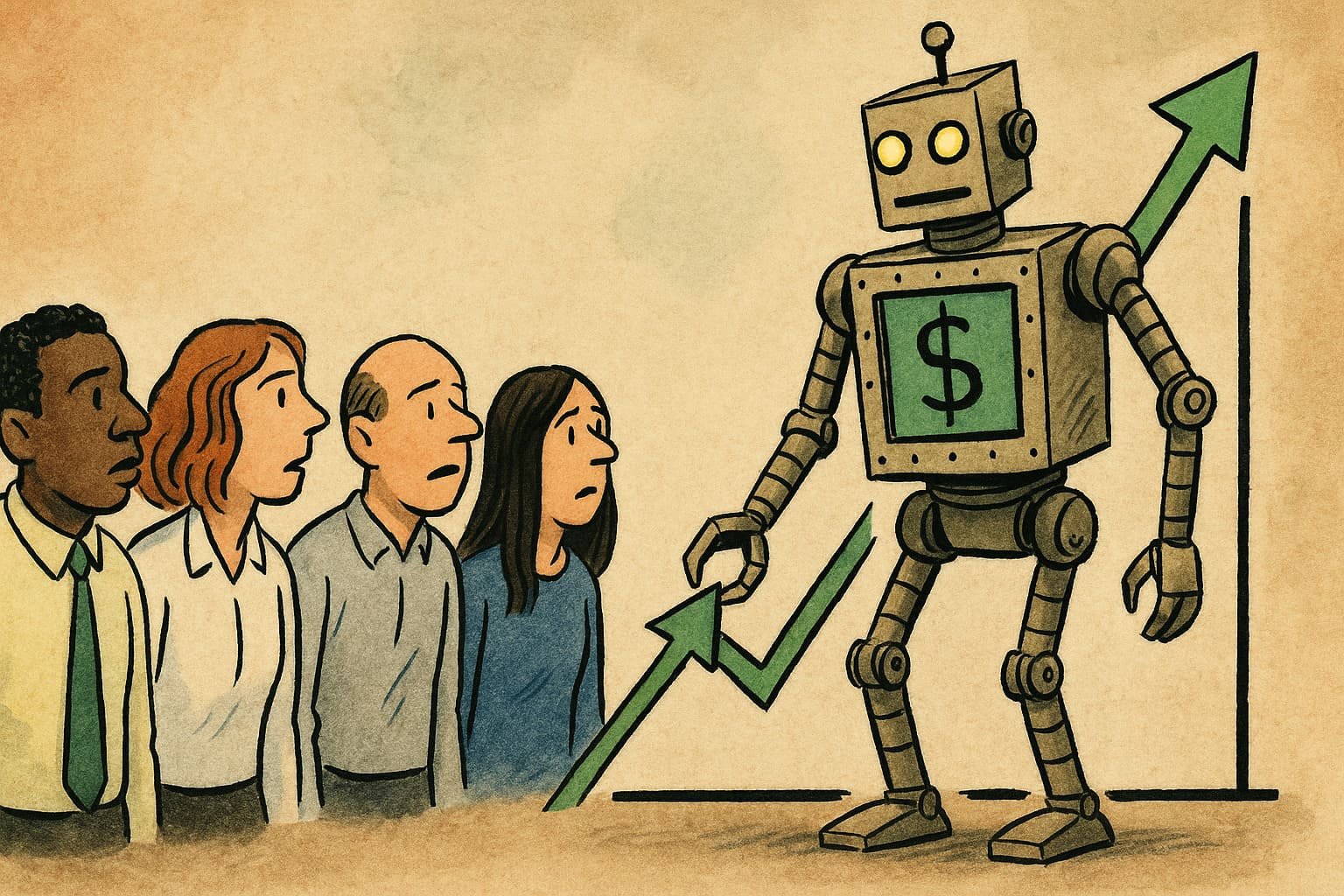
The applause usually comes first. That is the unsettling part. A company announces a dazzling leap in efficiency, analysts grin, shareholders nod, LinkedIn fills with breathless praise about transformation, and somewhere a talented employee quietly updates a résumé while pretending to be thrilled. Modern business has developed an odd habit of celebrating the subtraction of people as though it were proof of intelligence. Machines replacing repetitive labor is not new. That story began long before cloud software and machine learning decks. What feels different now is the moral packaging. Profit is cast as the enlightened hero. Human labor becomes an inconvenient relic. It is a remarkably polished story, and like many polished stories, it hides its roughest truths just off camera.
There is a legitimate argument buried inside that narrative, which is why it survives. Businesses absolutely need efficiency. Waste destroys competitiveness. Bloated operations suffocate promising firms. Nobody should romanticize inefficiency simply because people are involved. Yet something dangerous happens when profit stops being treated as a metric and starts behaving like a moral compass. The distinction matters. Kodak failed partly because it misunderstood technological transition. Netflix thrived because it disrupted its own assumptions before the market punished hesitation. Those stories are often retold as arguments for ruthless adaptation. Fair enough. Yet adaptation does not automatically mean dehumanization. Too many executives hear only the cheaper version of the lesson: remove expensive people, automate faster, and call it strategic clarity.
Take Miremba, who oversaw customer operations at a rapidly growing consumer brand. Leadership introduced automation software with entirely reasonable ambitions. Faster responses. Lower support costs. Better consistency. Nobody objected at first. Then experienced staff were reduced because the system handled “routine interactions.” Customers with unusual issues found themselves trapped in elegant digital loops that felt less like service and more like hostage negotiation with polite robots. Complaints rose slowly, which made them easier to ignore. Brand trust eroded in fragments. Miremba spent late evenings reading emails from customers who did not resent technology. They resented indifference disguised as progress. That distinction should make every executive slightly uncomfortable.
The deeper problem is that many organizations only respect what they can count neatly. Human contribution often behaves inconveniently. A veteran salesperson senses hesitation before a deal formally stalls. A manager notices emotional fatigue before resignations begin. An engineer prevents catastrophe through intuition no dashboard could forecast. None of that looks clean in quarterly metrics. Satya Nadella’s cultural transformation at Microsoft did not succeed because humanity became irrelevant. Quite the opposite. Empathy, curiosity, and internal learning became strategic assets rather than sentimental decorations. That shift mattered because companies do not compete only through systems. They compete through judgment, interpretation, trust, and the difficult art of making wise decisions under imperfect information.
Popular culture saw this tension long before business consultants monetized it. Science fiction repeatedly imagines efficient systems becoming emotionally grotesque. HAL was highly competent. Skynet was undeniably efficient. The recurring nightmare is not malfunction. It is optimization without conscience. That should feel uncomfortably familiar. A procurement executive named Tawanda once forced supplier costs downward so aggressively that manufacturing quality quietly deteriorated months later. The spreadsheets looked magnificent. The actual products smelled faintly of melting plastic and reputational decay. Numbers had technically won. Reality, eventually, filed an appeal. Efficiency without human judgment often resembles brilliance until the delayed invoice arrives.
Automation itself is not the villain here. Serious businesses should absolutely automate repetitive, error-prone, low-value processes wherever practical. The sharper question is what remains sacred. What forms of human contribution should never be treated as disposable friction. Amazon’s operational sophistication inspires admiration because large-scale execution at that level requires extraordinary systems design. It also creates discomfort because the public senses the unresolved tension between optimization and dignity. Customers increasingly reward humane experiences. Employees stay where respect survives. Innovation thrives where thoughtful humans retain agency. Profit behaves like oxygen. Vital, certainly. But no sane person confuses oxygen with the purpose of being alive.
Ask Farhiya, who built a software consultancy that grew faster than her internal culture could metabolize. Investors encouraged standardization. Junior analysts were replaceable, she was told. Mentorship consumed too much managerial time. Relationships could be systematized. For a while, the arithmetic seemed persuasive. Margins improved. Then senior talent began leaving with unnerving calm. Clients noticed something difficult to quantify. The work remained technically acceptable, yet oddly hollow. That word should terrify leadership. Hollow organizations can remain profitable longer than expected while their internal intelligence quietly drains away. Systems can preserve output. They cannot reliably reproduce judgment, emotional nuance, or earned trust simply because procurement signed a software contract.
Another executive will celebrate labour reduction as a triumph of modern management. Maybe it will even improve short-term economics. Somewhere else, a quieter competitor will invest in human judgment precisely because ambiguity, trust, invention, and moral restraint remain stubbornly difficult to automate. One company may manufacture cleaner quarterly optics. The other may build relevance that survives technological fashion cycles. This is the question lurking beneath every efficiency narrative: when business finally optimizes every measurable process and discovers human beings were never merely cost centres, will there still be enough humanity left inside the organization to recognize what it actually lost?
