Through the glass walls of a penthouse boardroom, the city sprawls in electric veins, pulsing beneath the kind of night that swallows sleep. Here, CEOs clutch coffee so bitter it tastes like last year’s regrets. In this room, forecasts shimmer on giant screens, each graph a nervous prayer. People don’t talk; they whisper, as if the market might overhear and adjust itself out of spite. Every number, every color-coded cell on the spreadsheet, hides a secret: nobody really knows if tomorrow will come with profit or collapse.
In the back, a rising star fidgets with her bracelet, haunted by the echo of her founder’s favorite line: “You have to believe.” Not in miracles, but in the story. In the vision that’s pitched to investors, tweeted to followers, and stitched into every waking dream. The company’s future is a vapor; vivid and intoxicating until the next product launch either lifts it into orbit or burns it in re-entry. Faith here is not religion; it’s oxygen. And everyone, from the janitor to the chairman, inhales it to survive.
Outside, the city coughs up another unicorn startup, built more on hope than cash. Screens light up with headlines: “Disruption!” “Revolution!” “Valuations soar!” All while in the shadows, a barista who lost her job to an app curses her luck and mutters, “All smoke and mirrors.” Truth slips between the cracks. Trust is what you buy when you have nothing left to sell. In the modern bazaar, faith sells for more than gold.
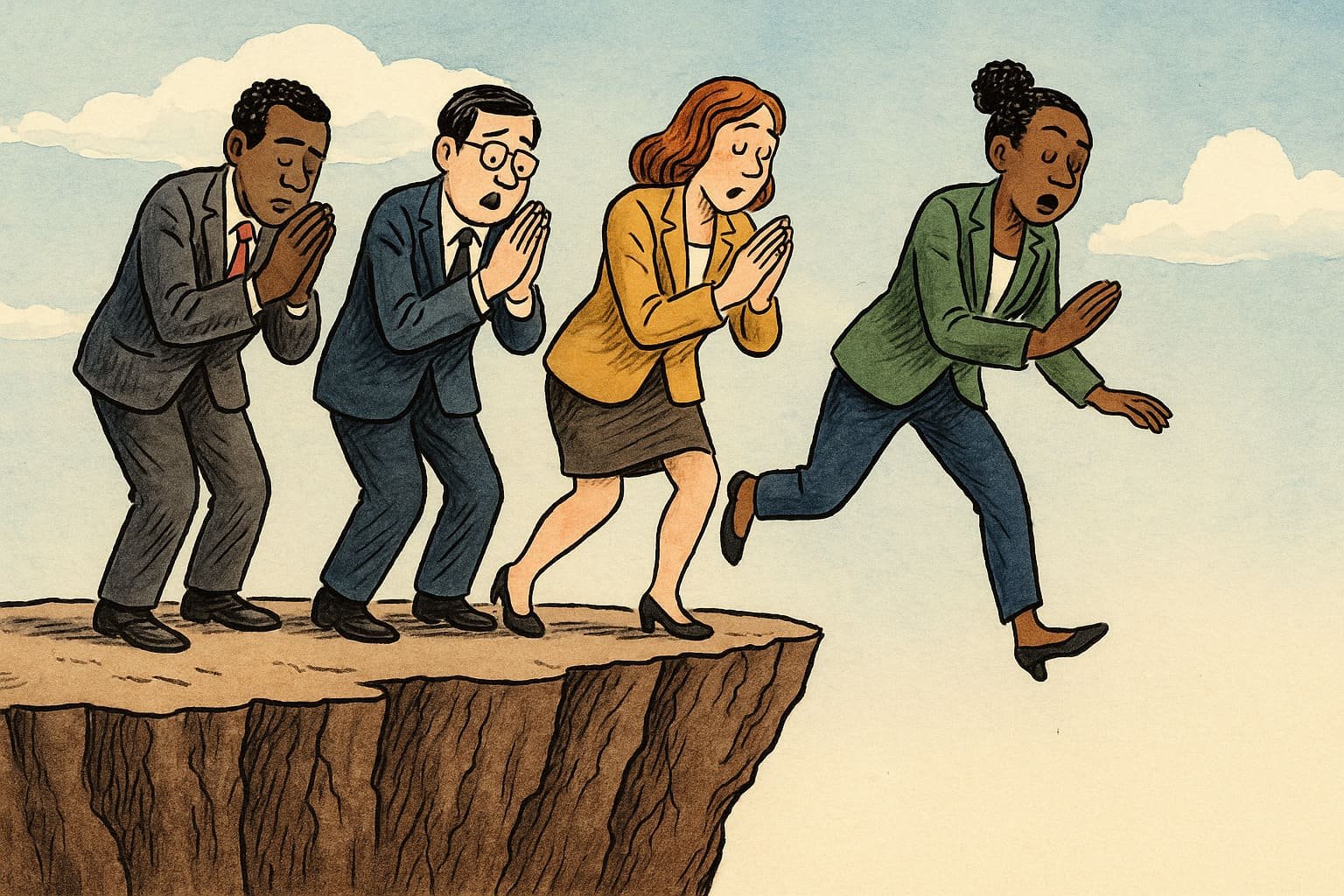
Boardrooms, garages, and open-plan offices become cathedrals for a new ritual: betting not on what is, but on what could be. It’s a strange paradox; every new leader must fake certainty, sell a vision, and somehow still sleep at night. Every deck is a confession. Every pitch is a leap from the high wire, hoping the net of belief will materialize in time. It’s not strategy; it’s a gamble where belief is the ante and self-doubt is a luxury nobody can afford.
Faith, it turns out, is the last competitive edge. The market doesn’t reward those who see things as they are. The market loves the heretic, the one who sees the future first and gets the rest of us to believe in it, too.
Quick Notes
- Belief Sells What Data Can’t: When logic and spreadsheets fail to predict the future, business runs on faith; pitching visions with more conviction than certainty, convincing people to buy into possibility, not just products.
- Risk Is Relabeled as Confidence: The most successful leaders aren’t the best at reading numbers, but the best at making others believe those numbers mean something bigger. Faith is what powers bold pivots and market leaps.
- Culture Is a Cult of Hope: Organizations with a mission that stirs hearts can overcome impossible odds; stories of Airbnb, Tesla, and countless no-names show that shared belief transforms culture into a weapon.
- Failure Breeds Faith (or Destroys It): Each crisis is a test: either deepen your conviction, or get swept away. Real power comes from learning to rebuild faith after setbacks, not just riding the highs.
- Trust Outlasts Technology: At the end of every cycle, the companies that endure are those people believe in; even when the product is broken, the funding is thin, or the news is bad. The future belongs to those who keep faith alive.
Faith Capital: The Hidden Currency of Modern Business
Every Fortune 500 company started with a roomful of skeptics and a single true believer. The world’s most iconic brands; Apple, Nike, even Netflix didn’t conquer their markets with technology alone. They conquered by getting people to buy into a story long before the story became true. The legend of Steve Jobs holding up an iPhone, insisting it would change everything, still ripples through Silicon Valley like a secular parable. In reality, the prototypes barely worked, but the faith in the mission was unbreakable.
You can see it in the nervous eyes of a founder pitching on Shark Tank. The room chills with skepticism, yet every now and then a judge leans forward, eyes bright, because belief is contagious. All those stories about someone selling a dream out of a garage, risking everything, aren’t just for nostalgia; they are the engine behind every startup gold rush. Real value is born the moment faith outpaces fear.
Consider the story of Maya, a Kenyan fintech founder, who convinced her skeptical team to launch their app in the middle of a recession. With no marketing budget and little support, she gathered her five-person crew and painted a vision so vivid it drowned out the noise of doubters. Her pitch became a battle cry: “If we don’t believe in this, nobody else will.” Against every prediction, the app found its first hundred customers within weeks. The early adopters didn’t care about perfect code; they bought the hope that things could be better.
Theoretical frameworks echo this: Behavioral economists argue that consumer decisions are rarely rational, but emotional. Even Warren Buffett calls trust the rarest commodity. The “leap of faith” is not just a cliché but a market force. The late Clayton Christensen described it as the “Jobs to Be Done” theory; people buy not what a company makes, but what they believe it stands for.
A close friend once joked, “Every new business is a cult in search of a congregation.” It sounds harsh, but scan the slogans of the biggest brands and you’ll find faith woven through every campaign. Businesses aren’t built on balance sheets; they’re built on belief, recharged every morning, one all-hands pep talk at a time.
Risk Roulette: How Leaders Bet on the Unseen
Boardrooms worship numbers, but history sides with those who risk everything for what cannot be seen. Every major breakthrough in business began with someone betting against logic, forecasting markets no one else could imagine. Take Reed Hastings, whose vision for streaming video faced mockery and doubt from analysts. He kept going, buoyed not by quarterly reports, but a stubborn faith in changing the way the world watched TV. Those who laughed at him now binge his gamble every weekend.
Risk isn’t what you think it is. It’s not spreadsheets or actuarial tables. Risk is the feeling in your gut when you decide to fire half your product line to double down on one new bet. It’s the late-night arguments with cofounders about pivoting into unknown waters. Real risk is not gambling with money, but with your own credibility and the faith of everyone who follows you.
Sophia, a rising manager at a global consulting firm, once decided to quit a high-paying job to launch a wellness startup after a personal health scare. Her friends warned her, “The market is crowded, and you don’t even have a prototype.” She pressed on, fueled by the conviction that if she could heal herself, she could help others, too. Within a year, her startup went viral on social media. Her story wasn’t about products; it was about the audacity to believe in a new way of living.
Organizations often hide behind the mask of data, pretending the numbers can predict the future. But data never won a revolution. The leap into the unknown is what launches new industries. The best investors, from Peter Thiel to Cathie Wood, say that the real secret isn’t seeing the data; it’s seeing what nobody else sees yet, and betting on that.
Risk, when reframed as faith, becomes an unstoppable force. Each “crazy” idea that became a unicorn did so because someone held the line against logic and the crowd. In a world obsessed with optimization, real power lies in taking the blind leap and inviting everyone else to jump with you.
Culture Wars: The Religion of Company Mission
Step into any modern company, and you’ll find rituals as fierce as any church. Weekly standups become sermons. The quarterly town hall is a revival meeting, complete with promises of a brighter tomorrow. Culture isn’t just perks and ping-pong tables; it’s the sum total of shared belief. When faith runs high, teams defy gravity and outpace every competitor. When it runs out, the collapse is biblical.
Airbnb’s early days offer a masterclass in collective faith. Their mission “Belong Anywhere” transcended business, transforming a scrappy startup into a global movement. Employees slept on couches, deferred salaries, and hustled strangers into trusting an idea that seemed ridiculous at the time. What kept them going wasn’t a salary; it was the sacredness of purpose. That sense of shared destiny propelled them through brutal winters, angry city councils, and empty bank accounts.
People crave meaning more than paychecks. The case of a small marketing agency in Berlin proves this. The founder, Lina, made every Friday a “mission day,” inviting staff to pitch wild, idealistic campaigns for charities. Turnover fell, morale soared, and clients started requesting projects that mattered. The agency’s reputation shifted: they weren’t just selling ads; they were selling hope.
Culture becomes a weapon when everyone believes. Sociologists call this “collective effervescence” the buzz that emerges when individuals feel part of something greater. This phenomenon, often reserved for religion, now fuels the world’s fastest-growing companies. A cult of hope can propel a team through crisis, outlast downturns, and attract the kind of talent that doesn’t just want a job, but a calling.
But the dark side is real. Faith misplaced can become fanaticism. Companies that lose sight of reality, drinking too much of their own Kool-Aid, risk implosion. Uber’s early run was as much a lesson in the dangers of unchecked faith as it was a tribute to disruptive vision. The line between inspiration and delusion is razor-thin. True leaders never let the mission become a straightjacket—they invite questions, not just worship.
Failure as Furnace: How Setbacks Forge Belief
Every entrepreneur carries the scars of faith tested by fire. The myth that great leaders never fail is just that a myth. The real giants of business wear their defeats like medals, each one a lesson in the cost of belief. Howard Schultz returned to Starbucks, not in triumph, but after a brutal defeat. His first vision had fallen flat, yet he returned with twice the conviction, rebuilding not just the brand but the culture. The company’s resurgence was born from the ashes of broken dreams.
Failure doesn’t just destroy belief; it refines it. The best teams don’t fall apart when the product bombs. They rally around a wounded leader, rework the vision, and dig deeper into what matters. In a small fintech in Lagos, the entire staff nearly quit after a disastrous product launch. Instead, their CEO, Chidi, stood up in front of his exhausted team and admitted every mistake, ending with, “If you’re still here tomorrow, it means you believe.” Nearly everyone came back. The next launch was a hit.
Adversity reveals who really believes. When the headlines turn sour and investors stop returning calls, the faithful remain. This grit, this doggedness, becomes the real moat around any company. It isn’t cash; it’s the willingness to bleed for the mission. Every comeback story; think Nintendo after near-bankruptcy or Lego reinventing itself from plastic bricks to digital worlds proves that belief, once forged in the furnace of failure, can outlast any downturn.
Yet, not all faith survives unscathed. Teams burned by repeated betrayals or false promises may never recover. Cynicism is contagious. The founders who bounce back are the ones who never lie about the losses. They turn setbacks into stories, failures into fuel. Faith isn’t blind optimism; it’s resilience, seasoned by truth.
Failure, far from being the enemy, is the crucible that tempers true belief. Only those who have been broken, and choose to build again, can inspire faith in others that no spreadsheet ever could.
Trust as Legacy: Outlasting the Algorithm
In a world obsessed with speed and scale, trust becomes the last bastion. The algorithm may set prices and allocate resources, but people buy from those they trust. The companies that become legends are not those who win every quarter, but those who build an unbreakable bond with customers and employees alike. Patagonia’s cult-like following, for example, comes not from slick ads, but from a decades-long commitment to sustainability, even at the cost of short-term gains.
Trust compounds. A single act of transparency, like Buffer’s radical openness about salaries, can ignite a movement. Customers remember when a company admits it screwed up. Employees stay when they know the leadership won’t cut corners in the dark. In the long game, trust turns companies into movements, brands into belief systems.
Consider the micro-story of Ravi, a small shop owner in Mumbai, who survived the arrival of a multinational giant by doubling down on honesty. When he couldn’t match prices, he matched empathy, calling loyal customers by name, sharing small kindnesses, and always delivering what he promised. His business shrank, but his reputation grew. Now, even tourists flock to his shop, seeking the rare taste of trust.
Theoretical frameworks like Social Capital Theory underscore this truth: the most powerful networks are built not on transactions, but on trust. Every handshake, every fulfilled promise, every honest apology becomes a brick in the legacy wall. Algorithms cannot touch what trust cements.
As technology accelerates, those who invest in trust; who keep faith alive through every crash and correction outlast every disruption. The world remembers the faithful, not the flashy. Legacy isn’t a logo; it’s the echo of belief, carried forward by every person who ever dared to trust you.
The Faith Engine Never Sleeps
On a rain-slicked rooftop above the city’s blinking lights, the architect of tomorrow stands with their coat pulled tight, watching clouds swallow the skyline. The air is heavy with unfinished dreams and silent bargains. It’s late, but the phone buzzes; another message from a partner who believes, another customer asking for a miracle, another team member still working because they trust that the dawn will bring something new.
Somewhere in the city, an old sign flickers over an empty store, proof that faith sometimes falters. But across the street, a tiny café fills with laughter, the owner placing her last bet on hope with every cup. The engine that runs business never really shuts off; it just changes hands, moving from leader to believer, from dreamer to doer, keeping the world’s heart pumping through risk and rescue, boom and bust.
The rain stops, the lights blink on, and the city’s pulse finds its rhythm. In the glass towers and forgotten alleys, belief stirs again, fresh and restless, refusing to quit. Every setback is a new invitation. Every disappointment, a dare. The only thing stronger than fear is the faith that refuses to die.
So now it’s your move: will you bet on the world as it is, or as it could be? The future will always belong to those who believe loudest; especially when no one else dares to.
Why scroll… When you can rocket into Adventure?
Ready to ditch the boring side of Life? Blast off with ESYRITE, a Premier Management Journal & Professional Services Haus—where every click is an adventure and every experience is enchanting. The ESYRITE Journal fuels your curiosity to another dimension. Need life upgrades? ESYRITE Services are basically superpowers in disguise. Crave epic sagas? ESYRITE Stories are so wild, your grandkids will meme them. Want star power? ESYRITE Promoted turns your brand cosmic among the stars. Tired of surface-level noise? ESYRITE Insights delivers mind-bending ideas, and galactic-level clarity straight to your inbox. Cruise the galaxy with the ESYRITE Store —a treasure chest for interstellar dreamers. Join now and let curiosity guide your course.