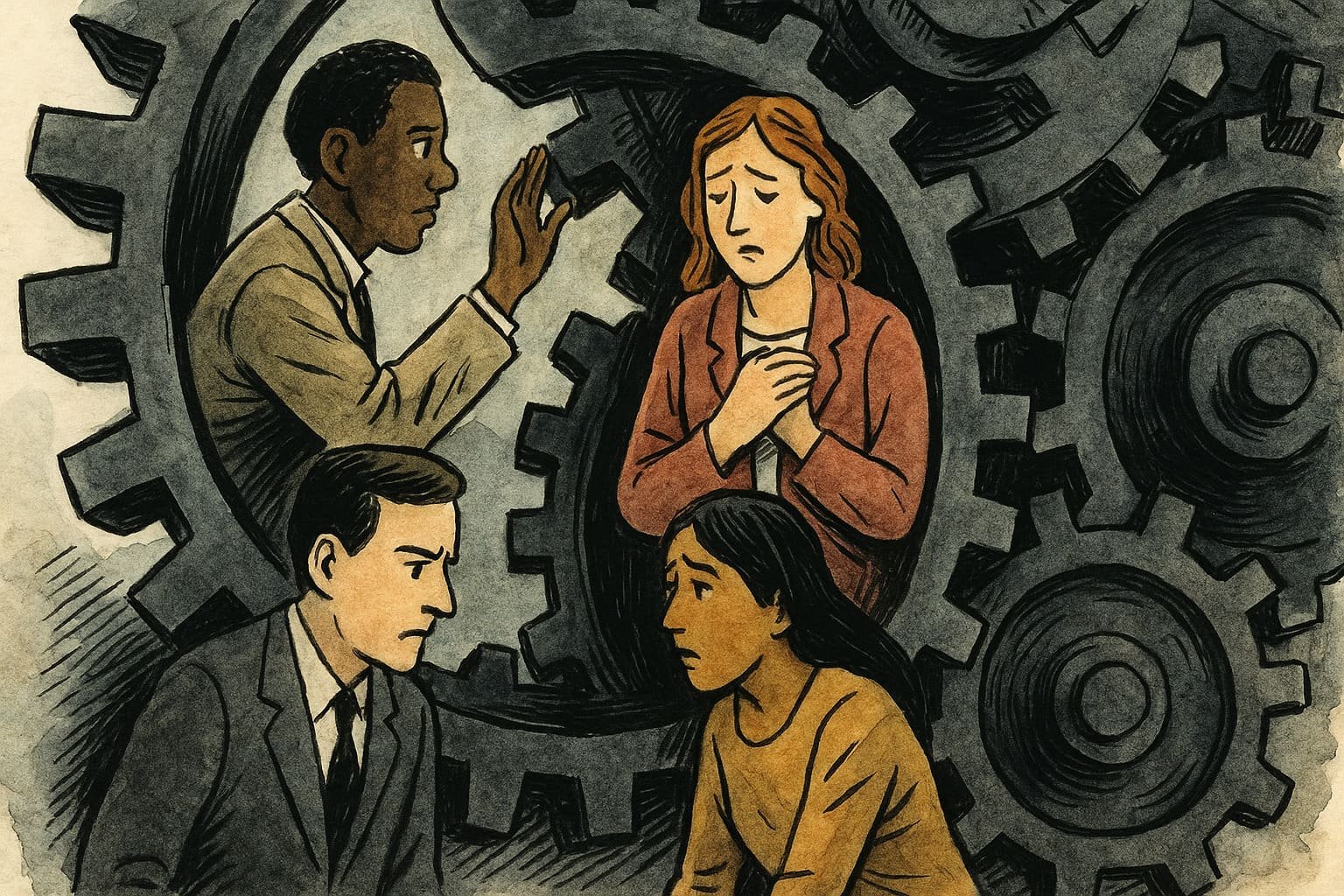
A blue light flickers above polished glass, bouncing off nameplates like spotlights on an empty stage. Beneath this sterile glow, a dozen faces are framed by laptop screens, each one angled just so, hiding more than they reveal. The air tastes faintly of burnt coffee and tension, a cocktail shaken by algorithms and quarterly targets. The voice leading the meeting speaks in bullets and acronyms, not names, the sentences as smooth and frictionless as a conveyor belt. Somewhere in the far corner, a young woman named Tara swallows her idea, feeling it stick in her throat like static, because systems reward speed, not voice, and today, the only thing truly optimized is silence.
Beneath this modern ritual, a different story hums; one where hearts used to matter more than dashboards. Empathy, once the heartbeat of every great brand, now survives only in the fine print of annual reports or as a tagline on company mugs. Meetings drift from connection to calibration, each decision faster but somehow colder, each gesture measured for efficiency, not humanity. The applause for another process improvement feels hollow, the sound echoing in the absence of genuine laughter or messy debate. Somewhere, someone remembers when leaders shook hands, not KPIs, and teams-built trust, not just Trello boards.
If you listen closely, you can almost hear the sound of relationships unraveling: the missed birthdays, the unsent thank yous, the rushed feedback that lands like a slap instead of a nudge. The pursuit of efficiency becomes a labyrinth, walls built higher by every new app, chatbot, or AI tool. Those who hesitate to adapt are quietly left behind, like passengers missing the last train out of a city that never loved them back. The only metric that grows faster than productivity is the distance between people.
When did the world decide that friction was the enemy? Some say it started with Henry Ford, others with Steve Jobs, but the truth feels older, woven into the wires and workflows that now bind us. In the age of automation, every conversation is a transaction, every smile a resource waiting to be harvested. This is not progress; it’s a perfectly calibrated emptiness, humming with the promise of profit and the quiet warning that, in the end, the machines don’t miss anyone.
So begins the secret story behind success: a world where empathy is traded for output, and every system that promised to set us free instead builds another invisible cage. But as the glass doors slide shut and the meeting ends, a question lingers; if the heart is no longer required, who, exactly, gets to win?
Quick Notes
- Machines Don’t Mourn Lost Connections: Every time a workflow speeds up, something slow and human is left behind. The first thing to go is conversation; the last is trust.
- Shortcuts Turn Empathy Into Roadkill: The more systems promise to “save time,” the less time anyone has to notice pain, celebrate effort, or forgive mistakes. It’s a magic trick where warmth disappears and nobody applauds.
- Automation Loves Numbers, Hates Stories: Data dashboards track everything except what matters. Real courage, the kind that builds loyalty or rights a wrong, never fits on a pie chart.
- Case Study: When Feedback Became a Firing Squad: Remember that time a team member got called out by an auto-generated report? It hurt more than an honest talk ever could.
- What Gets Measured Kills What Gets Felt: You can optimize the process or nurture the person. Choosing both is rare, choosing neither is failure, but choosing the system is the silent default in business today.
The Myth of Faster Is Better
The idea that speed equals progress drives nearly every industry today. Factories used to pride themselves on relentless tempo, but now even creative fields run on sprints, deadlines, and productivity hacks. Tara, the same employee watching her words die in that meeting, once tried to slow things down to check on a colleague after a family loss. Her manager smiled, but the process didn’t. Nobody scheduled time for grief. The assembly line moved on, and so did everyone else. In this world, slowing down for kindness is almost an act of rebellion.
Workflow apps and project management tools promise to “free up” time, but rarely do they return it to people. Instead, every new notification is another reminder that human attention is just another resource to be sliced and stacked. Companies celebrate each second saved, but the tally rarely includes hours lost to stress or misunderstanding. As the pace increases, so does the pressure to hide vulnerability. Efficiency becomes a mask worn so tightly that it leaves no room for tears, laughter, or uncertainty.
Every shortcut adds a hidden cost that rarely appears on the balance sheet. When automated messages replace handwritten notes, gratitude turns generic. When performance reviews become digital checklists, the story behind the numbers vanishes. Jason, a department head at a global consultancy, once tried to thank his team with a personalized email for each member. His assistant, eager to “help,” built a template. Suddenly, gratitude felt like spam, and the only thing optimized was indifference.
It’s easy to pay lip service to culture, much harder to carve out time for care. Leaders who once walked the floor, stopping to ask how people felt, now ping their teams with emojis and canned “wellness” prompts. Some companies even experiment with AI “wellness bots,” reducing the art of listening to a monthly pop-up. The result? Real struggles go unnoticed until they become HR incidents, and resilience is confused with silence.
Movies like “Her” and shows like “Black Mirror” echo the same theme: as systems get smarter, people grow lonelier. Tech giants sell frictionless futures, but the price is always a little bit of soul. Anyone who has watched “The Office” knows that the funniest, most memorable moments are never the ones that ran smoothly; they’re the awkward, human collisions that algorithms could never predict.
When Systems Outpace Souls
Every team wants to be data-driven, but the numbers never hug you back. Companies build entire cultures around dashboards, believing that “what gets measured gets managed.” What rarely gets managed is meaning. A real story: Olivia, a sales manager at a tech firm, watched her team hit record numbers for closed deals. At the same time, turnover doubled. Nobody could pinpoint why until someone finally listened to a quiet employee who felt invisible, despite the numbers celebrating her output.
Performance reviews, once a space for mentorship, now feel like traffic stops. Automated performance alerts send warnings for missed metrics but never ask, “What happened?” During one notorious quarterly review, an employee named Raj received an auto-generated performance improvement plan. He laughed, but the sting was real. The system noticed his slip in numbers, not the fact that he had spent weeks helping a colleague through a health crisis. Raj’s reward for empathy was an impersonal threat of replacement.
When processes get prioritized, creativity becomes an afterthought. Brainstorming sessions shrink to fit calendar invites, and brainstorming turns into “brain skimming.” When Zara, a creative lead at a startup, pushed for an untested campaign, the system rejected it for being “off-template.” Six months later, a competitor launched the same idea, winning awards. Zara left soon after, her boldness replaced by a new checklist item: “Follow process.”
Modern managers are often taught to “lead by data.” This works, until the data fails to capture fear, grief, or quiet brilliance. Chloe, a director at a logistics company, realized too late that her “star performer” was burning out. The dashboard celebrated his efficiency, but never warned her about his exhaustion. The day he quit, she stared at his empty chair, the only sign left of the person her metrics never truly saw.
Genuine care takes time, and time is expensive. Companies that build empathy into their DNA, like Patagonia or Southwest Airlines, often struggle to scale it without letting bureaucracy creep in. Empathy becomes a premium feature, reserved for customers or clients, rarely for the team that delivers it. In the end, efficiency wins by default, leaving a trail of lost connection, unspoken gratitude, and ideas never voiced.
Automation’s Cold Embrace
Customer service used to be about problem-solving with a human face. Now, AI chatbots handle the first and often the last touch with customers. While some celebrate the convenience, the loss is tangible. Maya, a small business owner, spent weeks trying to resolve an issue with a vendor’s bot. Her frustration peaked when the system looped her back to the same FAQ. The solution arrived days later, but her loyalty was already lost. The machine saved time, but it cost a customer.
Self-checkout lanes, automated HR portals, and digital onboarding strip out the messiness of human error and with it, the chance for kindness. When was the last time a self-service kiosk recognized someone’s frustration and tried to cheer them up? Machines can process requests, but only people can offer reassurance. In a hospital in Tokyo, a cleaning robot once navigated around a nurse who was crying quietly in a hallway. A colleague might have stopped. The robot kept moving.
Digital platforms promise frictionless collaboration, but too often, friction is where learning and empathy live. Slack channels and Zoom calls may keep projects moving, but nuance gets lost in the static. One finance manager, Ben, told the story of a team member whose joke was misunderstood in a chat, spiraling into weeks of awkwardness. Apologies landed flat. The team hit its goals but lost its laughter, and soon, its best people.
Every button pressed to speed things up is a button not pressed for patience or understanding. The “like” button replaced the thank you note. Scheduling software replaced the coffee break. In one Chicago advertising agency, a creative director hung a sign that read, “There’s no shortcut to belonging.” The sign disappeared after the next office redesign, replaced by a digital display showing KPIs in real time.
A quiet epidemic of disengagement follows in the wake of every automation rollout. People stop caring about outcomes when they stop feeling seen. A Gallup poll once revealed record-low employee engagement, but the real story lives in the stories no one tells. When empathy dies, cynicism blooms. Leaders notice too late, usually when the best people are already walking out the door.
Resistance Isn’t Futile—It’s Vital
In a world obsessed with output, the bravest act is to listen without rushing. In Denmark, a tech company named ByFounders banned internal emails on Fridays, forcing real conversation. At first, the experiment felt awkward and slow. By month’s end, productivity hadn’t changed, but trust had. One intern, Sofia, said she finally felt seen; not as a cog, but as a contributor.
Case after case proves that when teams are given space to connect, performance soars. Google’s famous Project Aristotle discovered that psychological safety; feeling safe to speak up without fear was the secret to high-performing teams. They didn’t build it with dashboards. They built it with time, patience, and the willingness to ask, “How are you, really?” The best ideas surfaced not during scheduled meetings, but in the moments in between.
Tiny gestures can undo months of automated coldness. During the pandemic, a London bakery began handwriting notes in every delivery box, thanking each customer by name. The business tripled its loyal base within a year. It wasn’t the bread that changed; it was the warmth. Empathy doesn’t scale, but it compounds, quietly, in every interaction.
Real leaders know when to hit pause, even if the world screams for speed. Satya Nadella, CEO of Microsoft, is known for saying, “Empathy makes you a better innovator.” Under his watch, the company shifted from ruthless competition to collaboration and in doing so, found fresh energy and loyalty. It wasn’t a process update. It was a mindset shift.
In the race to automate everything, empathy remains the one advantage that machines can’t replicate. Companies that recognize this truth build not just stronger teams, but legacies. Every time someone slows down to ask, listen, or care, a bit of the soul returns to the business. The best systems serve people, not the other way around.
The Hidden Cost of Winning the Wrong Game
Efficiency tends to reward the loudest, fastest, or most aggressive. But these winners often lose sight of the people left behind. A marketing agency in Berlin handed out awards for “fastest email responder,” only to discover a year later that their client satisfaction had tanked. The true hero was the project manager who spent time repairing a relationship with a frustrated client, quietly saving a contract that numbers never noticed.
As business processes get “smoother,” employees feel less essential. In a Dallas hospital, nurses now clock in and out via facial recognition, saving minutes but eroding the camaraderie of a morning greeting. The process is slick; the spirit, gone. Over time, people begin to feel like shadows passing through a system designed for speed, not solidarity.
In a South African nonprofit, a beloved team member died unexpectedly. The workflow didn’t pause. Tasks continued to ping, reminders kept arriving. It took a rogue team leader breaking protocol; shutting down the system for an hour to give everyone space to mourn together. The break wasn’t efficient, but it was essential. Healing isn’t in the workflow.
Metrics are supposed to create fairness, but they often erase context. When performance is only measured by output, the quiet strengths; mentorship, resilience, creative problem-solving vanish. A New York media company nearly fired its “least productive” writer, until a colleague revealed that he had been ghostwriting award-winning pieces for others all year. The system missed what only people could see.
Winning is hollow if no one misses you when you leave. The businesses remembered in history aren’t those that optimized best, but those that cared most. In the end, people are loyal to people, not processes. The final scoreboard isn’t a spreadsheet; it’s a legacy.
When the Machines Fall Silent
Rain spatters against the windows of an empty office tower, the city’s glow blurred and distant. A single chair sits beneath a buzzing light, the kind that never seems to warm the room. At a desk littered with unread notes and old badges, a manager stares at her reflection in the blank screen. She once believed that building the perfect system would set her free. Now, she feels every conversation she never had, every thanks unsaid, every voice silenced by her devotion to speed.
The ghosts of old colleagues pass by in memory, faces half-remembered, stories unfinished. Each system she built solved a problem but stole a little more time from the team she once loved. Outside, thunder rolls across the sky, and for the first time in years, she wishes for something messier; a broken process, a missed deadline, a moment that mattered.
Down the hall, the cleaning crew sings quietly, their voices echoing what the machines never learned: that work is more than output, that connection is more than convenience, and that sometimes, the greatest efficiency is found in the inefficiency of caring. The building hums with the knowledge that when the lights go out, it’s not the system people remember; it’s the warmth left behind.
One question remains, flickering in the silence: Will you build a business that remembers you, or one that only remembers what you did?
Why scroll… When you can rocket into Adventure?
Ready to ditch the boring side of Life? Blast off with ESYRITE, a Premier Management Journal & Professional Services Haus—where every click is an adventure and every experience is enchanting. The ESYRITE Journal fuels your curiosity to another dimension. Need life upgrades? ESYRITE Services are basically superpowers in disguise. Crave epic sagas? ESYRITE Stories are so wild, your grandkids will meme them. Want star power? ESYRITE Promoted turns your brand cosmic among the stars. Tired of surface-level noise? ESYRITE Insights delivers mind-bending ideas, and galactic-level clarity straight to your inbox. Cruise the galaxy with the ESYRITE Store —a treasure chest for interstellar dreamers. Join now and let curiosity guide your course.