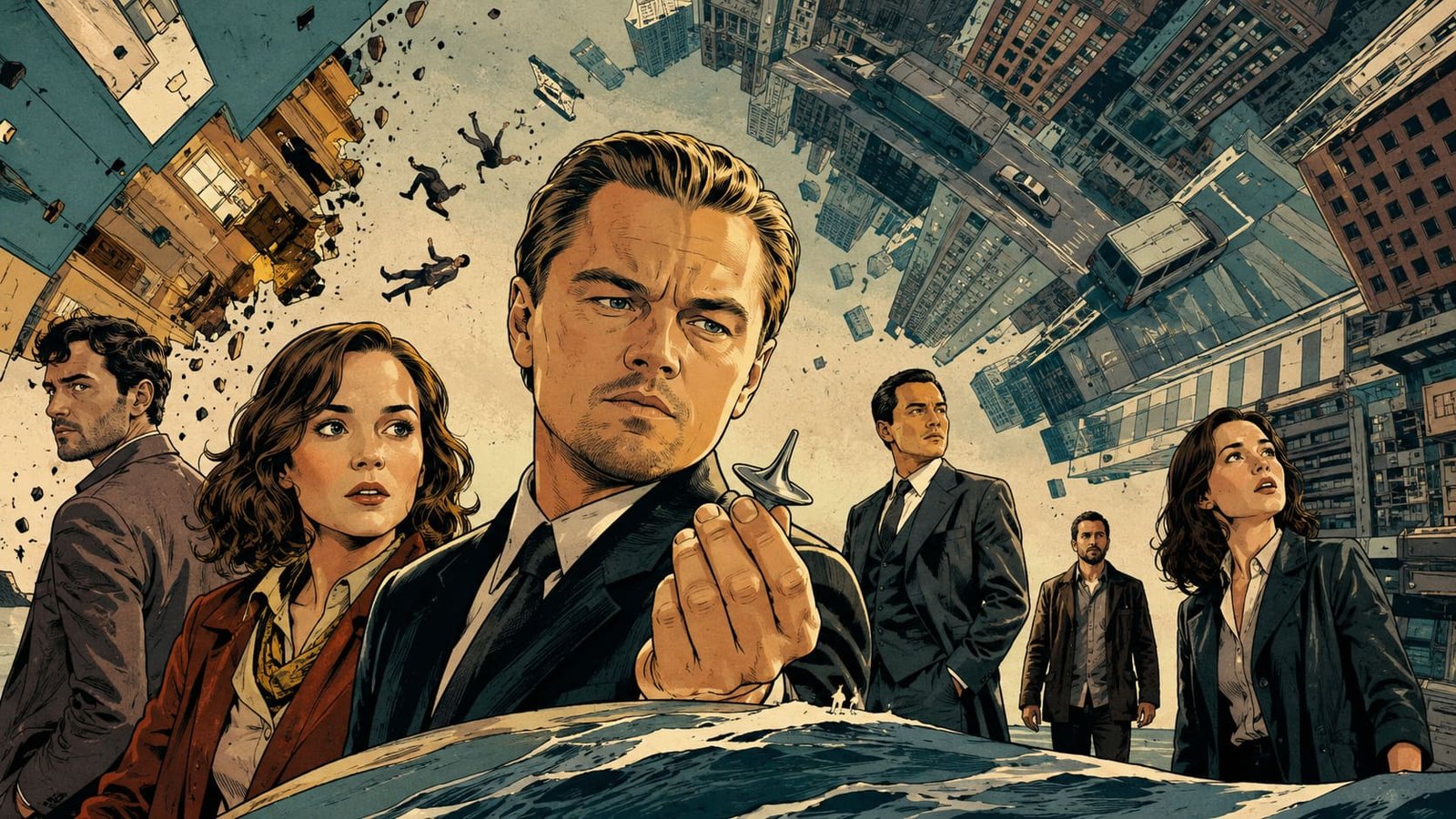
A city folded itself like paper above exhausted strangers while gravity lost interest in behaving properly. Elevators opened into oceans. Hallways twisted like nervous systems under stress. Men in tailored suits carried secrets through collapsing dream corridors with the cold precision of investment bankers transporting nuclear codes. Inception arrived dressed as a science-fiction thriller, yet the film’s real obsession was never technology. Christopher Nolan built a cinematic labyrinth about power over perception, about how modern systems colonize the human mind long before they touch the body. Beneath the rotating hotels and impossible skylines sits an unnerving proposition: the most valuable territory in the world is no longer land, oil, or currency. It is attention. It is memory. It is belief itself. Dom Cobb, played with haunted restraint by Leonardo DiCaprio, operates less like a thief and more like a psychological venture capitalist, entering vulnerable mental landscapes searching for profitable emotional leverage. The movie feels eerily prophetic now because entire industries have since emerged around manipulating thought, engineering desire, and reshaping identity through invisible architecture.
The brilliance of Inception lies in its refusal to separate business strategy from emotional trauma. Cobb assembles teams the way elite organizations assemble executive boards. Each member serves a specialized cognitive function. Arthur manages structure. Ariadne designs environments. Eames manipulates identity. Yusuf stabilizes chemistry. It resembles a startup operating inside the subconscious, except failure means psychological collapse rather than missed quarterly targets. Every successful institution secretly functions this way. Beneath polished mission statements sits a hidden ecosystem of emotional labor, manipulation, compromise, and carefully controlled illusion. A corporate strategist named Helena once admitted after leaving a consulting giant that “half the job was convincing clients they invented ideas already planted in the room.” That sentence hangs over Inception like invisible fog. The film exposes how leadership often works through suggestion rather than command. Real influence rarely announces itself loudly. It slips quietly into people’s internal narratives until they mistake implantation for intuition.
Cobb’s mission against Robert Fischer carries astonishing philosophical weight because it weaponizes grief as a business tool. Fischer’s inherited empire becomes vulnerable precisely because unresolved pain weakens psychological boundaries. Modern capitalism understands this mechanism intimately. Advertising rarely sells products directly anymore. It sells emotional resolution. Loneliness becomes a subscription service. Anxiety becomes productivity software. Nostalgia becomes luxury branding. Inception simply pushes that logic into science fiction territory, where ideas function like invasive software patches installed directly into the mind. The tragedy is that Fischer’s transformation succeeds not through coercion but through emotional longing. A dying father’s imagined approval reshapes an empire. That emotional architecture feels painfully recognizable. Entire careers are built chasing invisible parental validation. Entire organizations operate as monuments to unresolved insecurity. Nolan understands something many leadership books desperately avoid: people rarely make decisions rationally. They make them emotionally, then retrofit intellectual explanations afterward.
The film becomes even more unsettling when examining Cobb himself. He appears competent, composed, strategic. Underneath, he is disintegrating. Mal exists inside his subconscious like corrupted code infecting every operation. That dynamic transforms the movie into a brutal meditation on memory and guilt. Cobb cannot distinguish leadership from control because both became tangled inside grief. A venture capitalist in Singapore once described burnout with terrifying accuracy. “The body keeps attending meetings long after the soul resigns.” Cobb embodies that condition. He continues moving, planning, executing, while emotionally trapped inside unfinished mourning. The spinning top matters less than the emotional paralysis surrounding it. Inception suggests unresolved pain does not disappear. It redesigns perception itself. The subconscious becomes less a hidden basement and more a shadow government quietly influencing every visible decision.
Nolan also understands the strange violence hidden inside ambition. Every dream layer amplifies risk because speed, pressure, and complexity distort judgment. Modern professional culture behaves similarly. Executives boast about sleeping four hours while consuming enough caffeine to tranquilize a horse. Founders celebrate chaos as though nervous-system exhaustion were evidence of genius. Cobb’s team descends deeper into unstable dream layers searching for strategic advantage, yet each layer pulls them further from reality. The metaphor barely hides itself. Somewhere between endless notifications, artificial urgency, and algorithmic distraction, contemporary life became psychologically recursive. People exist inside simulations built from expectations, status performance, and curated identity management. Social media intensified this condition until many individuals now maintain multiple emotional selves simultaneously: professional self, aspirational self, performative self, exhausted hidden self. Inception externalizes that fragmentation visually. The collapsing dream worlds resemble emotional states people already inhabit silently.
A smaller film would have treated Ariadne merely as exposition machinery. Instead, she becomes the audience’s moral compass. Her name itself references the Greek mythological figure guiding Theseus through the labyrinth. She notices what others normalize. That matters deeply. Every broken system survives because insiders stop questioning distorted behavior. Ariadne recognizes Cobb’s instability long before the mission fully unravels. Her presence introduces a subtle organizational truth rarely discussed honestly: institutions often depend on younger or less conditioned individuals to expose dysfunction veterans learned to tolerate. A junior analyst named Tariq once shocked a senior leadership meeting by asking why employees were praised publicly for “resilience” while privately collapsing from exhaustion. Silence swallowed the room. Nobody answered because everybody understood the question cut too close to the bone. Ariadne functions exactly like that disruption. She forces hidden contradictions into visibility.
Visually, the movie behaves like philosophical architecture. Streets bend. Time stretches. Buildings explode outward like neural networks under stress. Yet beneath the spectacle sits a surprisingly intimate anxiety about reality itself. Cobb desperately wants certainty. Audiences do too. That explains the enduring obsession with the ending. Did the top fall? Was Cobb still dreaming? The genius of Nolan’s conclusion is that it denies the audience absolute reassurance. Reality becomes less important than emotional reconciliation. That idea terrifies modern culture because certainty became a commercial addiction. Algorithms promise prediction. Consultants promise clarity. Gurus promise optimization. Inception whispers the opposite. Human existence may always contain ambiguity no spreadsheet can eliminate. The deeper people descend searching for total control, the more unstable perception becomes. There is almost something spiritual about that recognition. Not mystical in a cheap motivational sense, but profoundly human. Life often refuses clean resolution precisely because consciousness itself remains unfinished terrain.
Near the end, snowstorms rage inside fortified dream bunkers while synchronized explosions echo through multiple dimensions like a nervous breakdown choreographed by mathematicians. Yet the emotional climax arrives quietly. Cobb finally releases Mal, not because he stops loving her, but because he recognizes memory cannot replace reality without destroying both. That distinction elevates Inception beyond science fiction into modern mythology. Entire societies now live haunted by versions of themselves they can no longer inhabit. Former identities linger like ghosts: failed relationships, abandoned ambitions, younger selves frozen inside photographs and old messages buried deep in forgotten devices. The movie argues that survival requires letting certain illusions die, even beautiful ones. Otherwise the mind becomes a museum curated by regret.
Somewhere inside a quiet airport terminal, fluorescent lights hummed above strangers carrying invisible wars behind carefully neutral faces. A man walked toward his children after years spent trapped inside architectures built from guilt, ambition, and longing. Around him, the world appeared ordinary again. Chairs remained still. Buildings obeyed gravity. Yet the silence carried tension because certainty had vanished permanently. That is the final seduction of Inception. The film does not merely ask whether reality is real. It asks whether modern life has already trained people to prefer elegant illusions over difficult truth. And once a person learns how comforting the dream can feel, waking up becomes the most frightening decision imaginable.
Editorial Disclaimer: Whether a film is rooted in fiction or inspired by real events, the actions, decisions, and behaviors portrayed within are not intended to be encouraged, replicated, or endorsed in real-world settings. This review exists solely to analyze the storytelling, characters, themes, and business dynamics presented in the film for educational, analytical, and entertainment purposes. Any ethical or unethical conduct depicted in the film does not reflect the views, values, or endorsements of ESYRITE.
