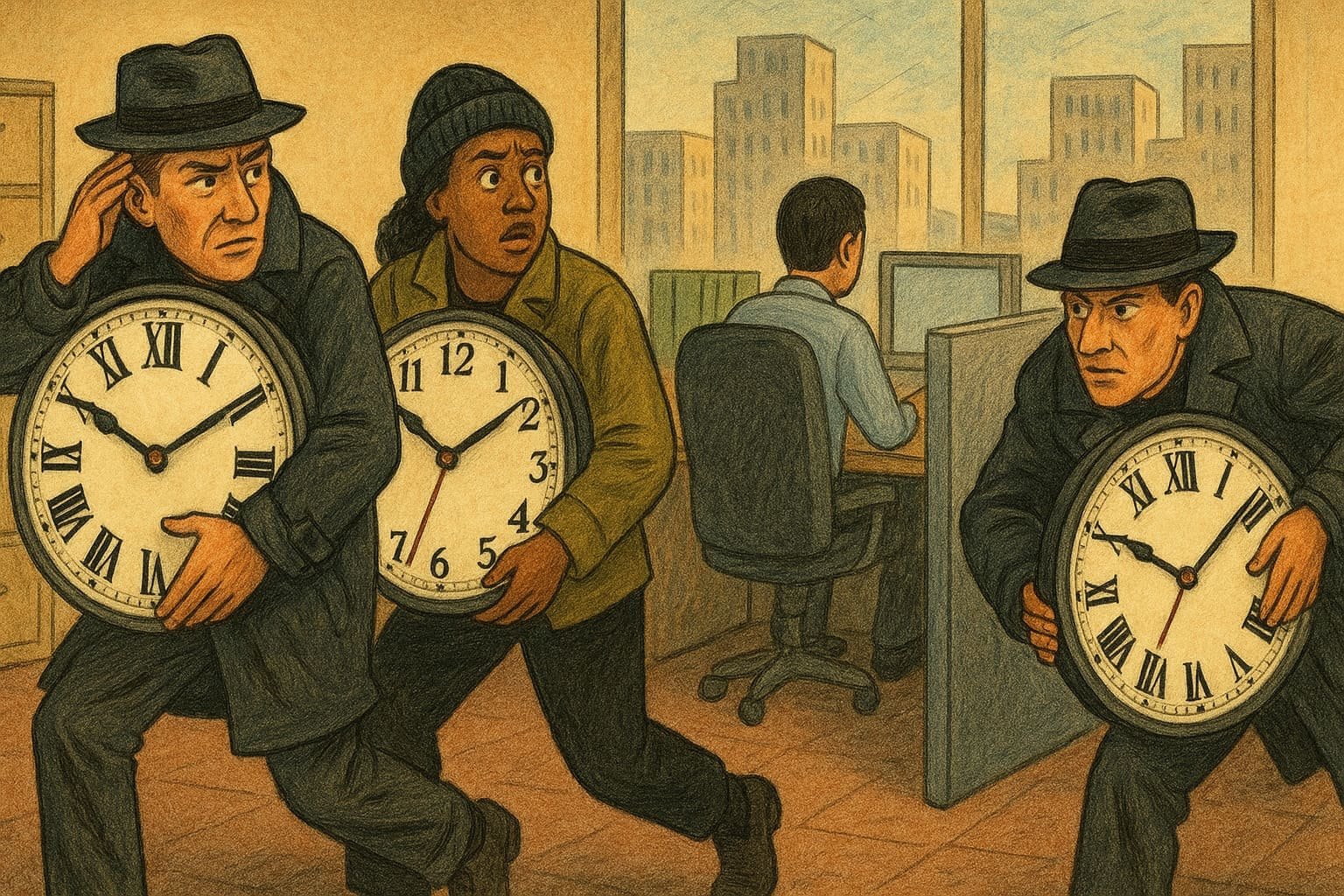
Beneath the polished surface of the corporate skyscraper, the real drama unfolds with the subtlety of a psychological thriller. The security cameras never catch the culprits, yet the evidence is everywhere: stolen glances at smartphones, hushed side conversations, and the slow drip of hours traded for nothing. Fluorescent lights buzz overhead, illuminating faces glued to screens, each one locked in a silent battle against boredom and distraction. People gather around digital campfires—Slack, Teams, email—passing stolen time from desk to desk, all under the watchful eye of invisible rules.
The most elaborate crime in modern business isn’t embezzlement, fraud, or espionage. It’s the theft of time, and everyone is both victim and perpetrator. Meetings expand to fill the day, morphing from “essential” to “never-ending,” as if talking about work is a kind of work itself. Office legends like Carla, who once scheduled a brainstorming session during lunch, are remembered not for ideas but for the creative ways they made hours disappear. The organization’s biggest expense, hidden in plain sight, isn’t salaries or software. It’s time, siphoned away by habits, culture, and systems that thrive on waste.
No alarms ever sound when a workday is lost to chasing approvals or refreshing inboxes. The guilty parties smile from every floor, camouflaged as “productive” colleagues. Even the coffee stains on the shared table tell a story of minutes poured down the drain. One day, someone might notice the missing hours, but by then, the crime is ancient history, and everyone is an accomplice.
This is the daily heist that shapes careers, defines cultures, and quietly rewrites lives. Step into the real story behind productivity, loyalty, and the corporate time thief hiding in plain sight.
Quick Notes
- Time Theft Isn’t What You Think: Time is stolen in tiny increments—pointless meetings, excessive emails, and busywork that serve nobody. It feels harmless, but multiplied across a team, it becomes a major cost.
- Everyone Plays a Role: Managers and employees alike contribute to time theft, often without meaning to. Leadership sets the tone, but employees shape the culture in small, everyday decisions.
- Technology Isn’t Always the Solution: Tools meant to save time can actually create more distractions. Notification overload and constant connectivity often drain more focus than they provide.
- Real Productivity Means Protecting Time: Top-performing companies treat time like cash: it’s budgeted, tracked, and fiercely guarded. Individuals who master this mindset find room for innovation, growth, and genuine satisfaction.
- You Hold the Power to Change: Change begins with noticing where time goes missing. Calling out time theft—your own and others’—creates a ripple effect that can transform teams, careers, and even entire organizations.
Time on Trial—How Everyday Moments Disappear
Every workday is a courtroom, and time stands accused. The judge is the calendar, the jury made up of reminders and notifications that never sleep. As the morning sun filters through half-open blinds, minutes vanish like coins in a magician’s hand. The defense offers endless justifications: “It was an urgent call,” “I had to check that update,” or “Someone might need me.” The prosecution, though, is relentless: where did all those precious hours go?
Office rituals disguise the heist. The stand-up meeting lasts an hour, with only five minutes of substance. People nod along, taking notes that will never be read, while the real decisions are made in private chats after the fact. Each “quick sync” becomes a small leak, dripping time onto the floor, never to be recovered. There’s no villain—just a thousand tiny distractions, each one dressed up as duty.
Case studies reveal the cost. At Berris Consulting, a rising star named Sofia was assigned to optimize workflows for a mid-sized retailer. She found entire afternoons lost to status meetings and redundant reports. Sofia ran a simple experiment: she canceled three recurring calls and gave that time back to her team. Within weeks, sales improved and people reported less stress. The change was so dramatic that the CEO declared “meeting bankruptcy” for the rest of the quarter.
Pop culture captures this farce, too. Michael Scott from The Office once scheduled a meeting to plan meetings, a joke that resonates in every real-life breakroom. The script is familiar: nobody wants to waste time, but nobody wants to challenge the status quo either. The clock ticks, the budget burns, and another day slips away unnoticed.
At the root, time theft is a cultural story. Companies teach people to equate motion with progress, and everyone learns to play along. “If you’re not in the loop, you’re out of the game,” says Ben, an HR manager at a fintech startup. But when everyone’s in every loop, real work never gets done. The cycle feeds itself, growing bolder with every unchecked hour.
Digital Smoke and Mirrors—Why Technology Makes Time Vanish
Workplaces invest in the latest apps, dashboards, and platforms, promising to turn time into gold. Yet, each new tool arrives with its own set of demands: new logins, notifications, and training sessions. The illusion of control grows as calendars fill up, but behind the screen, distraction rules. One moment you’re checking a project tracker; the next, you’re lost in a rabbit hole of chat threads and status updates.
Tech companies profit from your attention. Every alert, ping, and red bubble is engineered to keep you engaged—whether or not it serves your goals. Real productivity is buried beneath layers of interface, while your focus is auctioned off to the highest bidder. The result? Meetings multiply, deadlines slip, and teams spiral into chaos disguised as progress.
Jake, an IT specialist at Spark Digital, learned this the hard way. His team rolled out a new collaboration tool meant to “streamline workflow.” Instead, confusion reigned. People missed messages, files went missing, and the team spent more time troubleshooting than creating value. Jake finally suggested a radical move: disable all but two channels, set boundaries on notifications, and schedule tech-free hours. Performance rebounded, and morale soared.
The movie “Office Space” turned this chaos into comedy. Characters click through endless screens, trapped in a digital maze where the boss’s email is both lifeline and leash. The humor rings true because the pain is real: technology, meant to liberate, often enslaves.
When tech becomes the thief, only intentional habits can take back control. The question isn’t which app works best, but which ones deserve your attention at all. The battle for your time is fought not on the screen, but in the choices you make every minute.
Complicity in Crime—Why We Sabotage Our Own Time
Every employee carries a set of invisible lockpicks. You know how to make an hour disappear—scrolling, multitasking, or escaping into the comfort of busywork. Some call it procrastination, but it’s often deeper: a subtle rebellion against systems that undervalue attention. When rewards are tied to presence instead of outcomes, people learn to look busy instead of being productive.
Sabotage takes many forms. There’s the perfectionist who spends an entire day tweaking fonts on a slide deck nobody will see. The manager who creates tasks just to stay relevant. The well-meaning teammate who checks in “just to make sure” and steals your flow state in the process. These crimes are small but add up, leaving entire teams trapped in a loop of distraction.
Alexis, a customer service lead at CallFast, saw the effects firsthand. Her team prided itself on always being available, but response times grew longer as interruptions spiked. She realized that the “open door” policy was an invitation to chaos. By shifting to dedicated office hours and setting boundaries around her team’s time, Alexis reclaimed focus and improved results. Employees felt empowered, and customer satisfaction improved.
TV and social media idolize the multitasker—the one who can juggle emails, Zoom calls, and spreadsheets with a single hand. The reality is messier. Neuroscience shows that multitasking destroys focus and erodes memory, making even simple tasks harder. Yet the myth persists, fueled by a culture addicted to urgency.
Time theft, then, is a collective conspiracy. We steal from ourselves and each other, not out of malice, but because the system rewards the wrong behaviors. Recognizing this is the first step to breaking free and building a healthier, more humane workplace.
The True Cost—How Time Theft Kills Growth and Happiness
Every minute lost to distraction comes with a price tag. Companies bleed talent when people realize their work is meaningless or their time is wasted. Burnout follows, morale craters, and innovation withers in a desert of meetings and emails. The best employees quietly disengage, their energy drained by tasks nobody values.
The hidden cost surfaces when teams try to scale. At UrbanWorks, a design agency, growth stalled just as new clients rolled in. Founder Jenna Clarke dug into the numbers and found the culprit: time wasted in status updates and unstructured brainstorms. She cut nonessential meetings by half and tracked project hours in real time. Creativity returned, turnover fell, and the agency landed its biggest client yet.
The science supports what people feel. Chronic time theft leads to stress, fatigue, and mental overload. Teams lose their rhythm, and the joy of problem-solving fades. High performers look for exits, while those who remain feel trapped in cycles they cannot break.
Pop culture gets it, too. Movies like “The Devil Wears Prada” and “Up in the Air” show what happens when ambition eats every minute. The protagonists look successful on the outside, but inside, their lives are hollowed out by work that never ends. The most dangerous thief is the one nobody sees—the culture that normalizes constant urgency.
Taking time back is an act of rebellion. It demands courage from leaders, honesty from employees, and a shared belief that work should serve life, not the other way around. Only then can organizations thrive without sacrificing their soul.
Stealing Back the Hours—Practical Strategies for Reclaiming Your Day
Change starts with one question: “Where did the time go?” Track a single day, and the leaks become obvious—endless approvals, pointless pings, waiting for answers that never come. The first move is to set boundaries. Cancel a recurring meeting, silence unnecessary notifications, or carve out an hour for deep work without apology.
Successful organizations empower teams to protect their time. At Mediview Health, the CEO instituted “Focus Fridays”—no meetings, no emails, just quiet time for big projects. Results improved, and employees felt trusted to manage their own priorities. When teams see leadership respecting their time, a culture shift follows.
Small habits matter. Block your calendar for thinking, not just doing. Use “do not disturb” signals or set up physical cues to signal when focus is required. Share these practices openly so others feel permission to do the same. Over time, these signals become contagious, creating an environment where real work happens.
Don’t be afraid to question the status quo. If a tool wastes more time than it saves, retire it. If a process exists “because it always has,” challenge it. The bravest voices in any company are the ones that ask “why” and wait for a real answer. Every act of reclamation inspires others to do the same.
The ultimate strategy is self-respect. Value your own hours as fiercely as you value money, reputation, or success. When you become a steward of your time, others will follow. It’s not just a personal victory—it’s the spark that can ignite change throughout your entire workplace.
When the Last Second is Spent
A single office lamp glows in the midnight silence, casting long shadows across a boardroom now emptied of arguments and ambition. The air carries the residue of unspoken regrets and unfinished dreams. A forgotten planner sits on the table, its pages filled with meetings that led nowhere. The clock’s slow ticking is the only sound left, each second a silent witness to all that was lost and never reclaimed.
Through the glass, city lights flicker like distant promises, unreachable from the confines of routine. Somewhere on the twelfth floor, a worker stands frozen by the window, memories of missed dinners and fading laughter rising with the hum of the air conditioning. The building is quiet now, but the real noise—the torrent of hours given away without thought—echoes in every silent corridor.
There are no guards for time, no alarms to alert you when it slips through your hands. The crime is slow, polite, disguised as duty and devotion. Yet beneath the routine, a different story waits—one where courage replaces compliance and every minute becomes a treasure, not a transaction.
The bravest act is not to give more, but to take back what is already yours. Even the smallest rebellion—a canceled meeting, an hour of undisturbed thinking, a gentle “no” to busyness—can change the ending. The future belongs to those who protect their time with the same devotion they once gave away.
So answer honestly: If your life is a ledger, who is stealing the hours—and when will you call the crime by its real name?
