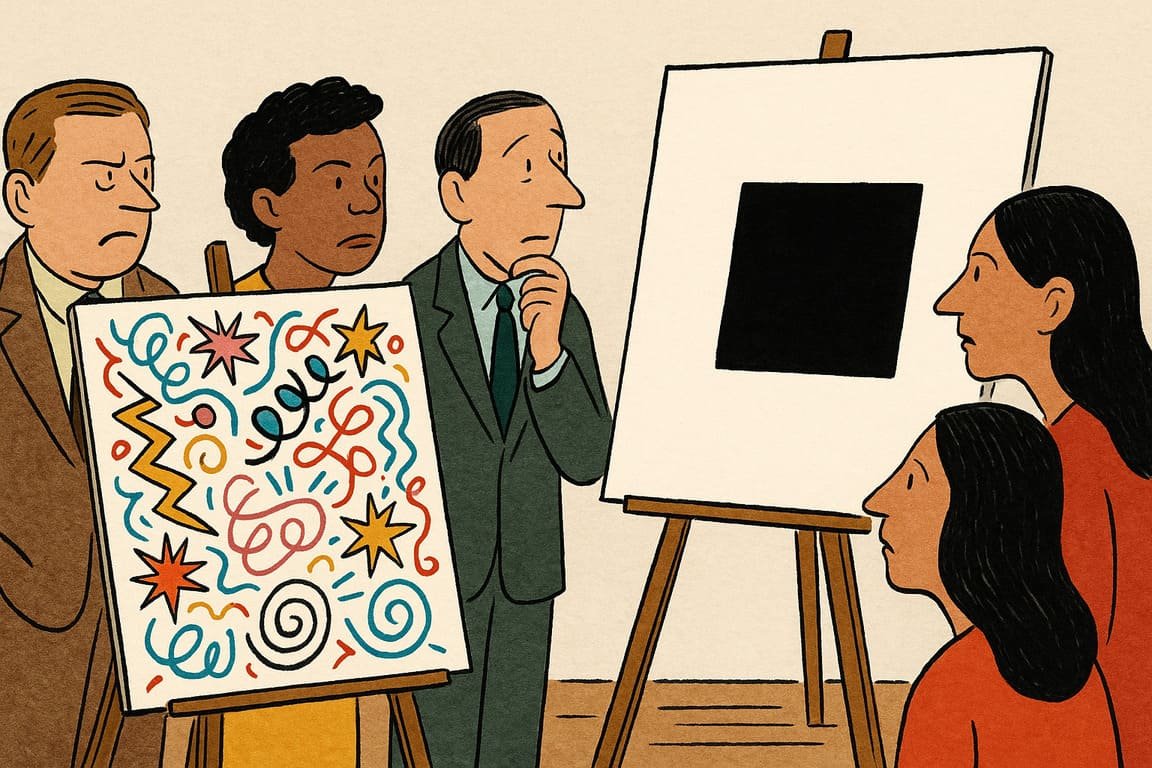
A lone billboard stands at the edge of a sleepless city, whispering a silent challenge. Its surface holds only a single word, black on white. The rush of traffic slows as faces turn, drivers reaching for meaning in the emptiness. That word, unadorned and raw, somehow drowns out the riot of neon and digital noise crowding every block. In this moment, simple design grips the modern mind with a force that a thousand glittering graphics cannot match. The message isn’t just visible; it’s unforgettable. A new obsession is born on that empty canvas: Less isn’t just more, it’s magnetic.
Behind glass doors, in a startup office where even the espresso machine is voice-activated, two founders argue over the homepage of their latest app. One votes for more banners, more color, more movement. The other strips it all away, leaving space and silence. The investors, jaded by cluttered pitches and sticky marketing decks, pause at the prototype. Their gaze lingers on the calm, on the quiet, on the confidence of restraint. Someone quotes Steve Jobs, but it’s the hush between slides that seals the deal.
A pastry chef in Paris, famous for desserts so ornate they trend on TikTok, spends her nights sketching a new recipe: flour, butter, salt, nothing else. At her next tasting, guests close their eyes and taste not sugar or spectacle, but memory and longing. She writes on her notepad, “Simplicity is the flavor that never fades.” The city’s critics agree. The most powerful designs, whether edible or digital, let the senses do the talking.
You can spot the champions of simple design everywhere once you start looking. A coffee cup with only a dot for a logo sparks conversation in crowded coworking spaces. People ask, “Who made this?” They take pictures, not because it’s loud, but because it feels rare. In a world of marketing screaming for attention, the quietest voice often lingers longest.
You probably know the sensation. You open an app, expecting a maze of options, but find yourself greeted by a single prompt: “What do you want to do?” Suddenly, your mind breathes. You don’t have to work to understand the interface. You feel seen. That invisible hand guiding you is the secret strength of minimalist design. The complexity isn’t missing; it’s hidden, buried deep, working behind the curtain so you can simply move forward.
Minimalism in design isn’t an accident. It’s a weapon forged through ruthless editing, painful choices, and the courage to trust the user. You want your brand to stick in someone’s mind, not their bookmarks. So you ask yourself: What is essential? What’s merely noise? Iconic brands—think Apple, Uniqlo, or Muji—built empires on ruthless subtraction. They know the world is already full. Your task is to carve out space, not fill it.
You don’t have to be a tech titan or a fashion mogul to benefit from simple design. Think of local bakeries with blank paper bags, indie musicians with single-color album covers, or non-profits with one-word slogans. The signal slices through the static. What’s left is memory. The best part? You get more freedom to tell your story, because your message isn’t fighting for air.
There’s a case study that lives in the halls of every design school. Google’s homepage, in its earliest days, looked almost unfinished compared to Yahoo’s sprawling portal. Critics called it bare, naive. But users found relief. The search box was an invitation, not a test. Google became the window to the web because it never made you stop and think about the window itself. In the battle for attention, simplicity became the most sophisticated weapon.
You might worry that stripping down your design means sacrificing personality or creativity. In truth, it’s the opposite. When every element must earn its place, creativity explodes within the boundaries. The world’s most influential album covers, from Pink Floyd to Kendrick Lamar, say everything with almost nothing. This is not silence. It’s the pulse beneath the noise.
One company that bet everything on simplicity is Basecamp. Their founders, Jason Fried and David Heinemeier Hansson, made careers out of saying no. No to new features, no to overwhelming dashboards, no to user fatigue. Their software became the antidote to complexity in a world obsessed with more. They write about the struggle: “You can’t fake simple. You have to fight for it.” Their cult following proves that clarity, not clutter, is what customers crave.
The science of simple design is more than visual. Psychologists talk about “cognitive load”—the mental effort required to process information. When you reduce clutter, you give people space to think, breathe, and act. That’s why hospital signage, subway maps, and emergency apps rely on the fewest elements. In the chaos of real life, simplicity saves time, attention, even lives.
You’ll see the contrarian power of simple design play out every time a new product launches with fanfare and fizzles out in confusion. Meanwhile, another quietly disrupts the market because it just works. The secret is out: the less you show, the more they remember. Legendary ad man David Ogilvy put it bluntly: “If it doesn’t sell, it isn’t creative.” Simple design sells because it doesn’t beg. It belongs.
The urge to add “just one more thing” is a universal temptation, but restraint is what separates the signal from the static. The world isn’t looking for more information—it’s begging for less noise. That’s the punchline: Simplicity wins, not by being basic, but by being brave. Are you bold enough to trust it?
Under a single fluorescent bulb in a forgotten office, a team stares at a blank whiteboard. There are no bullet points, no timelines, no color-coded charts. Someone inhales, the dry-erase marker hovers. Every possibility exists in the emptiness, but it’s the act of leaving space that inspires real awe. A single word, finally chosen, lands like a revolution. They realize the blankness is not absence, but potential. It’s not about what is removed, but what remains—unforgettable.
One designer, years later, will say the most important thing she ever learned was when to stop. She tells her students to listen for the hush in a room after a bold idea is spoken, to notice the way a single phrase can outshine a page of clever copy. In that quiet, the real work of design begins.
The city outside continues its noisy dance, but within that empty space, clarity is a force of nature. The world will keep asking for more, faster, louder. The true revolution waits in the discipline to say no. In a landscape painted with excess, the canvas left blank becomes an act of genius.
You are not forgotten by simplicity. You are the reason for it. So here’s your mirror: Are you willing to be the voice that stuns by saying less? Or will you vanish in the crowd that always shouts for more?
