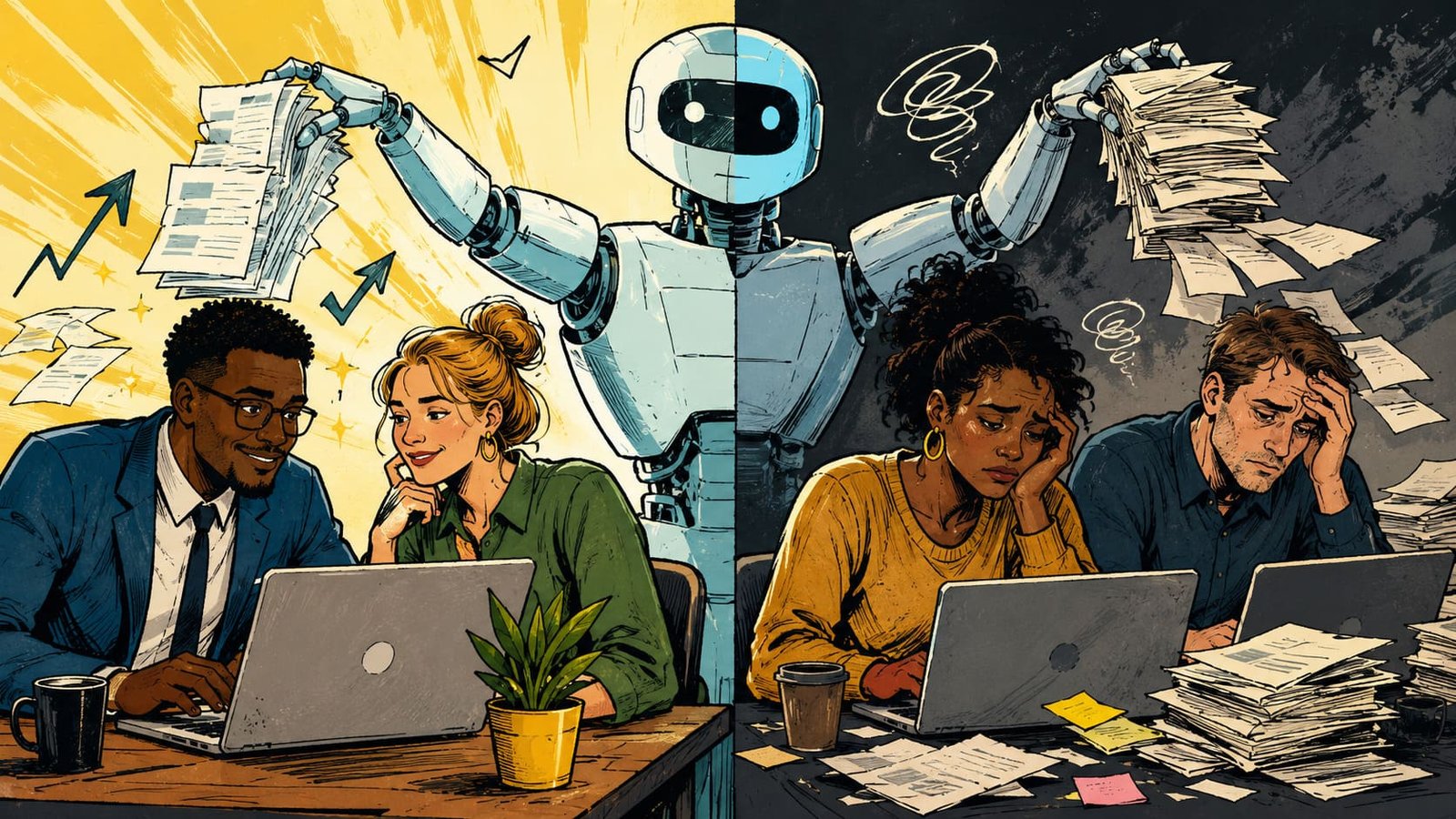
Steel doors slide open inside a spotless research laboratory where silent machines finish tasks before tired employees reach their desks. Coffee cools untouched while glowing dashboards celebrate another record for efficiency, yet uneasy faces betray a different story unfolding beneath impressive performance charts. Progress rarely arrives wearing a warning label. Artificial intelligence has become business history’s fastest productivity engine, but every remarkable leap forward now carries a quieter question that spreadsheets alone cannot answer: what invisible price accompanies astonishing speed?
Organisations celebrate automation because results often arrive faster, costs shrink, and routine work disappears with astonishing consistency. Those gains deserve recognition, yet they reveal only part of a far more complicated picture. Microsoft has woven artificial intelligence across productivity software, while Amazon continues expanding automation throughout fulfilment operations, showing how digital systems can accelerate work without pausing for fatigue or distraction. Impressive achievements deserve applause, but thoughtful leaders also ask whether rising efficiency strengthens human capability or merely disguises new forms of dependence.
Consider Maya, a customer support specialist whose daily workload once demanded constant multitasking and emotional resilience. Artificial intelligence began drafting replies, summarising conversations, and suggesting practical solutions, leaving her more time for difficult customer relationships that required patience instead of speed. Relief arrived first. Months later she quietly admitted that fewer opportunities to think through complicated problems had slowly weakened her confidence, creating an unexpected dependence on software that seemed designed to empower rather than replace thoughtful judgement.
A similar pattern appears inside research environments where artificial intelligence accelerates discovery without eliminating the need for human interpretation. Pharmaceutical companies increasingly rely on machine learning to identify promising drug candidates faster than traditional laboratory screening, shortening early research cycles while leaving scientists responsible for testing, validating, and challenging every promising result. That distinction matters deeply. Evidence becomes meaningful only when experienced researchers question assumptions, investigate anomalies, and recognise subtle patterns that algorithms cannot fully explain without thoughtful human oversight.
History repeatedly shows that technological revolutions reward societies capable of adapting institutions alongside innovation. During earlier industrial transformations, productivity expanded dramatically, yet education, labour protections, and management practices required years of adjustment before broader prosperity emerged. Artificial intelligence presents a remarkably similar challenge, though its pace compresses decisions that previously unfolded across generations. Businesses investing equally in continuous learning, ethical governance, and human judgement appear better positioned to create resilience than organisations pursuing efficiency alone as their ultimate competitive advantage.
Rain taps steadily against office windows while glowing monitors continue processing requests long after evening conversations have faded into memory. Numbers still look impressive, yet another measure quietly waits beneath every performance report, asking whether stronger organisations are also producing wiser people capable of independent judgement. That question refuses easy answers. Real progress will never belong to machines alone, because every breakthrough ultimately depends upon human curiosity, ethical courage, and a willingness to decide what kind of future deserves to be built before technology builds it instead.
