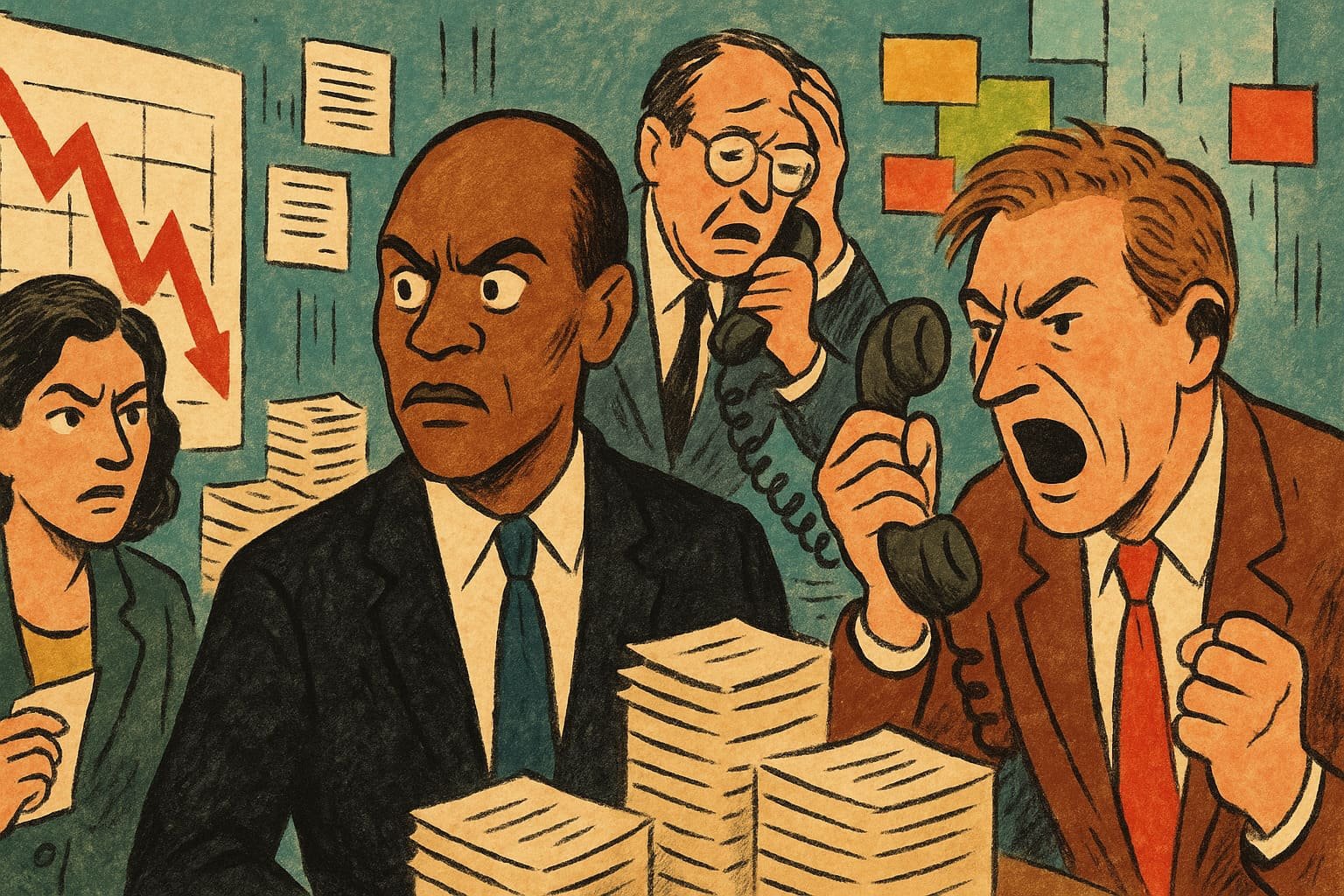
In the neon-lit maze of a twenty-four-hour trading floor, a thousand minds flicker across a wall of screens. Monitors spit out charts, notifications, and urgent reminders while the hum of caffeine and anxiety fills the air. Traders swap jokes about “losing their edge,” yet every glance at the glowing graphs reveals a truth nobody will voice. Here, the greatest commodity is not gold or tech stocks, but the battered currency of human attention. Every moment, another bid: your focus, up for grabs.
A junior analyst named Victor slumps at his terminal, hands trembling as market alerts pile up. His supervisor, Mona, strides past, phone glued to her ear, snapping, “Ignore the noise, find the signal!” The noise, of course, is relentless—screaming headlines, TikTok trends, a thousand digital voices tugging at every neuron. Mona’s mantra is simple: control your attention, or the market will strip you bare. Victor wishes he could.
The canteen echoes with stories. A crypto investor boasts about “multiplying mindshare,” turning distraction into dollars. A risk manager jokes about meditation apps as “portfolio insurance.” Even the janitor, sweeping up shredded reports, shakes his head at the chaos. The real winners aren’t those with the sharpest minds, but those who defend their focus like it’s their last breath.
A digital clock ticks toward midnight. A CEO, isolated in her corner office, watches her team unravel as deadlines crash into distractions. She wonders: are they trading talent for dopamine hits? Her own calendar brims with meetings that never end, messages that never rest. The market is always open, and so is her mind—until, inevitably, it isn’t.
In this arena, the only law is brutal: pay with your focus, or someone else will spend it for you. The stakes are not just wealth, but sanity. Every mind is an exchange, every thought a currency, every distraction a costly trade. Welcome to the Mind Market. The opening bell never rings, because it never stops.
Quick Notes
- Your Focus Is Currency: Every minute you spend online or in meetings is an investment. The best returns go to those who guard their attention.
- Distraction Is Expensive: Multitasking, endless notifications, and digital noise bleed value from your day. You pay with time and never get a refund.
- Winners Master Mindset: Leaders, founders, and creators win by setting ruthless boundaries. Their mental energy is never up for auction.
- Scarcity Powers Productivity: Fewer choices and clear goals create leverage. Focused teams produce more than frantic ones chasing every new trend.
- Protect Your Exchange Rate: Burnout, fatigue, and digital addiction devalue your mind. Rest, clarity, and discipline strengthen your internal economy.
Auctioned Minds—How Attention Became the Hottest Commodity
Digital screens never sleep. Every ping and pop-up is a trader’s shout across the marketplace, calling for your eyes, your time, your soul. Tech giants know the game. They hire neuroscientists and designers to craft infinite feeds, addicting loops, and irresistible “one more scroll” traps. In their world, engagement is profit, and your distracted mind is their margin.
A true story: Sarah, a product manager at a rising startup, launched a new app designed to “capture micro-moments.” Her team cheered as daily active users soared, but Sarah felt a chill. Each spike in metrics meant another mind lost to the vortex. She confided in a colleague, “Are we selling value—or just mining attention?” That question haunted her, even as the app topped the charts.
In the financial sector, attention arbitrage is a daily hustle. Hedge fund managers race to slice through the fog of data, searching for the one signal in a sea of noise. Their edge isn’t raw intellect, but an almost monastic devotion to filtering out distraction. Those who fail lose not just money, but their grasp on reality. The market rewards discipline, not genius.
Advertising agencies auction your thoughts with ruthless efficiency. They design campaigns that break your train of thought, then insert a new desire in its place. “You’re not the customer,” a grizzled creative director once told a new hire. “You’re the product. Sell well.” That’s the brutal truth of this trade: the marketplace never bargains, it only takes.
Focus itself has become a flex. Executives pay thousands for “deep work” retreats, hoping to buy back the discipline their environment destroys. Productivity gurus promise hacks and shortcuts, but the only real shortcut is saying no—to noise, to FOMO, to the never-ending auctions for your mind.
Scarcity Economics—Why Your Focus Is Worth More Than Gold
The Mind Market rewards the scarce. Unlimited choice breeds paralysis, while constraint unlocks genius. Elite athletes and chess grandmasters know this well. They design routines that minimize friction, automate the mundane, and reserve mental energy for the big moves. That’s not luck—it’s strategy.
A legendary tale from the world of finance tells of Lena, a fund manager who banned smartphones during critical meetings. Her team complained until they closed their biggest deal of the year, undistracted by the noise outside. Lena called it “attention discipline.” Others called it “old school.” Either way, the results spoke for themselves.
Economists point to “opportunity cost” as the core of every decision. Every moment spent on trivia is a moment lost from your life’s work. The price of distraction is invisible, but devastating. One project manager recalled missing a multi-million-dollar deadline because a “quick check” on email spiraled into hours of lost focus. The lesson stuck: every glance is a trade.
Scarcity builds momentum. Startups with tiny teams and limited budgets often out-innovate giant corporations, not because they have more talent, but because they have fewer distractions. Their vision is laser-sharp. They’re too busy surviving to waste attention on what doesn’t matter.
The paradox? You live in an age of abundance, but those who manufacture scarcity—of time, energy, access—are the ones who thrive. If you treat your focus like gold, you’ll outlast those who trade it away for shiny distractions.
The Cost of Chaos—Distraction as the Silent Tax on Ambition
Every lost minute is a hidden fee. The real price of distraction is not just wasted time, but dreams that never launch and goals that quietly dissolve. Think of Amir, a rising star at a consulting firm, who prided himself on multitasking. His phone buzzed nonstop, his Slack never stopped pinging. On paper, he looked productive. In reality, his progress stalled. His big ideas stayed trapped in half-finished slides.
Distraction multiplies like compound interest, quietly eroding your edge. Research from high-performing companies shows that teams who check email less often finish projects faster. It’s not about working harder, but clearing space to think deeply. A lead designer at a gaming studio confessed: “I do my best work before anyone else wakes up, when my mind is mine alone.” That window was sacred, unbroken by digital noise.
Managers fall for the illusion that busyness equals value. Schedules become crowded with status updates, brainstorming sessions, and “quick syncs.” Each meeting chips away at the reservoir of creative energy. A veteran HR director quipped, “We’re drowning in communication but starving for meaning.” In the Mind Market, more is not always better.
The hidden tax of distraction also shows up as fatigue. People end the day exhausted, unsure what they achieved. Burnout creeps in when the mind is never allowed to settle, always flickering from one demand to another. The economy of attention is ruthless: those who cannot defend their focus eventually crash.
There is a rebellion brewing. Startups are experimenting with “focus Fridays,” companies install “deep work” blocks, and individuals reclaim time with ruthless do-not-disturb boundaries. The cost of chaos is high, but so is the payoff for those who refuse to pay.
Ruthless Focus—The Competitive Advantage Nobody Talks About
Winners in the Mind Market don’t chase every opportunity. They double down on a single goal, cut distractions, and guard their mental bandwidth like it’s sacred. Steve, a software developer, turned off all notifications for a month. His productivity soared, but so did his satisfaction. He found joy not in finishing more, but in finishing well.
Elite leaders craft rituals to protect their edge. Morning routines, digital sabbaths, and even “focus contracts” with coworkers become shields against the chaos. One executive, Maria, famously declined every meeting without an agenda. Her peers thought she was arrogant. Yet, her team delivered projects faster than anyone else.
Clarity of focus leads to clarity of purpose. Artists, athletes, and entrepreneurs all know the magic of entering “the zone.” The world fades, time distorts, and work flows. That state is not accidental—it’s engineered by eliminating distractions before they arise.
Competition is fierce. Those who scatter their attention thinly lose to those who harness it fully. In a viral case, a small online retailer beat industry giants by limiting SKUs and perfecting a single product line. Their secret wasn’t scale, but attention to detail. Customers noticed, and loyalty followed.
You might think the world rewards multitaskers and hustlers. The truth? The future belongs to those who defend their mind’s bandwidth with ruthless intent. In the Mind Market, scarcity is power and clarity is king.
Building Your Fortress—How to Defend Your Most Valuable Asset
Turning focus into a fortress is not about force—it’s about design. High performers create environments that make distraction impossible. One biotech founder, Eva, designed her office with no Wi-Fi, just to force her team to finish deep work before logging online. At first, people rebelled. Soon, the results spoke: breakthroughs multiplied.
Rest is underrated. The most successful investors schedule blank hours for reflection, treating them as seriously as board meetings. During one downturn, a legendary hedge fund manager walked the city streets for hours, sorting complex problems in his head while the world chased headlines. His calm mind spotted opportunities others missed.
Guarding your attention also means saying no—often, loudly. Legendary product designer Kenji tells his interns, “Delete your inbox if you want to change the world.” Ruthless? Maybe. Effective? Absolutely. Scarcity drives value, and boundaries create freedom.
Recovery is not weakness. Breaks, walks, even naps recharge mental reserves. Companies with mandatory rest periods find their teams bounce back stronger, not weaker. A coffee brand’s CEO insisted on “quiet hours” at the office, banning meetings for two hours every day. Productivity and morale soared.
Your mind is an asset, not a battlefield. Build routines that guard it, relationships that respect it, and spaces that nurture it. The Mind Market is always open, but your focus doesn’t have to be for sale.
When the Auctioneer Falls Silent
Moonlight cuts through the blinds of an empty corner office, casting sharp lines across an abandoned desk. Folders lie untouched, while a single lamp flickers against the silence. All the emails, the alarms, the never-ending rush have faded to nothing. There, a leader sits, shoulders hunched, staring into the quiet. For once, no screens demand, no alerts intrude, no deadlines loom. Just the slow, steady breath of a mind at peace.
On the far side of the glass, city lights blink like distant invitations—opportunities always knocking, always tempting. Yet tonight, none are answered. The market of minds has closed for now, the noise replaced by the soft hum of reflection. An old notebook rests in the leader’s lap, pages blank, waiting for a new kind of value: ideas born not of chaos, but of calm.
Somewhere below, the janitor whistles, sweeping away the day’s debris. The last trades of focus and attention have been made. What remains is more precious than any bid: the unclaimed space for something real to grow.
Only one thought remains, echoing through the hush, sharper than any closing bell:
You decide what your attention is worth—so will you sell it cheap, or hold out for something priceless?
