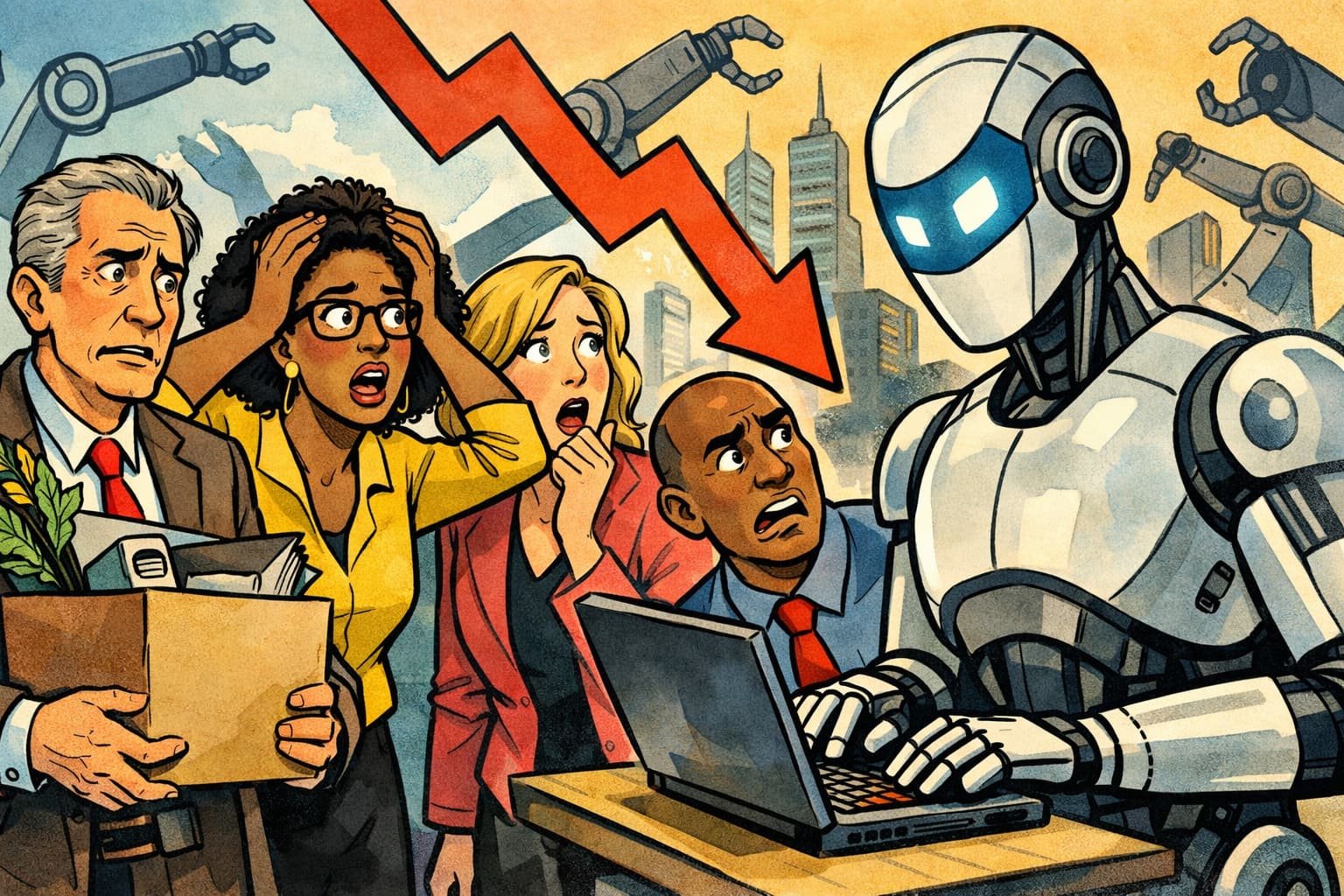
Curtains lifted on another ordinary workday, yet every glowing monitor carried an invisible countdown that nobody could see. Coffee cooled beside untouched keyboards while conversations drifted from promotions to survival, not because businesses had suddenly become cruel, but because a new competitor never asked for weekends, overtime, or sleep. Every click echoed with quiet urgency. Careers once considered secure now faced uncomfortable questions, forcing executives, graduates, accountants, and factory supervisors alike to confront an unsettling possibility that technological progress could reshape employment faster than human expectations could adapt.
Conversations about artificial intelligence often collapse into dramatic headlines predicting either paradise or catastrophe. Reality refuses either script. Businesses adopt automation because financial pressure rewards efficiency, lower operating costs, faster decision making, and stronger margins. That economic logic matters more than excitement. History repeatedly shows organizations replacing expensive processes whenever practical alternatives emerge. During earlier industrial revolutions, machinery transformed agriculture and manufacturing. Today’s transformation reaches offices instead, challenging analysts, marketers, legal assistants, customer support teams, and even software developers whose routine responsibilities increasingly resemble structured instructions that intelligent systems execute remarkably well.
Microsoft, Alphabet, and Salesforce have all expanded artificial intelligence throughout their operations while encouraging employees to focus on higher-value work requiring judgment, creativity, negotiation, and leadership. Their experiences reveal an important distinction. Automation rarely removes entire professions overnight. Instead, repetitive activities disappear first. Consider Elena, a finance analyst who spent countless evenings preparing monthly reconciliations. After her employer introduced automated accounting tools, those reports finished before lunch. Anxiety quickly became opportunity because she redirected attention toward forecasting cash flow, advising executives, and evaluating investments that software alone could not confidently interpret.
Accounting illustrates this transition particularly well because financial reporting depends upon precision, compliance, and consistent processes. Automated bookkeeping now completes transactions that once occupied junior accountants throughout entire weeks. Yet experienced professionals remain essential when interpreting complex regulations, managing audits, evaluating business risks, or explaining uncertain market conditions to anxious investors. Similar patterns appear across banking. JPMorgan Chase uses artificial intelligence to accelerate document review while experienced bankers continue making lending decisions requiring commercial judgment, relationship building, and contextual understanding that extends beyond numerical calculations captured inside financial statements.
Economic consequences stretch further than individual careers because productivity gains rarely distribute benefits evenly across society. Companies often capture larger profits before wage growth reflects increased efficiency, creating tension between shareholders and workers. Economists describe this as uneven productivity distribution rather than universal prosperity. Factory owner Malik celebrated record earnings after automating inventory management, yet warehouse employees worried about reduced overtime opportunities. Both experiences were genuine. Financial success for organizations does not automatically translate into stronger household security unless investment, retraining, education, and policy evolve alongside technological capability.
Flickering elevator displays reflected unfamiliar faces carrying laptops toward another strategy meeting where tomorrow’s workforce quietly took shape through ordinary business decisions rather than dramatic announcements. Employment has never been frozen in time. Every generation inherits new tools, loses familiar routines, and discovers unexpected opportunities hidden beneath uncomfortable disruption. Artificial intelligence follows that timeless economic pattern while moving with unprecedented speed. Careers will not disappear simply because machines become smarter. Careers vanish whenever curiosity stops growing before change does. Are your skills becoming more valuable, or merely more familiar?
