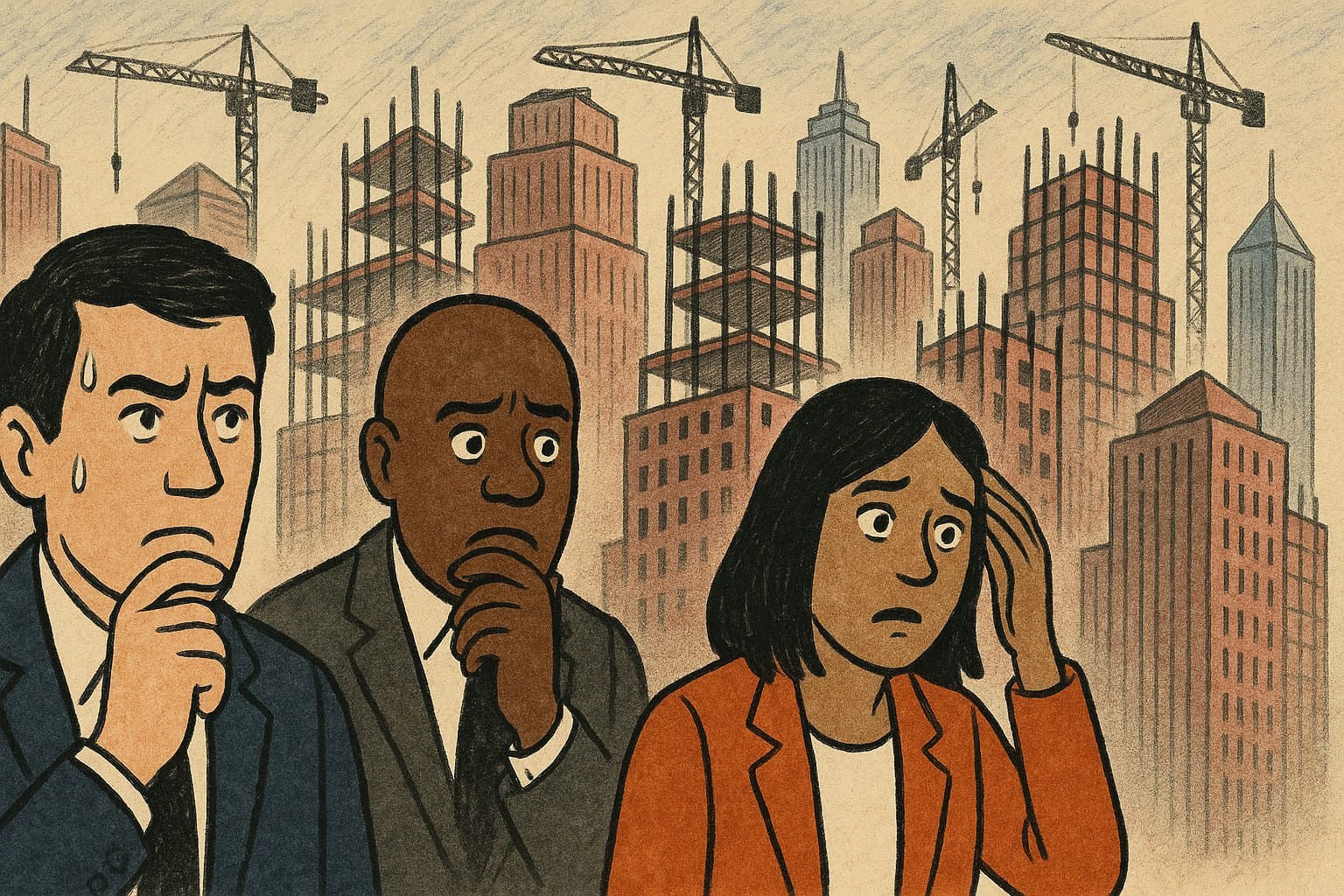
It always starts in a room buzzing with borrowed energy. Lights flicker overhead while the smell of burnt coffee rides the air, circling like a bored vulture. On a glass table sits a laptop, crusted with fingerprints, pulsing notifications from Slack, and a spreadsheet named “Unicorn Roadmap – Final FINAL.” The founder’s pulse thuds with the rhythm of an auctioneer selling dreams at a midnight market. Everyone around her is nodding, grinning, clapping, each face polished with faith or the fear of being caught doubting.
Phones light up as tweets fly: “World-changing,” “Legendary launch,” “The next big thing.” No one here believes a word of it, but the applause is deafening. Behind each cheer, a sliver of dread slices through—the kind that hides behind every monster pitch and viral thread. Underneath every “we did it” post, there’s a trapdoor creaking open. And every empire, no matter how dazzling, stands on a secret: the higher you build, the bigger the doubt that claws at the foundations.
Somewhere, a junior engineer named Jonah shuffles between monitors, refreshing his inbox for code review approvals that never come. He recalls his last job, where nobody pretended to “disrupt everything.” Here, the only thing truly getting disrupted is his sleep. Outside, the city yawns, indifferent. On the street below, food delivery drivers line up, each scrolling through the same gig apps, caught in their own hustle loops. The empire is humming. Every fluorescent-lit window promises a story—ambition, envy, betrayal, and always, the low drumbeat of imposter syndrome growing louder as the tower climbs higher.
It’s no accident that the biggest startup myths are minted in glass towers where no one can see the cracks until the sun hits just right. The world worships these builders: the ones who never sleep, who devour risk, who “fake it till they make it.” But no one warns you how fake it can feel to wake up, check your bank balance, and realize your self-worth is just another pitch deck slide. “Build big, doubt bigger,” whispers the city, never blinking, always hungry for the next confession.
Quick Notes
- Imposter Syndrome Is the Shadow of Success: Every leader in a glass tower secretly wonders if they’re a fraud. Even the most confident mask is stitched together from fear, ambition, and clever bluffing.
- The More You Build, the More You Doubt: Scaling your empire isn’t a cure. It amplifies your inner critic, multiplying anxiety with every investor call, product launch, or viral feature.
- Fake It Till You Break It: Startup culture celebrates bluffing, but relentless posing poisons teams, stokes burnout, and quietly kills trust.
- No One Escapes Alone: Stories of resilience are usually stories of support—mentors, partners, rivals, or anonymous users in online forums who become lifelines when the curtain slips.
- Your Doubt Is the Real Empire: Embrace it, shape it, let it fuel your growth. The difference between collapse and comeback is learning to dance with uncertainty instead of running from it.
The Echo Chamber of Nearly Famous
Founders wear their smiles like battle armor. You scroll through your feed, counting the wins: funding rounds, press hits, features. But behind the curtain, those very people replay their mistakes at midnight, eyes glued to Slack, desperate for evidence they’re not out of their depth. The most dangerous addiction in the startup world is external validation. Each retweet soothes for a minute, then the emptiness creeps back.
Every team meeting is a performance. You deliver your metrics with a steady voice, but the numbers feel slippery, like trying to hold fog in your hands. There’s a secret competition at every office: who can act the busiest, sound the smartest, seem the least rattled by the chaos. “Did you see that Stripe update?” someone asks, masking uncertainty with Silicon Valley banter. Real power in these rooms is not knowledge, but confidence—real or feigned.
You remember the story of Alice Zhou, a young founder who launched a celebrated AI startup and landed a magazine cover before the product even worked. Her photo went viral. Inside, she worried her team would soon uncover that she barely understood half the code. Alice kept building anyway, hoping no one would notice the scaffolding behind the marble. Years later, her biggest lesson wasn’t about AI, but about living with chronic doubt. In her words: “Every big launch made me feel smaller, like I was growing backwards in my own story.”
This is not unique. Everyone who builds anything worth talking about secretly wonders when they’ll be found out. The conference badge, the speaking slot, the investor handshake—none of it cures the itch of self-doubt. Sometimes the most gifted founders are the ones who’ve mastered the art of acting as if they belong, while quietly questioning everything.
One night, in a windowless coworking room, you overhear a product manager confess to a teammate: “I Google half the stuff I pretend to know.” Laughter breaks the tension, and suddenly, the room feels lighter. It’s not the success that binds people together, but the willingness to admit how shaky the ladder really is. There’s magic in that moment—raw, messy, human. You realize the biggest fraud is the myth that everyone else has it figured out.
Building on Shaky Ground: Why Doubt Grows as You Rise
Growing your startup feels like sprinting up a down escalator. Every win pulls you up, but the doubts gather like rainclouds at your heels. The higher you climb, the more people look up, expecting you to have answers, vision, clarity. That’s when the little voice in your head gets louder. “Are you sure you belong here?” it whispers during investor calls and demo days.
Imposter syndrome isn’t a phase. It’s a parasite that adapts, learning your new tricks as you level up. You finish a major project, sign a big deal, or get glowing reviews—and your inner skeptic scoffs: “Lucky break. Try doing it again.” The voice finds new angles, new evidence, always updating its playbook. For every milestone, there’s a matching moment of panic: “What if this is the peak?”
Consider Raj Malhotra, who built a fintech company that reshaped how small businesses access credit. At every stage—seed, Series A, IPO—he told his story, inspired his team, and wore the founder’s mask. Privately, Raj battled insomnia, plagued by the fear that his entire narrative was built on sand. After a turbulent board meeting, he admitted to a friend: “Success is just a ladder. Each step up, I feel the rungs getting thinner.” That honesty saved him from burning out, and his company survived, not because he conquered doubt, but because he learned to coexist with it.
If you think building bigger will finally quiet the voice, you’re in for a surprise. Doubt grows in the shadows of growth. Teams get larger, problems more complex, the stakes skyrocket. With each hire, each round, you become the main character in a play you’re terrified to flub. Your confidence, like startup equity, gets diluted unless you guard it with care.
The dangerous trick is pretending you’re immune. Those who boast the loudest, who mock the doubters, usually have the most to hide. Healthy empires allow room for uncertainty. The ones that fall are often the ones built on forced bravado, where no one dares admit fear until it’s too late.
Doubt, when acknowledged, can be a gift. It pushes you to ask better questions, to stay humble, to surround yourself with real partners, not just cheerleaders. The smartest leaders learn to welcome uncertainty like an old friend, using it as a compass rather than a curse. The empire you build inside—the one that knows its own shadows—is the only one that lasts.
The Bluff Economy: How “Fake It Till You Make It” Fuels Collapse
Startup lore is filled with swagger. Elevator pitches, demo days, “move fast, break things.” The subtext: never let them see you sweat. Every founder is coached to act as if the revolution is already here, even if the servers are crashing behind the scenes. This is the bluff economy, and its currency is confidence.
You have seen it. Founders talk about “hockey stick growth” as if they have already mapped the path, even while the metrics point the other way. Teams hear mantras about “crushing it,” when, in truth, the wheels are barely attached. The myth becomes self-sustaining. “Fake it till you make it” is printed on mugs and conference swag, treated as gospel. The unspoken rule: show doubt, and you lose your seat.
Take the story of Gloria Kim, who ran a SaaS startup out of her Brooklyn apartment. She faked demos with mocked-up screens, pitched partnerships before code existed, and spun tales of “soon-to-be-released” features to secure early adopters. It worked for a while. The press bought the dream. Investors circled. Inside, Gloria felt the anxiety rising, her imposter syndrome morphing into a full-blown identity crisis. When the tech finally caught up with her story, she felt relief, not triumph—a sobering moment of truth.
Bluffing is dangerous, not because it always leads to fraud, but because it warps the culture. Team members become actors, hiding concerns, ignoring bugs, chasing applause over progress. Burnout follows, then the exodus. “We all believed the myth,” confided a developer after Gloria’s company almost collapsed, “because it felt better than the alternative.” The real price is trust, which, once lost, rarely returns.
The greatest trick in the bluff economy is making everyone complicit. Investors, employees, even customers buy in, each hoping to ride the wave. When things unravel, the shock is not that the dream failed, but that nobody said anything sooner. Faking it may get you through the door, but only honesty keeps you in the room.
Honest storytelling has become the new luxury in the startup world. Empires built on bluffs are always an earthquake away from collapse. The antidote? Vulnerability, transparency, the courage to say “I don’t know.” The next era of building will belong to those who can own their doubts as much as their dreams.
Survivors’ Club: No Empire Is Built Alone
Every empire, no matter how grand, is propped up by a cast of characters—mentors, cofounders, rivals, even the quiet users whose feedback rewrites the script. The myth of the solo genius is just another ghost story whispered over bad wine in WeWork kitchens. Success, when it arrives, is communal, not singular.
Support comes in unexpected forms. A friend’s late-night text, a parent’s offhand wisdom, or a stranger’s thoughtful comment on your product forum. In startup lore, there’s the tale of Marcus Reed, whose app sputtered on launch. A user named Sarah found a critical bug, then sent a heartfelt message: “Keep going. I believe in this.” That note became a lifeline. Marcus shared it with his team, taping it to the office wall. “It’s the only reason we didn’t quit,” he later admitted at a panel.
Communities form in the cracks between ambition and anxiety. Founders who share their missteps attract allies who bring truth, not just applause. When doubt looms, the best teams huddle closer, swapping war stories, swapping memes, holding space for each other’s breakdowns. The empire becomes less a monument, more a mosaic.
There’s no shame in needing support. Every great founder from Bezos to Rihanna leans on teams, advisors, and unknown believers. The strongest entrepreneurs cultivate vulnerability alongside grit, building cultures where dissent is safe and laughter is not a luxury but a lifeline.
Loneliness is the silent killer in the world of building. The story of every survivor is a story of unexpected hands reaching in the dark. Building together isn’t weakness. It’s the only insurance policy that matters when the lights flicker and the empire shakes.
The Paradox Throne: Making Doubt Your Crown
The secret to outlasting imposter syndrome is not erasing it but wearing it with pride. Doubt, if harnessed, can become a founder’s greatest strategic asset. It keeps you honest, humble, and always searching for blind spots. The trick is to make the empire inside your head as strong as the one you build for the world.
Look at the arc of Michelle Suarez, a founder who spun her eco-commerce brand out of her kitchen. Michelle battled waves of panic every time the brand landed a magazine mention. She once told her COO, “If I ever stop worrying, that’s when we’re in trouble.” Over time, Michelle taught her team to treat doubt as a question, not an accusation: “How can we prove we’re the real thing?” became their rallying cry. The result: a company that learned faster, iterated harder, and never coasted on hype.
This is the paradox throne. Every great builder sits atop a pile of worries, watching both the horizon and the cracks at their feet. The truly legendary don’t conquer fear—they befriend it, using its sharp edge to cut through delusion. Empires that last are led by founders who confess uncertainty, invite feedback, and find meaning in the mess.
People crave certainty, but the world changes too quickly to offer guarantees. The real legacy of your work is not perfection, but resilience—the ability to dance with doubt, turn it into fuel, and teach your team to do the same. Your empire is not what you build, but what you survive.
Legacy isn’t measured in headcount or headlines. It’s carved in the stories people tell when the lights are out and the crowd is gone. Make yours a story of struggle, truth, and the courage to sit with uncertainty and keep building anyway.
Empire of Glass: The Doubt That Saves You
Somewhere, far above the city’s glow, the founder sits in a quiet office lined with floor-to-ceiling windows. Glass towers shimmer with distant reflections, each pane a mirror for ambitions and regrets. The world below hums with stories—launches, layoffs, second chances, silent tears. Her empire looks flawless from here, every angle calculated, every shadow erased by curated light. Yet, when the room empties and the city quiets, the old doubt returns, soft and familiar.
Hands rest on the desk, trembling just enough to betray the cost of pretending. Moonlight paints the blueprints, the P&Ls, the thank-you notes from customers who never knew about the midnight panic attacks. Every surface glimmers with a different kind of truth. The founder breathes in, heart beating louder than any applause, and remembers that every empire worth building is born in fear and finished in hope.
In another window, a junior engineer wipes sleep from his eyes, reading a late-night Slack message from the founder: “We don’t have all the answers, but we have each other.” The words are simple, but they slice through the darkness, holding the pieces together for one more day.
You are not alone in your doubt. You are the architect of its transformation.
So ask yourself: Will your empire be the fortress you hide in, or the beacon that lights the way for others lost in the fog?
