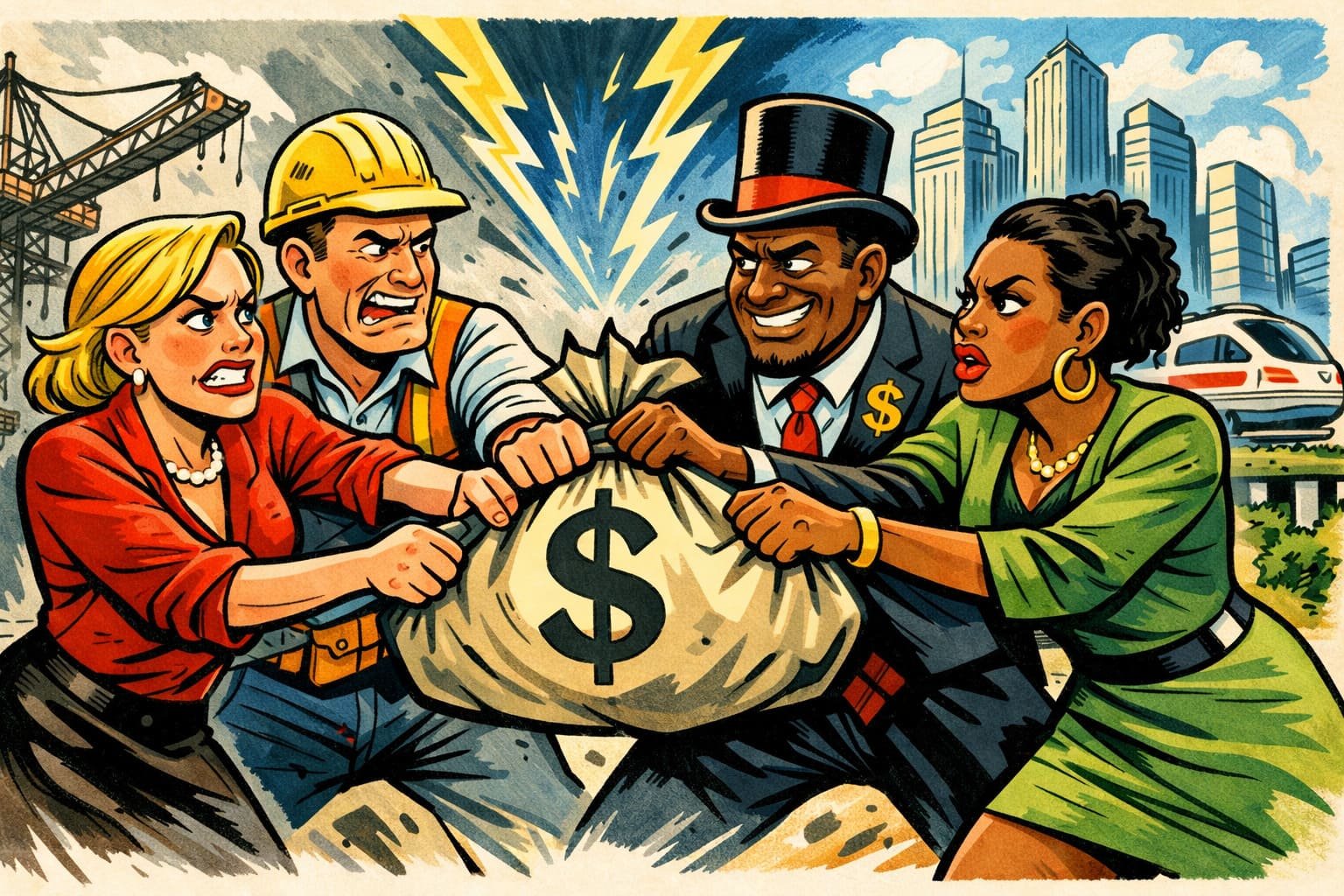
A grand public project always begins with a mood before it becomes a spreadsheet. Someone stands at a lectern, points toward a cleaner future, and makes concrete sound like poetry. Rail lines become destiny. Ports become pride. Bridges become proof that a nation still believes in itself. For a while, the story feels irresistible. Then the invoices arrive, the legal challenges multiply, the contractors revise their assumptions, and the dream starts sounding less like a symphony and more like a very expensive argument.
That is the trap inside modern infrastructure policy. Governments sell speed, dignity, jobs, and growth in one neat package, while the financing often rests on shaky political patience. Voters hear the ribbon-cutting version. Bond desks hear a different soundtrack. They hear land acquisition risk, procurement complexity, inflation exposure, refinancing trouble, and the ancient curse of projects that look elegant on presentation slides but turn feral once steel, labor, and time enter the room.
The British saga around HS2 offered a brutal reminder. A project pitched as transformational ended up shrinking in scope after years of controversy, political redesign, and rising costs. California’s high-speed rail has lived inside a similar storm, with official plans acknowledging serious schedule pressure and heavy cost implications if delivery slips further. The lesson is not that rail is foolish. The lesson is that ambition without durable financing discipline becomes a hostage situation between hope and arithmetic.
Planners often pretend infrastructure is mostly an engineering exercise. It is not. It is a choreography problem. Money has to arrive in the right sequence. Institutions have to hold their nerve across elections. Procurement rules have to protect the public without strangling progress. Communities have to believe the disruption is worth it. A tunnel boring machine cannot solve mistrust. A dazzling station design cannot rescue a broken funding model. Politics enters the room long before the first shovel touches dirt.
A transport minister can announce a visionary corridor on Tuesday and leave office by Friday. The concrete remains. The debt remains. The public memory remains. That mismatch is where fiscal stress gets vicious. A government can inherit a half-built promise and discover that stopping it looks wasteful, while finishing it looks ruinous. Suddenly the country is trapped in the logic of sunk costs, which is a polite phrase for paying more because stopping would be too embarrassing.
Consider a mayor trying to revive a neglected industrial city. The renderings look cinematic. A tram line cuts through old warehouses. Cafes bloom beside renovated stations. Private investors circle the district like gulls over a fishing boat. Then borrowing costs rise. Materials jump. A change in national leadership delays grants. The local authority trims school repairs to keep transport contracts alive. That is the moment infrastructure stops being a symbol and becomes a battlefield. Citizens stop asking whether the dream is inspiring. They ask who is being sacrificed to keep it breathing.
The contrarian truth is that many countries do not suffer from a shortage of infrastructure imagination. They suffer from a shortage of financing honesty. Too many projects are launched as if cost estimates were polite suggestions. Too many public private partnerships are structured to make near-term budgets look cleaner while shifting ugly risks into the future. Too many officials behave as though markets exist to admire national vision rather than price national credibility.
Private capital is often presented as the adult in the room. Sometimes it is. Sometimes it is simply faster at spotting an upside and even faster at walking away when conditions sour. The World Bank has stressed the importance of stronger local financing ecosystems if infrastructure gaps are to be closed sustainably. That matters because borrowing in local currency, with institutions built for long-term project finance, can reduce the drama that comes from relying on fragile external appetites.
There is also a cultural problem. Political systems reward announcements more than maintenance. New airports look glamorous. Sewage upgrades do not. Fiber networks photograph poorly. Flood defenses become popular only after floodwater reaches the living room. So governments chase prestige assets while boring essentials age in silence. This is how countries end up loving monuments and neglecting systems. Then one storm, one blackout, or one procurement scandal exposes the whole habit.
The smarter frame is not growth versus prudence. It is sequencing versus fantasy. Strong infrastructure strategy asks harder questions early. What can be financed through bad years, not just good headlines. What survives a change of government. What creates measurable productivity instead of ceremonial excitement. What can be maintained without cannibalizing hospitals, teachers, or municipal basics. That is less romantic. It is also far more developmental.
A well-run state treats infrastructure like a relay race, not a fireworks show. It builds institutional memory, not just beautiful launches. It keeps reserve capacity for surprises. It speaks to citizens in plain language about trade-offs, delays, and cost escalation. It does not promise a bullet train future on a bicycle-budget tax base. It earns the right to dream by proving it can finish ordinary things well.
Somewhere in every capital city, a glossy project board is still glowing under conference-room lights, full of arrows, milestones, and heroic nouns. The wiser officials already know that the fight is not over concrete. It is over credibility. A country does not become modern because it can announce megaprojects. It becomes modern when it can pay for them, complete them, maintain them, and still look its people in the eye. The real question is brutal and simple: when the bill turns savage, what kind of state is left standing?
