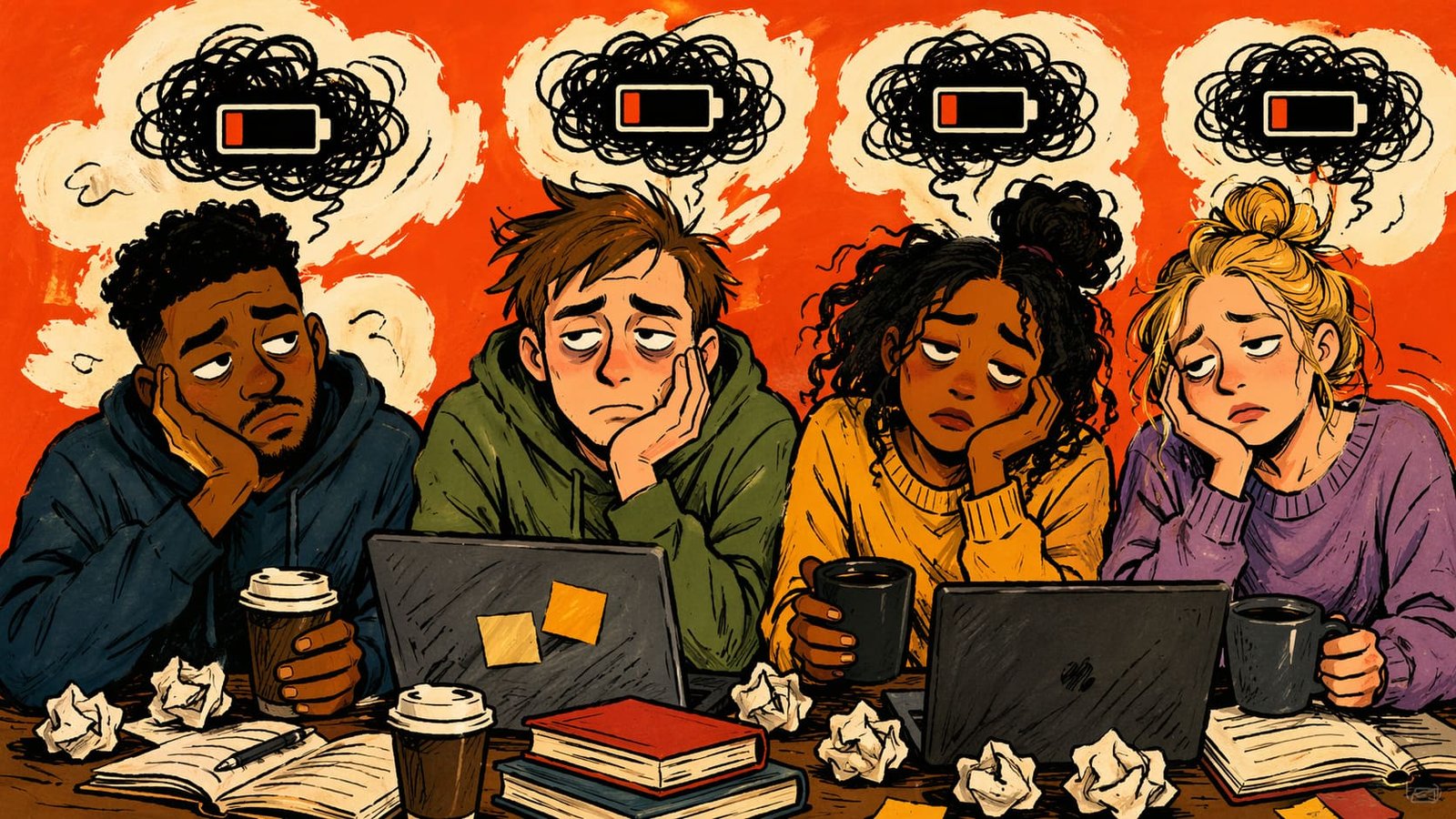
A laptop glows in a dark room long past midnight, tabs stacked like silent witnesses, deadlines hovering without shape or mercy. A young professional stares at the screen, eyes tired yet alert, caught between ambition and depletion. Notifications pulse softly, reminders of tasks unfinished, expectations unmet, potential unrealized. The body whispers for rest, the mind refuses. Somewhere in that tension, exhaustion stops feeling temporary and starts feeling like a personality.
The language around burnout has shifted in recent years. It no longer sits at the edges of conversation. It has moved to the center, spoken casually, almost as a shared condition. Terms like “overworked,” “drained,” and “running on empty” circulate with a strange familiarity. Platforms such as LinkedIn and TikTok amplify these expressions, turning personal fatigue into a collective narrative. The tension beneath it all feels unavoidable: ambition versus sustainability.
There was a time when burnout signaled a breaking point. Now it often signals participation. To be busy, to be stretched thin, to be constantly occupied has become a subtle badge of seriousness. A consultant named Arjun once described a conversation with a group of recent graduates. When asked how they were doing, each responded with some version of exhaustion. None framed it as failure. Instead, it sounded like proof that they were trying hard enough. “If I’m not tired,” one said, “am I even doing anything meaningful?”
This reframing carries weight. When exhaustion becomes normalized, even expected, it reshapes how individuals interpret their own limits. Rest begins to feel like a deviation rather than a necessity. Slowing down can trigger quiet anxiety, a sense of falling behind in a race that rarely reveals its finish line. The body signals fatigue, the mind translates it into urgency.
A young analyst named Sofia experienced this shift during her first year at a fast-growing firm. She entered with energy, curiosity, a desire to prove herself. The pace accelerated quickly. Late nights became routine, weekends blurred into weekdays, the distinction between work and rest softened. At first, the intensity felt exciting. Over time, it became heavy. Sofia noticed something subtle. Conversations with colleagues revolved around how little sleep they had, how many tasks they were juggling. The shared language reinforced the cycle. “We bonded over being tired,” she said.
There is a cultural layer to this pattern that extends beyond individual workplaces. The narrative of hustle, of constant striving, has been widely celebrated. Success stories often highlight relentless effort, long hours, sacrifice. Figures like Elon Musk have spoken publicly about extreme work schedules, shaping perceptions of what commitment looks like. While these stories can inspire, they also set expectations that may not be sustainable for most.
Psychologists have begun to observe the emotional consequences of this environment. Chronic fatigue does not only affect productivity. It alters mood, perception, decision-making. A therapist named Dr. Lena Morris once described burnout as “a slow erosion rather than a sudden collapse.” Clients often struggle to identify when it began because the shift is gradual. Energy decreases incrementally, motivation fluctuates, a sense of detachment emerges. By the time it is recognized, it feels deeply embedded.
The digital environment intensifies this experience. Work no longer exists within clear boundaries. Emails arrive at all hours, messages demand quick responses, updates appear continuously. The expectation of availability becomes implicit. Even during moments of rest, the possibility of interruption lingers. This creates a state of partial engagement, where the mind never fully disengages.
A designer named Kofi shared a moment that captured this tension. He took a short break, stepping away from his desk, intending to reset. Within minutes, he found himself checking messages, responding to minor requests, returning mentally to work. The break existed physically, but not psychologically. “I wasn’t working,” he said, “but I wasn’t resting either.” The distinction had blurred.
There is also a social dimension that reinforces burnout. Conversations among peers often revolve around workload, deadlines, pressure. These exchanges create a sense of shared experience, which can be comforting. At the same time, they normalize the condition. When everyone around you feels exhausted, it becomes harder to question whether that state is necessary or avoidable.
A startup founder named Daniel once reflected on his early years building a company. He pushed himself relentlessly, driven by urgency and belief. The results were tangible. Growth, recognition, momentum. Yet he noticed a cost that was less visible. Relationships strained, creativity narrowed, decision-making became reactive rather than thoughtful. “I was moving fast,” he said, “but I wasn’t thinking clearly.” The realization came slowly, almost reluctantly.
Despite this, the cycle persists because it is reinforced by visible rewards. Promotions, recognition, financial gain. These outcomes validate the effort, even when the underlying cost remains unaddressed. The system celebrates output more readily than it acknowledges sustainability. Individuals adapt accordingly.
There are emerging conversations about balance, about redefining success in ways that include well-being. Some organizations experiment with new structures, flexible schedules, clearer boundaries. Individuals explore practices that support recovery, from structured downtime to mindful engagement with work. These efforts represent a shift, but they coexist with existing expectations rather than replacing them entirely.
A small scene offers a different perspective. A young professional sits in a quiet space, away from screens, away from immediate demands. The absence of noise feels unfamiliar at first, almost uncomfortable. Gradually, attention shifts inward. Thoughts slow, breathing steadies, the body begins to recalibrate. The moment is simple, yet it carries a different kind of intensity, one that does not rely on urgency.
The contrast between these experiences highlights the central tension. Productivity thrives on motion, while well-being requires pause. Both are necessary, yet they pull in different directions. Navigating this tension becomes an ongoing challenge, one that does not resolve easily.
As evening settles and the pace of the day softens, a quieter awareness begins to emerge. The tasks completed, the messages sent, the progress made, all remain. Alongside them, a question forms, not loud, not demanding, but persistent.
In a room where the lights have dimmed and the screens have gone dark, the body finally begins to rest, carrying the weight of effort and the possibility of something different.
And within that stillness, a thought lingers, steady and unresolved, like a line that continues beyond the edge of the page:
If exhaustion has become the proof of your ambition, what part of you is left to enjoy the life that ambition was meant to build?
