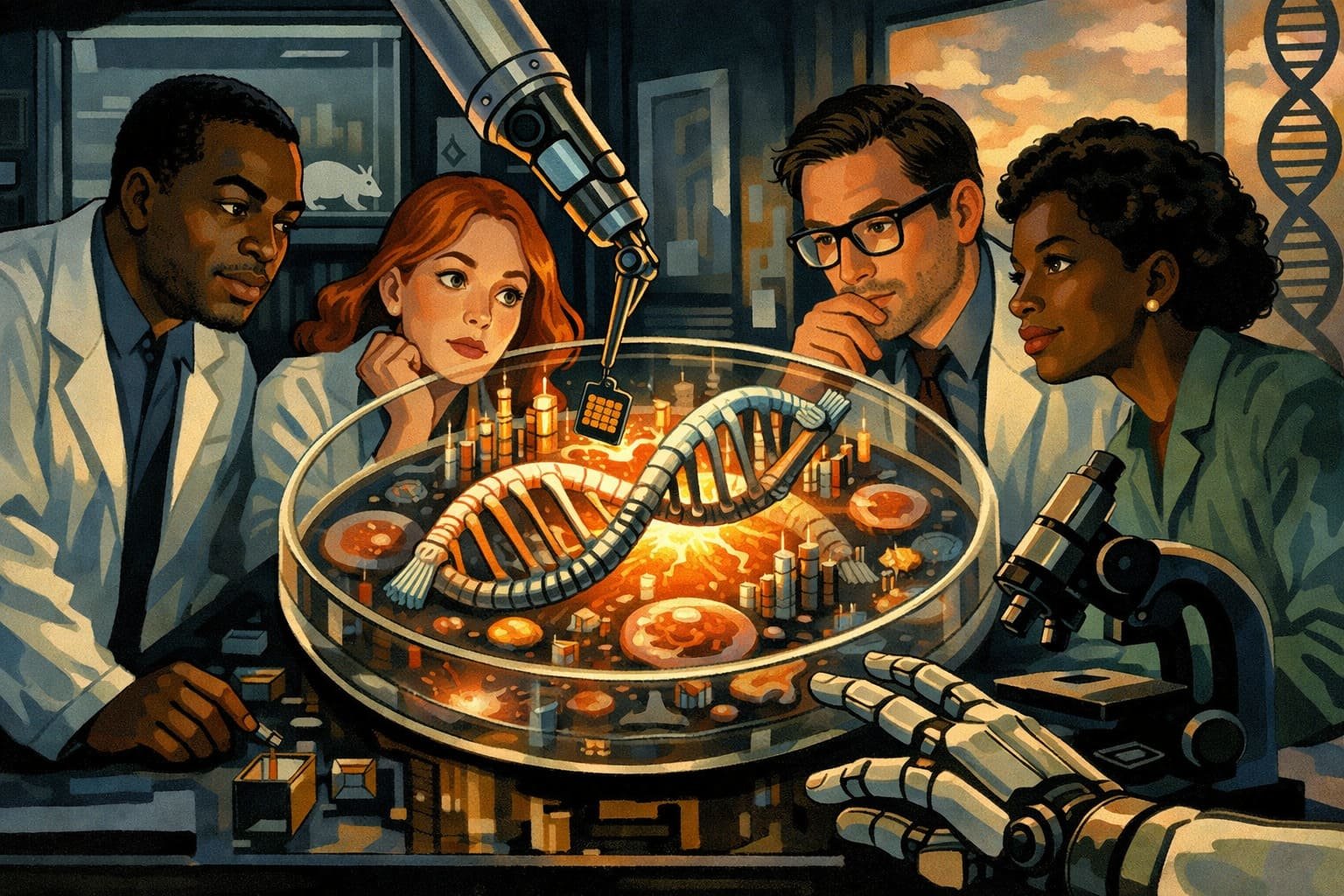
A laboratory once echoed with careful observation, glass instruments, and patient waiting. Today another sound joins the rhythm, the steady hum of computers interpreting DNA as if biology were becoming software waiting for its next update. The old belief that life could only be observed is quietly disappearing. A new generation of technologies now treats living systems as something that can be designed, tested, improved, and responsibly engineered through digital precision and scientific imagination.
Biology is steadily evolving from a descriptive science into an engineering discipline powered by artificial intelligence, computational modeling, synthetic biology, and advanced automation. Researchers increasingly simulate biological behavior before entering the laboratory, reducing uncertainty while accelerating discovery across medicine, agriculture, and manufacturing. The implications stretch well beyond healthcare. Organizations that understand programmable biology are positioning themselves to create new products, strengthen food security, improve sustainability, and solve challenges that traditional industrial systems have struggled to address for decades.
The rapid development of mRNA technology demonstrated how programmable biological platforms could dramatically shorten vaccine development without changing the underlying scientific discipline. Companies such as Ginkgo Bioworks have also built platforms that engineer microorganisms for industrial applications, treating biology with principles resembling software development. Priya led a small agricultural startup searching for crops resilient to changing weather patterns and exhausted soils. Computational biology helped her team identify promising genetic pathways, allowing researchers to focus experiments where evidence suggested the greatest chance of meaningful success.
Technology alone never transforms an industry because systems matter more than individual breakthroughs. A programmable biology strategy depends upon integrated data platforms, responsible governance, secure laboratories, interdisciplinary collaboration, and continuous learning between computational scientists and experimental researchers. Daniel experienced this challenge while coordinating biotechnology partnerships across universities and manufacturers pursuing sustainable materials. Progress accelerated only after every participant agreed on shared digital standards, transparent data practices, and common objectives that encouraged collaboration instead of protecting isolated discoveries behind organizational walls.
The most profound opportunity may not involve replacing nature but understanding it with unprecedented clarity. Artificial intelligence can recognize biological relationships invisible to ordinary observation, while automated laboratories rapidly validate promising hypotheses generated through digital simulation. That combination creates a powerful innovation cycle where every experiment strengthens future predictions. Businesses embracing this approach gain more than scientific capability because they build adaptive knowledge systems that continuously improve decision making, reduce development risk, and unlock discoveries once considered impossible through conventional research methods.
The future of biology will not belong solely to scientists wearing laboratory coats or programmers writing elegant code. It will belong to communities capable of blending curiosity, ethics, engineering, and respect for life into technologies worthy of public trust. Creation is no longer viewed as something completely fixed, yet wisdom remains more valuable than capability whenever powerful tools reshape the living world. Every remarkable breakthrough ultimately asks the same enduring question, will humanity program biology responsibly, or simply because it can?
