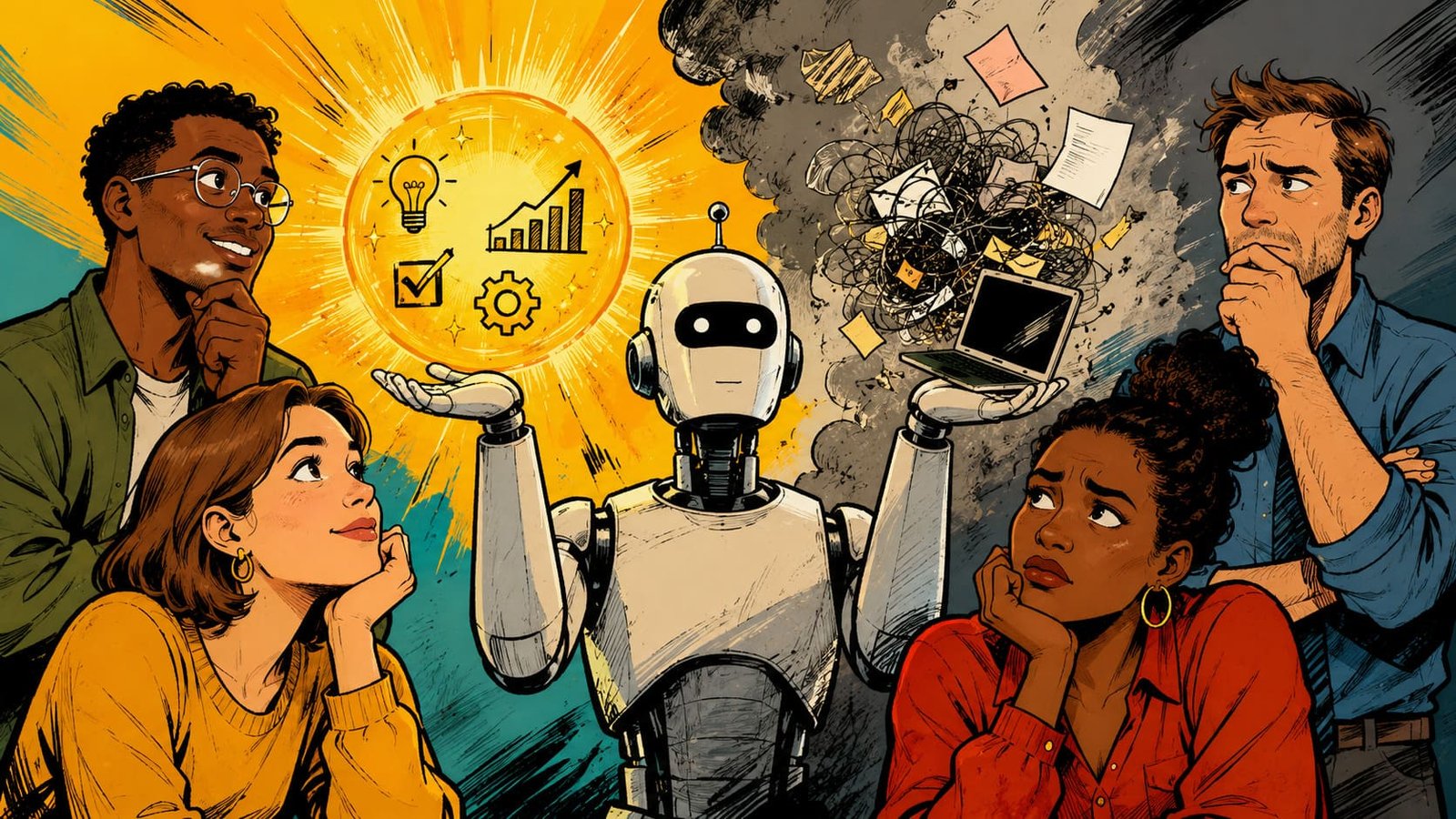
A manager watches an AI assistant turn a blank screen into a polished proposal before the coffee beside the keyboard has cooled. For a few seconds, work appears to have broken the laws of physics. Then the questions arrive: Is the argument sound? Where did that claim come from? Who checks the numbers? What happens when the machine sounds certain and happens to be wrong? Artificial intelligence has made work faster in striking ways, but speed has a mischievous habit of disguising the difference between producing more and accomplishing more.
That distinction is becoming central to management. AI can draft, summarize, classify, translate, generate code, suggest responses, and help workers move through repetitive tasks with less friction. Research on customer-support workers found meaningful productivity gains from AI assistance, with particularly large benefits for less experienced employees. Yet productivity gains are uneven, and a tool that accelerates one part of a workflow can create verification, judgment, training, or rework elsewhere. The machine may remove the boring part of a job without removing the difficult part. Sometimes it simply moves difficulty downstream.
GitHub’s research on Copilot offers an illuminating example because software development makes the trade-off visible. Developers can use AI to handle routine code and stay focused on more demanding problems, and controlled research has found substantial speed improvements on particular coding tasks. But even GitHub’s own research stresses that developer productivity cannot be reduced to output volume or typing speed. A programmer named Nikhil discovered this during a rushed release when an AI-generated function looked perfect, passed its immediate test, and still created a subtle maintenance problem weeks later. Faster code had not created faster engineering. It had created a future appointment with engineering.
Customer service reveals a more hopeful possibility. At a large software company studied by researchers Erik Brynjolfsson, Danielle Li, and Lindsey Raymond, AI assistance helped workers resolve customer issues more efficiently, with especially strong effects among less experienced agents. That finding matters because the most interesting productivity story may not be automation at all. It may be capability transfer. A new employee who receives useful guidance at the moment of uncertainty can learn faster, while an experienced employee can spend more time on unusual cases. AI becomes less like a replacement worker and more like an unusually patient colleague who never gets tired of explaining the first draft.
Yet there is a darker possibility. Imagine a marketing department that suddenly produces ten campaign concepts where it once produced three. The creative director now has more material to review, more claims to verify, more mediocre ideas to reject, and less time to think about customers. Output has exploded while judgment has become the bottleneck. That is the AI paradox: when production becomes cheap, selection becomes expensive. Organizations that understand this will redesign jobs around discernment, taste, context, accountability, and relationships. Those that do not may discover that automation has simply industrialized mediocrity.
AI productivity therefore cannot be measured by how much work disappears from a person’s hands. The better question is what human capacity appears after the work changes. Does a doctor have more time to listen, does an analyst investigate harder questions, does a junior employee learn faster, does a manager make a better decision, does a designer spend more time understanding people rather than formatting slides? Those are harder outcomes to display in a software demonstration, but they are closer to the real prize. AI may become one of the greatest productivity tools ever introduced into work, or merely the fastest machine ever built for producing more things nobody needed. The difference will not be decided by the technology alone. It will be decided by what managers choose to do with the human judgment left behind.
