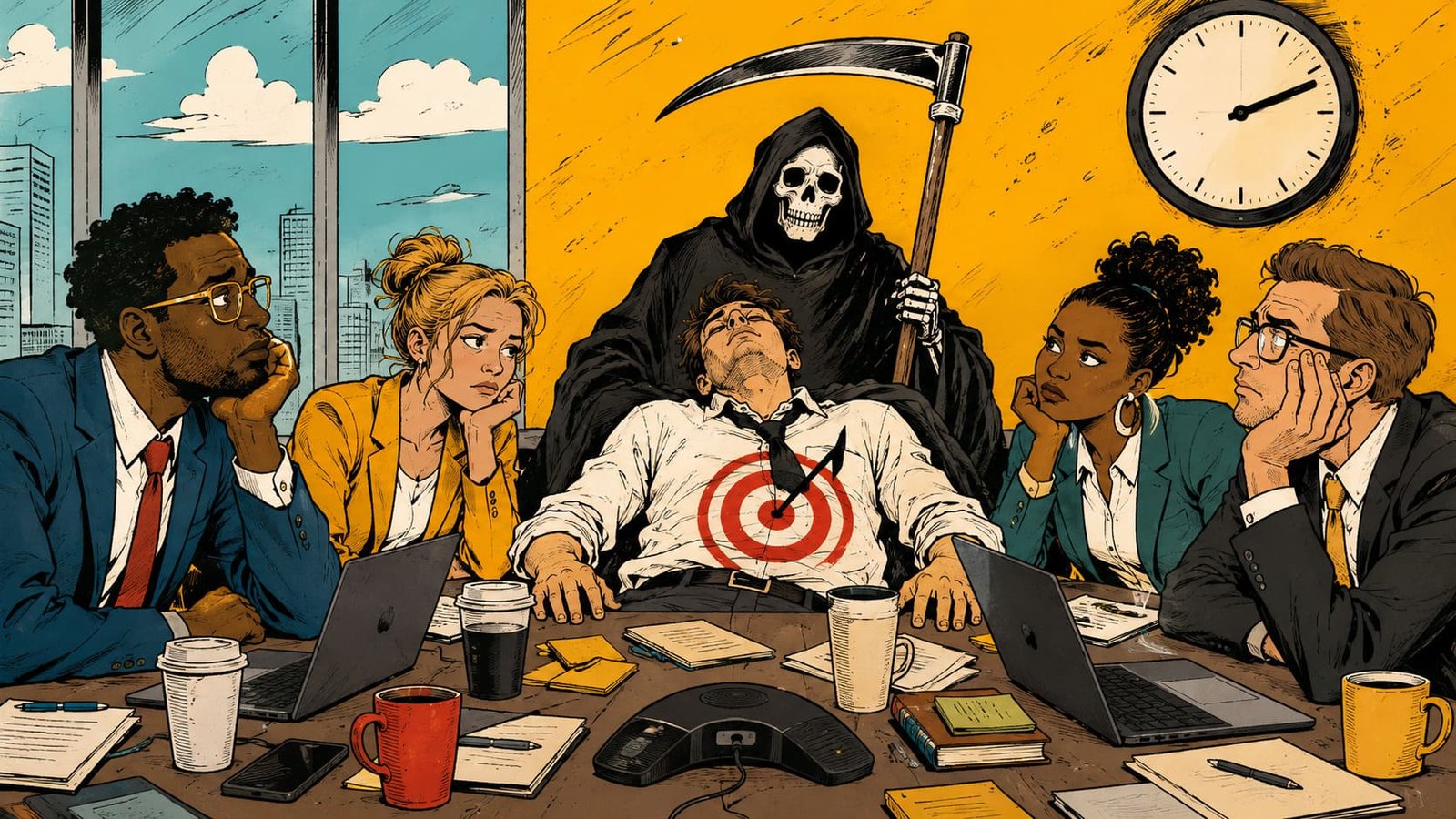
A conference room waits with twelve chairs, three abandoned water bottles, and a screen displaying a title nobody remembers approving. One person arrives carrying a notebook, another brings a laptop, and a third carries the unmistakable expression of someone whose previous meeting has already stolen the useful part of the morning. Then comes the ritual: introductions, updates, clarification, another update, and finally the sentence that should have ended the whole thing before it began. “Let’s take this offline.” A meeting has consumed the hour and somehow created homework.
Meetings are not inherently wasteful. A difficult decision may genuinely require several minds, a crisis can demand rapid coordination, and creative work sometimes benefits from disagreement in the same room. The problem begins when meetings become substitutes for ownership, because inviting everyone feels safer than deciding who actually needs to decide. Managers can fill calendars without moving priorities forward. Employees notice this quickly, then learn a strange workplace rule: attendance looks like commitment, even when contribution is absent. Soon, the calendar becomes a theatre where busyness performs as progress.
A software team once spent an hour discussing why a feature was late. Engineers explained dependencies, designers described revisions, and the product manager promised to “take this offline.” Nobody asked the question that mattered: who has authority to make the decision today? Afterward, one engineer and one designer solved the problem in a short conversation beside the coffee machine. The meeting had produced discussion, documentation, and twelve tired people. It had failed to produce the only thing the project needed, a decision.
Amazon offers an interesting counterpoint through its emphasis on written narratives for important discussions and decisions. Requiring people to explain an issue in writing changes the quality of preparation because weak thinking becomes harder to hide behind attractive slides and confident speaking. The broader lesson reaches beyond Amazon. Meetings often exist because information is scattered, ownership is unclear, documentation is poor, or leaders are uncomfortable making decisions with incomplete certainty. When responsibility becomes blurry, gathering more people can feel like risk management. Often, it is simply risk avoidance wearing a calendar invitation.
Meeting overload also creates a hidden productivity tax. A designer loses the uninterrupted stretch needed to understand a customer problem. An analyst breaks concentration just as a pattern begins to emerge. A manager spends the afternoon recovering from conversations that fragmented the morning. None of this appears neatly on a financial statement, yet the cost accumulates through slower decisions, shallow thinking, unfinished work, and employees pushing meaningful tasks into evenings. Managers can reverse the pattern by asking three blunt questions before inviting anyone: what decision is required, who genuinely needs to be there, and could the same outcome be achieved without a meeting?
There is something almost absurd about companies scheduling meetings to discuss how to reduce meetings. Yet the joke exposes a serious principle of organizational design: time is shared infrastructure. Every unnecessary invitation consumes attention belonging to other people, then scatters that attention across whatever remains of the day. A healthy organization does not worship empty calendars, because collaboration matters, but it protects collaboration from becoming compulsory theatre. Before another meeting appears on the screen, someone should be willing to ask the question that can rescue an entire room from an hour of polite conversation: what will be different when this meeting ends?
