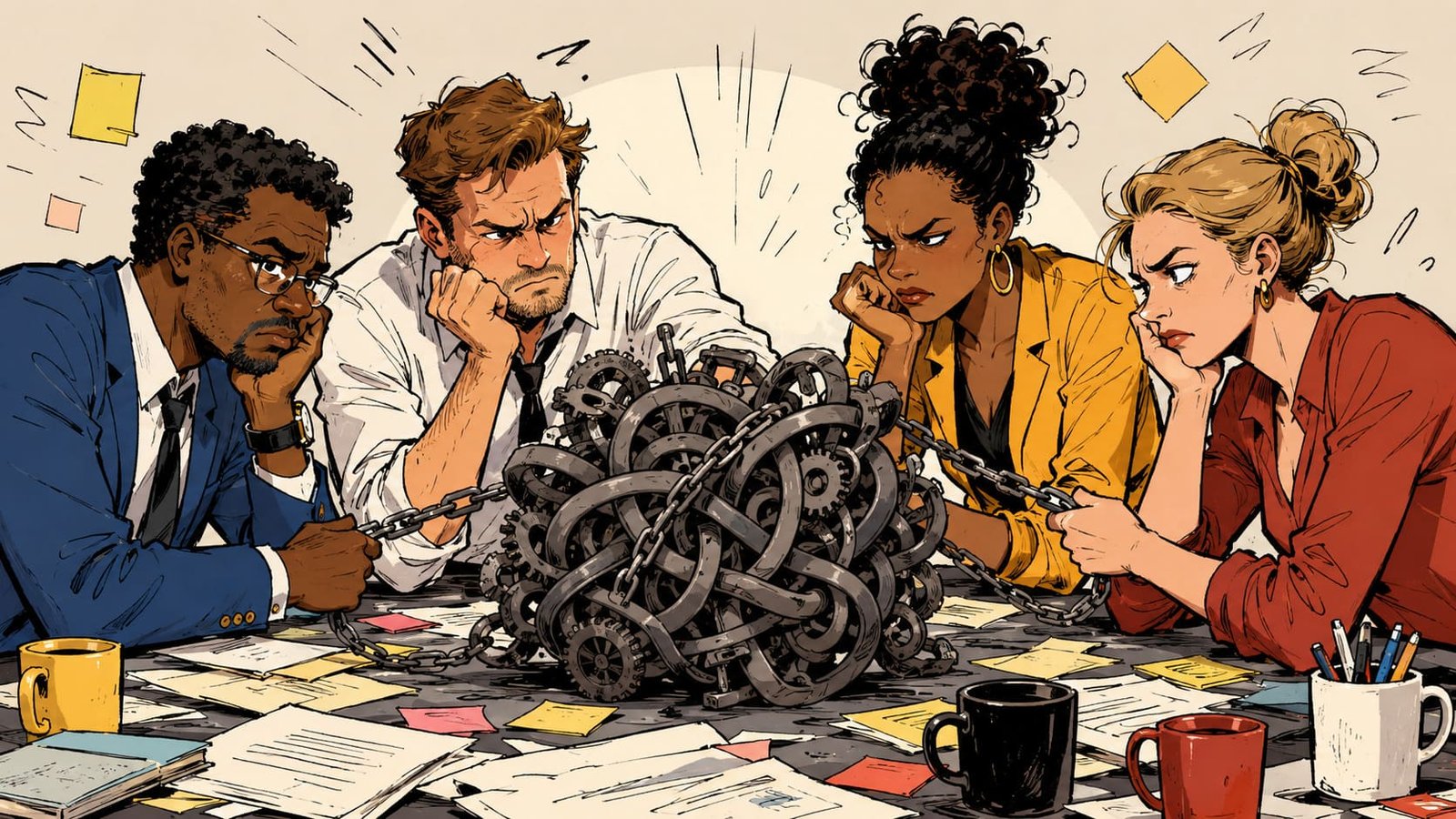
A manager opens a laptop and finds twelve approvals waiting, four unread messages, three calendar invitations marked urgent, and an employee standing beside the desk with a problem that cannot be placed inside a dropdown menu. Somewhere between those demands sits a deceptively simple question: what is actually stopping the work? Every organization accumulates tiny obstacles, and each one looks harmless in isolation. Together, they turn capable people into commuters trapped behind invisible traffic.
Workplace friction rarely announces itself as a crisis. It appears as a form requiring information already stored elsewhere, a meeting scheduled because nobody knows who owns a decision, software that makes a simple task strangely elaborate, or a manager who insists on approving work that should never reach their desk. Employees adapt because humans are remarkably good at adapting to bad systems. That adaptation can fool leaders into believing everything works. People keep moving, but they move around the organization rather than through it.
Amazon’s operating philosophy has often emphasized clear ownership, decision-making, and reducing unnecessary complexity, offering a useful principle for managers trying to identify where work gets stuck. At a professional-services firm, Leila noticed consultants were spending more time seeking approval for minor client changes than discussing what clients actually needed. She changed the decision boundary. The inbox became quieter, clients received faster responses, and consultants became more accountable because freedom had been paired with explicit responsibility rather than endless permission.
Friction also hides inside managerial habits. A leader who changes priorities every few days can create more disruption than a difficult customer. A manager who schedules meetings without a clear purpose converts everyone else’s concentration into company property. At a software company, Tomas rewrote his team’s priorities every Monday and then wondered why projects slipped. One developer finally asked, “Which list should actually be trusted?” The question sounded ordinary. It exposed the real bottleneck: the team had plenty of effort but nowhere stable for that effort to land.
Removing friction does not mean removing standards. That distinction matters because speed without judgment creates its own problems, while excessive procedure can turn sensible work into bureaucratic theatre. Toyota’s production philosophy offers a useful reminder that disciplined processes can reduce waste while making problems more visible rather than hiding them. Strong managers therefore study the journey of work: where does it wait, where does ownership disappear, where does information become distorted, and where does a capable employee need permission for a decision they should already be trusted to make?
A manager’s job is partly to notice obstacles that everyone else has learned to ignore. The duplicated form. The pointless meeting. The approval nobody understands. The software everyone dislikes but nobody questions. Each obstacle reveals an assumption about how work should happen, and each unnecessary one quietly tells employees that their time is cheap. Remove enough friction and productivity may improve, but a deeper change follows: people recover attention, judgment, and momentum. Perhaps the most respectful thing a manager can do is stop making good work unnecessarily difficult.
