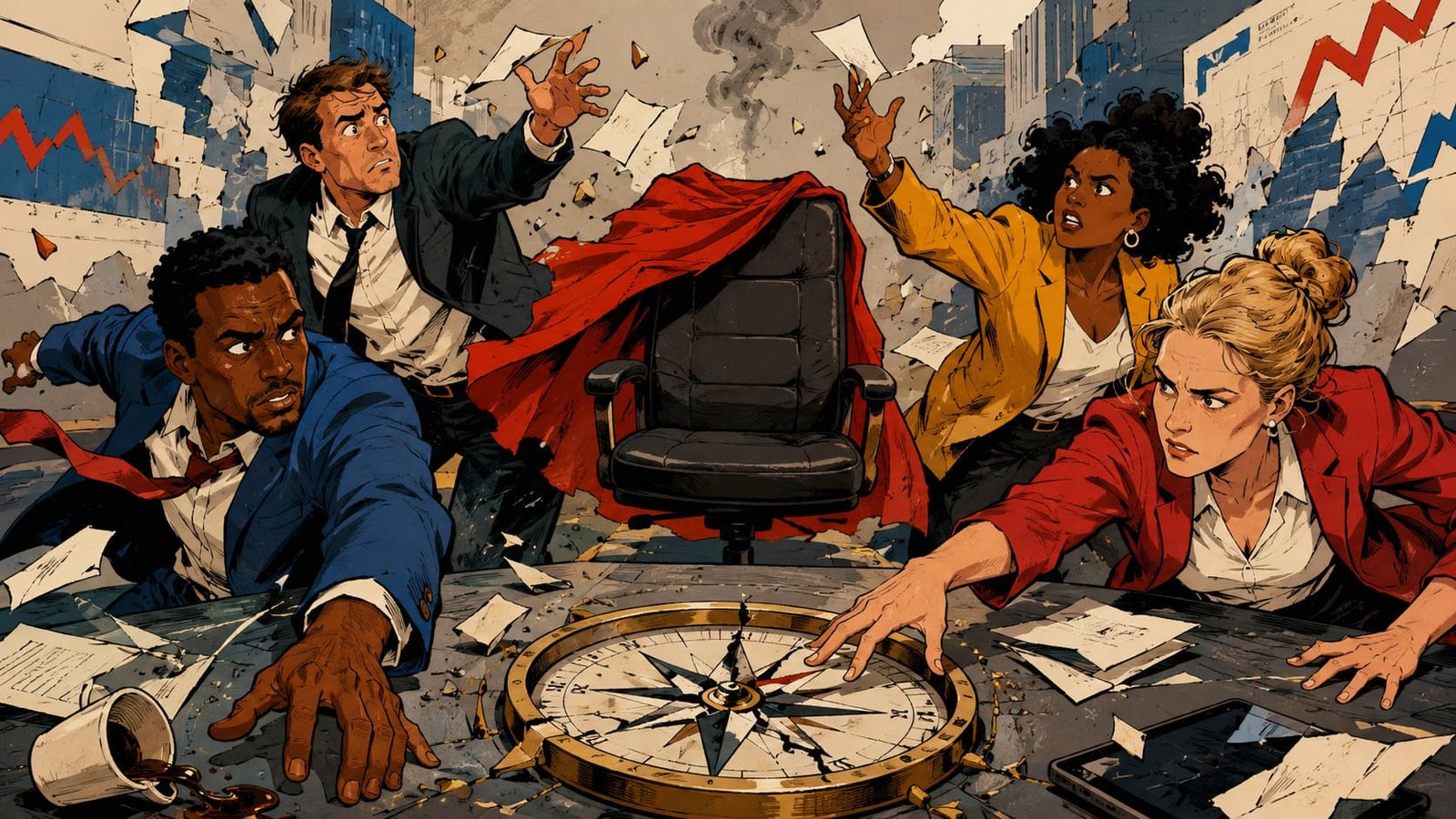
A conference room sits strangely intact after everyone has left. Twelve chairs surround a table, twelve laptops remain open, and nobody is officially in charge. Yet tomorrow’s deadline still exists, the client still expects an answer, and a disagreement about priorities is quietly becoming a fight about power. “Everyone owns the decision” sounds wonderfully modern until everyone discovers that nobody owns the consequence. Research on distributed leadership offers a more complicated picture: leadership can emerge through interactions among multiple people, but removing hierarchy does not remove power, conflict, or the need for coordination.
That is where leaderless leadership becomes fascinating. A genuinely decentralized organization does not eliminate leadership so much as relocate it into relationships, expertise, routines, informal influence, and shared practices. Research on radically decentralized organizations describes leadership as a collective system in which responsibility and decision-making can be distributed across members rather than concentrated in one formal figure. The trouble begins when an organization confuses distributed authority with absent authority. A vacant throne does not create equality. It creates a competition over who gets to stand nearest to it.
Imagine a product team called Northstar preparing a major launch without a designated project leader. The engineer insists reliability comes first, the designer argues for simplicity, and sales wants a feature that a major customer has demanded. For several hours, everyone speaks with impressive confidence. Then someone asks, “Who decides?” The room changes temperature. Research examining leaderless teams found that leadership still emerges through how members resolve disagreements and negotiate consensus, even when nobody holds a formal leadership position.
A similar drama unfolds inside a fast-growing creative company where managers are deliberately removed from routine decisions. At first, employees celebrate. Meetings shorten. Permission requests disappear. Then two senior specialists begin attracting followers because they control different pools of expertise, and an informal hierarchy quietly appears. Nothing is written on an organization chart, yet everyone knows whose opinion carries weight. That is the strange joke of leaderless organizations: power rarely disappears. It changes clothes. Research on distributed leadership warns that effective arrangements often require hybrid configurations rather than assuming every person must become a leader or that formal leaders become irrelevant.
Good decentralization therefore needs architecture. Teams need clear decision boundaries, access to information, mechanisms for resolving conflict, and ways to recognize who has authority in a particular situation. Recent research on organizational decentralization also points to the continuing importance of formal leaders in empowering employees, suggesting that decentralization does not necessarily make leadership obsolete. The strongest leader may be the person who creates conditions where authority can move without becoming mysterious. That requires restraint, because leaders must resist grabbing every decision back, while employees must accept that freedom includes responsibility.
A leaderless organization can become remarkably alive when expertise moves toward whoever understands the problem best. It can also become political in ways a hierarchy makes easier to see. Influence gathers around personalities, information, friendships, technical knowledge, and proximity to scarce resources. A formal boss at least gives employees a visible target for accountability. In a supposedly leaderless system, power can become harder to name precisely because nobody admits to holding it. The real test is therefore not whether an organization has leaders, but whether people can see where power lives, challenge it when necessary, and still know who answers when things go wrong.
