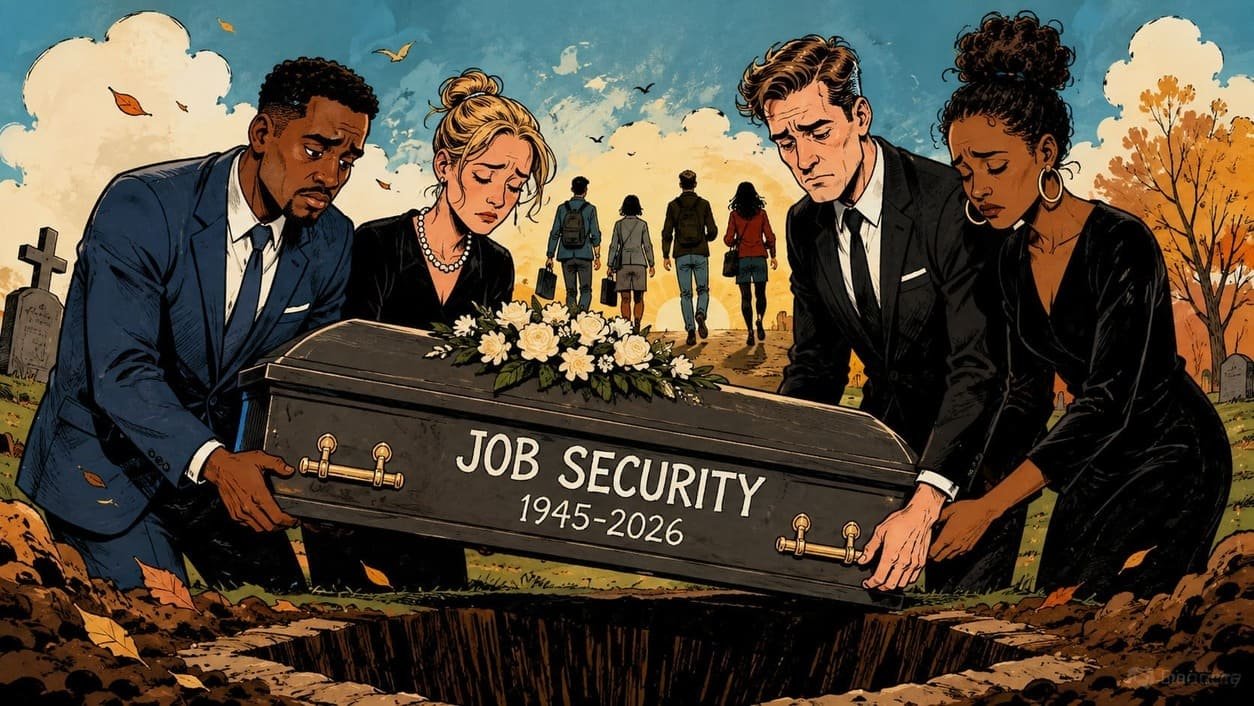
A security guard watches employees swipe into a building where almost everyone carries a laptop powerful enough to relocate an entire department. Upstairs, calendars fill, targets rise, and a cheerful presentation promises continuity. Then an organizational chart changes overnight. Names disappear, responsibilities move, and a phrase that once sounded reassuring, “job security,” suddenly feels like an artifact from another economic era. Career security has not vanished, but its address has changed. It no longer lives inside a company promise. Increasingly, it lives inside what a worker can carry.
For much of modern employment, security meant staying useful to one employer for many years. Loyalty was exchanged for stability, and experience gradually became protection against uncertainty. That arrangement still exists in places, but technology, restructuring, outsourcing, acquisitions, and shifting customer demands have weakened its certainty. A capable employee can lose a position without losing a career, provided valuable skills remain portable. That distinction matters. Employment security asks whether a particular seat survives, while career security asks whether the person can keep finding meaningful work when the seat disappears.
Nadia, a procurement specialist, learned this after her department was reorganized following a merger. Her role vanished, despite strong performance and years of praise. For several weeks, every rejection felt personal, until a former supplier introduced her to a smaller company struggling with complex purchasing relationships. Nadia discovered that her real asset had never been her title. It was her ability to negotiate, interpret markets, manage relationships, and make expensive decisions less frightening. A career had survived because capability traveled farther than an organizational chart.
A similar lesson appears in technology. An employee can become highly valuable inside one system while becoming surprisingly vulnerable outside it if skills become too narrow or obsolete. Consider a manager named Pavel who spent years mastering one company’s internal reporting tools. When new software replaced much of that work, his institutional knowledge lost market value almost overnight. Another colleague had spent those same years learning data analysis, customer communication, and project leadership. She was not protected from disruption, but she had options. That difference is the heart of modern career security: optionality beats attachment.
Leaders have responsibilities here too. Organizations cannot promise permanent employment, but they can make people more resilient by investing in learning, internal mobility, meaningful feedback, and exposure to work that develops judgment rather than narrow compliance. A strong manager should occasionally ask, “If this role disappeared tomorrow, what would this person be better prepared to do?” That question may feel uncomfortable, yet it is healthier than pretending permanence exists. Companies that develop portable capability create employees who are harder to trap and often more valuable while they remain.
In an old office drawer, an employee finds a certificate from a first promotion, carefully folded beside an expired access card. Both once represented security. One proved advancement inside a company, while the other proved belonging to a particular building. Neither guarantees much now. Career security asks for something harder and more liberating: continuous learning, strong relationships, adaptable judgment, financial discipline, and the courage to remain employable beyond one employer’s walls. A career becomes safer when its foundation is not a promise that can be withdrawn, but a capability that keeps opening doors.
