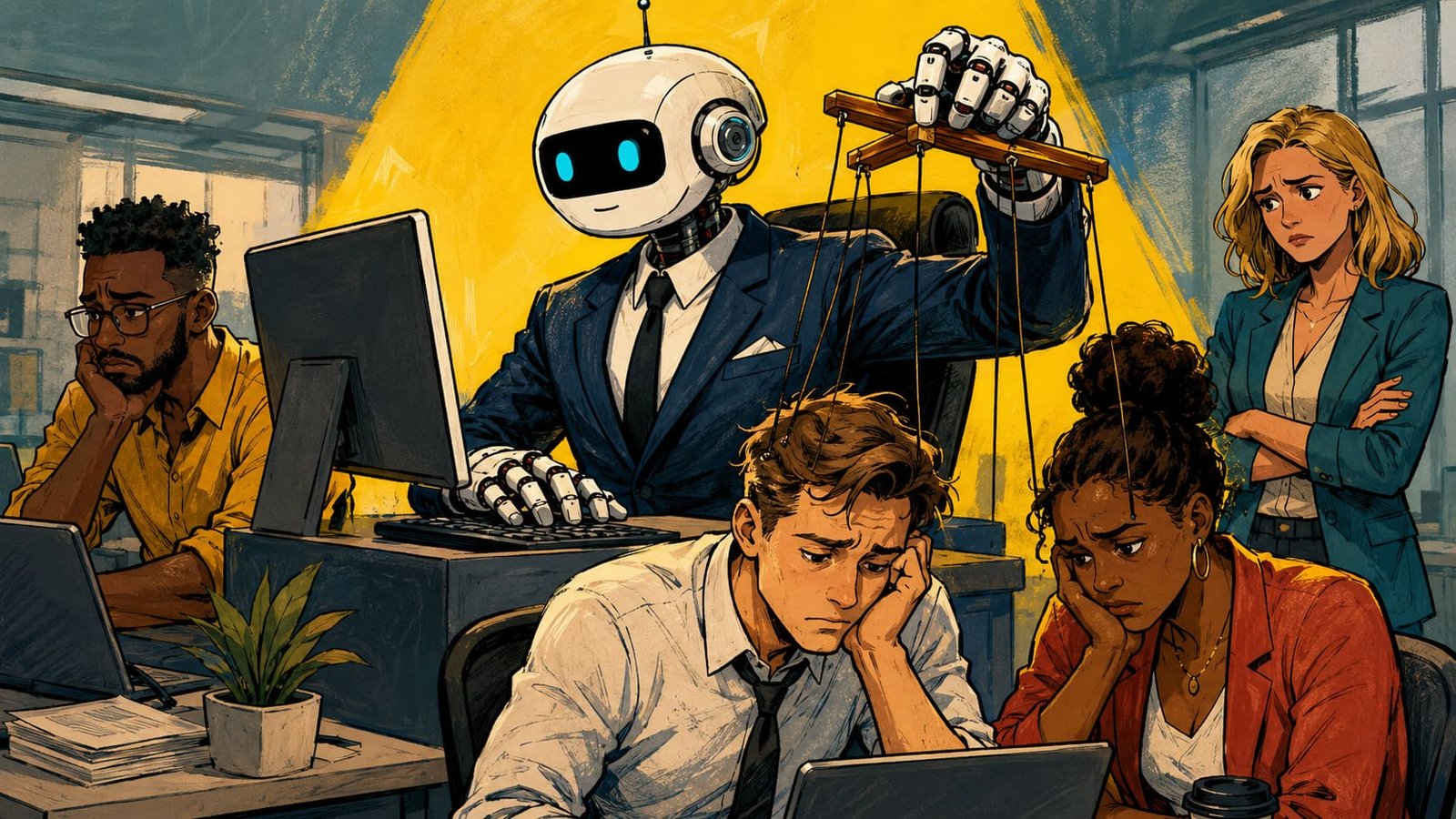
A hospital corridor hums beside a server room, and nobody notices the strange bargain being made behind the screens. Software schedules shifts, drafts reports, sorts requests, predicts demand, and answers questions before a human has finished reading them. Work appears lighter, cleaner, almost frictionless. Yet every technological shortcut can move a burden somewhere else, often onto attention, judgment, trust, learning, or emotional energy. Recent workplace research describes this tension clearly: AI can improve performance while also creating hidden work around checking, correcting, contextualizing, and supervising its output.
That hidden bill rarely arrives in the technology budget. It appears in the employee who spends an afternoon fixing an AI generated report, the manager who must review five drafts because none quite understands the client, or the team that loses confidence after an automated recommendation quietly goes wrong. A productivity dashboard might celebrate faster completion while nobody measures the mental residue left behind. One analyst finishes a presentation before lunch, then spends another hour checking every claim. Faster, yes. Lighter, not necessarily. Research on workplace AI increasingly points toward this gap between visible output and invisible human effort.
Consider a marketing team using an AI system to generate campaign concepts. At first, the room feels transformed, with screens filling faster than people can type and coffee cups abandoned beside keyboards. Then a junior strategist notices that three supposedly different ideas share the same underlying assumption, while a senior manager catches a recommendation that ignores the company’s actual customers. A similar pattern appears in professional services, where AI can make production cheaper while shifting value toward checking, interpretation, and decision making. The machine has not eliminated work. It has changed which work carries the risk.
Another company introduces an AI assistant for customer support, promising shorter queues and happier clients. Within weeks, representatives discover that difficult cases now arrive after automated systems have already confused the customer, leaving humans to repair relationships before solving the original problem. One employee keeps a handwritten note beside the monitor: “Fix what the machine forgot.” That sentence captures a growing organizational problem. When automation handles easy cases, humans inherit exceptions, ambiguity, complaints, and consequences, precisely the situations requiring patience and judgment rather than speed.
The deeper cost is learning. If AI performs routine analysis, drafting, research, coding, and diagnosis before employees have struggled through those activities themselves, workers can become efficient without becoming deeply capable. Recent research on early career work argues that the configuration of AI matters greatly: tools can either hollow out junior development or support expertise when people actively review and learn from machine output. That distinction should worry executives because organizational capability is not stored inside software alone. It lives inside people who know why something works, when it fails, and what deserves doubt.
A strange accounting problem is emerging inside modern work: companies can save money by removing human effort while quietly creating new forms of human responsibility. The bill arrives through fatigue, weaker judgment, brittle skills, damaged trust, managerial overload, and employees who know how to operate a system but not how to think without one. None of those costs looks dramatic on a quarterly spreadsheet. Yet they accumulate like water beneath a floor, invisible until the structure begins to bend. Perhaps the real question is not what AI can remove from work, but what humans cannot afford to lose.
