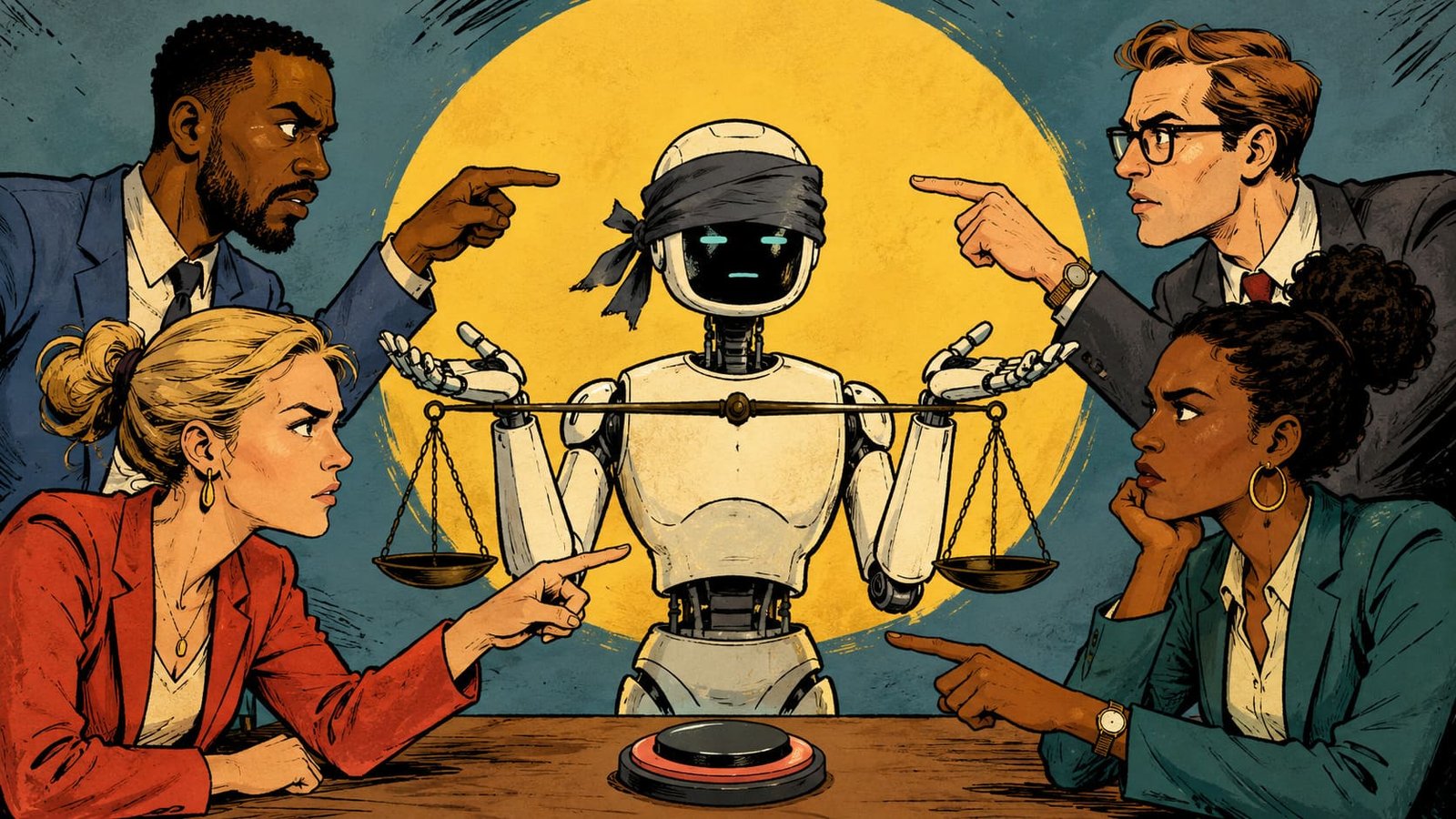
A red warning light flashes across a manager’s screen, followed by a recommendation that feels strangely final: reject, investigate, escalate. Nobody in the room wrote those words. Nobody quite owns them either. That is the uncomfortable territory created when artificial intelligence moves from helping people think to influencing decisions about hiring, promotion, discipline, lending, scheduling, customers, or employees. Research on algorithmic decision-making has repeatedly returned to the same problem: when a machine participates in judgment, responsibility can become strangely difficult to locate. The decision has an author, but apparently no culprit.
A company can say that a manager made the final call, even when software shaped the shortlist, ranked the candidates, summarized their records, and highlighted supposedly risky behavior. That arrangement creates a peculiar managerial illusion: human hands remain on the steering wheel while much of the route has already been selected. A recent OECD study found that unclear accountability for wrong algorithmic decisions was among the leading concerns reported by managers using algorithmic management tools. Responsibility cannot be outsourced simply because computation became involved.
Imagine a hiring manager named Elise reviewing two candidates. One has an impressive résumé but receives a lower algorithmic recommendation because several features in the model quietly favor another profile. “The system knows more than I do,” someone says in the meeting, and discussion stops. That sentence is more dangerous than the software itself, because it turns uncertainty into authority. Research on algorithmic decision-making in human resources finds that people’s reactions can depend heavily on whether systems replace human judgment or augment it, with trust and perceptions of fairness affected by that distinction.
Now consider a different room, this time inside a financial institution where an automated system flags a customer for additional scrutiny. An employee follows the recommendation because ignoring it feels risky, even though the employee cannot explain precisely why the system reached its conclusion. Months later, an error becomes visible, and the familiar corporate question appears: “Who approved this?” Modern governance increasingly answers that question by insisting that responsibility must remain identifiable, with meaningful human oversight rather than decorative human approval. The principle matters because a person who cannot understand or challenge a recommendation cannot provide meaningful accountability.
A sensible organization therefore builds responsibility before deployment, not after something goes wrong. Someone must own the system, understand its limits, review outcomes, investigate complaints, and have genuine authority to override its recommendations. European policymakers have proposed precisely this kind of human oversight for workplace algorithmic management, including review of decisions affecting hiring, pay, performance, scheduling, and discipline. That approach changes the manager’s role from rubber stamp to guardian of judgment, which is less glamorous than saying “AI-powered decision-making,” but considerably more useful when consequences arrive.
A machine can calculate without feeling the weight of a wrong answer. A manager cannot afford that luxury. Every automated recommendation eventually lands somewhere human: in a rejected application, a lost promotion, a difficult conversation, a frightened employee, or a customer wondering why an invisible system decided against them. Organizations that treat AI as an authority will discover that responsibility does not disappear when decisions become automated, it merely becomes harder to find. When the algorithm makes the call and everyone says they were only following the system, who will have the courage to say, “That decision was mine”?
