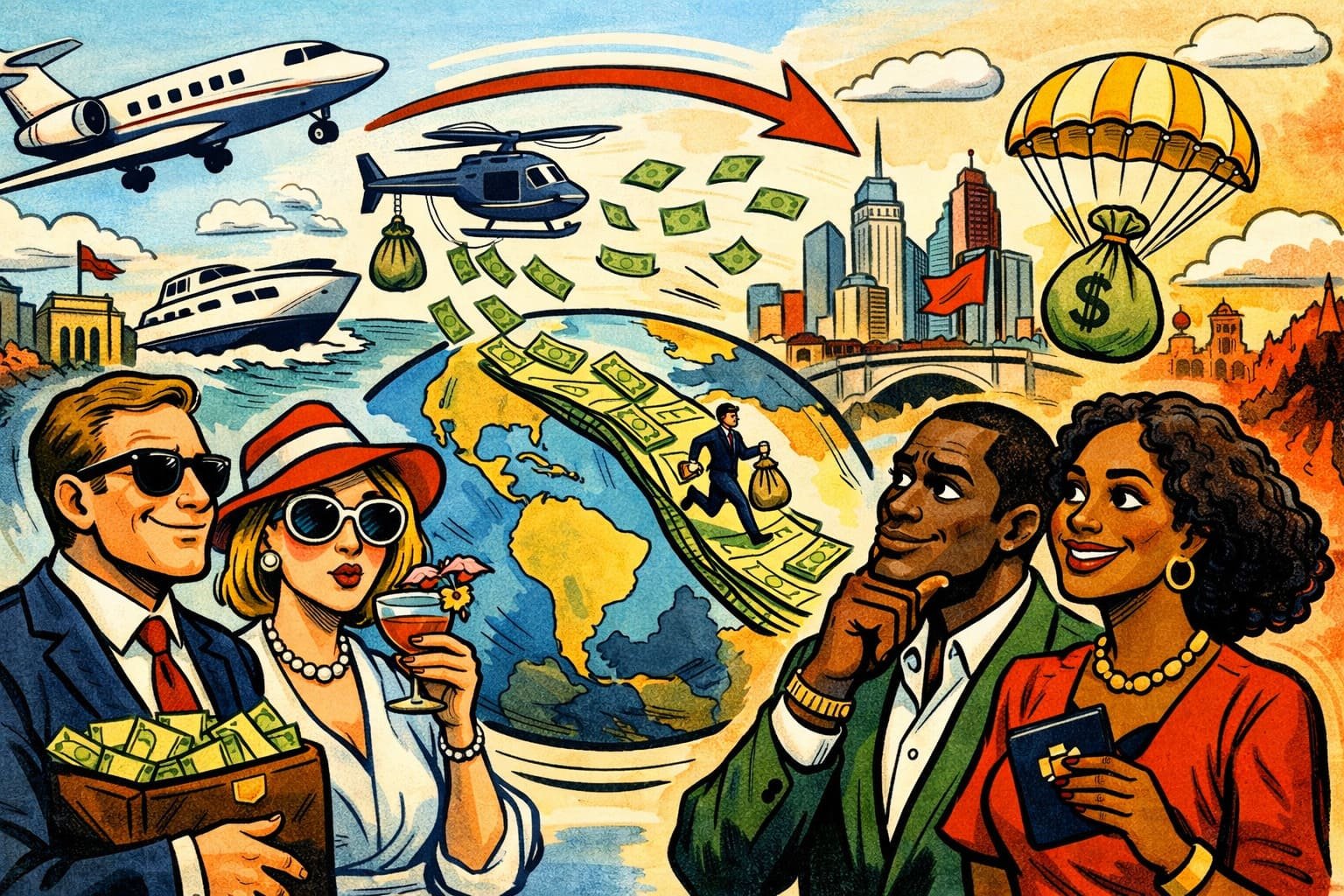
Crystal chandeliers still glittered above a charity gala while conversations drifted from art collections to residency permits. Nobody raised a voice. Nobody needed to. A billionaire quietly asked whether another passport would protect a family business from tomorrow’s uncertainty, and the table suddenly understood that wealth no longer measures only opportunity. Increasingly, it measures optionality. Capital has always crossed borders in search of better returns. Now it often travels first in search of greater certainty.
Financial capital dislikes surprises more than taxes. Investors routinely accept lower returns if they believe legal systems, property rights, and political institutions will remain dependable. Geopolitical tension alters that calculation. Elections, sanctions, armed conflicts, shifting trade alliances, and changing regulations encourage wealthy families to reconsider where assets should be held and which currencies deserve greater trust. Money rarely moves because headlines appear frightening. It moves because uncertainty quietly reshapes the expected balance between risk and preservation.
Singapore has become one example of this broader trend, attracting family offices seeking political stability, sophisticated financial infrastructure, and predictable regulation. Switzerland continues to appeal for similar reasons, despite evolving transparency standards. Dubai has also emerged as a destination for entrepreneurs and investors relocating businesses alongside personal wealth. Ray Dalio frequently argues that empires rise and decline through long economic cycles. Wealth migration often becomes one of the earliest financial signals that confidence is changing before economic statistics fully reveal the shift.
Adrian inherited a manufacturing business that had operated from one country for generations. Family photographs filled headquarters walls, making relocation feel almost disloyal. Then export restrictions complicated international contracts, banks requested additional compliance reviews, and suppliers demanded different payment structures. During a quiet dinner, Adrian admitted that preserving the business mattered more than preserving tradition. He established a regional holding company elsewhere while keeping factories at home, reducing geopolitical exposure without abandoning employees who had built the firm’s reputation.
Accounting textbooks often describe capital as mobile, yet mobility carries emotional weight rarely captured on balance sheets. Families leave familiar legal systems, executives build relationships across unfamiliar jurisdictions, and advisors spend years navigating regulatory complexity that customers never notice. Wealth migration therefore represents more than financial engineering. It reflects changing perceptions of institutional credibility. Markets reward countries capable of offering consistency because predictability itself becomes a scarce economic resource whenever geopolitical uncertainty expands across international commerce.
Airport lounges rarely appear in discussions about global finance, yet countless strategic decisions begin beside departure gates rather than trading desks. Wealth has never belonged permanently to geography. It belongs wherever confidence can survive uncertainty with the greatest resilience. Nations compete for investment through stability as much as taxation, while investors quietly search for places where tomorrow feels less fragile than today. Perhaps every movement of capital carries the same silent question: where will trust still feel valuable when headlines grow louder?
