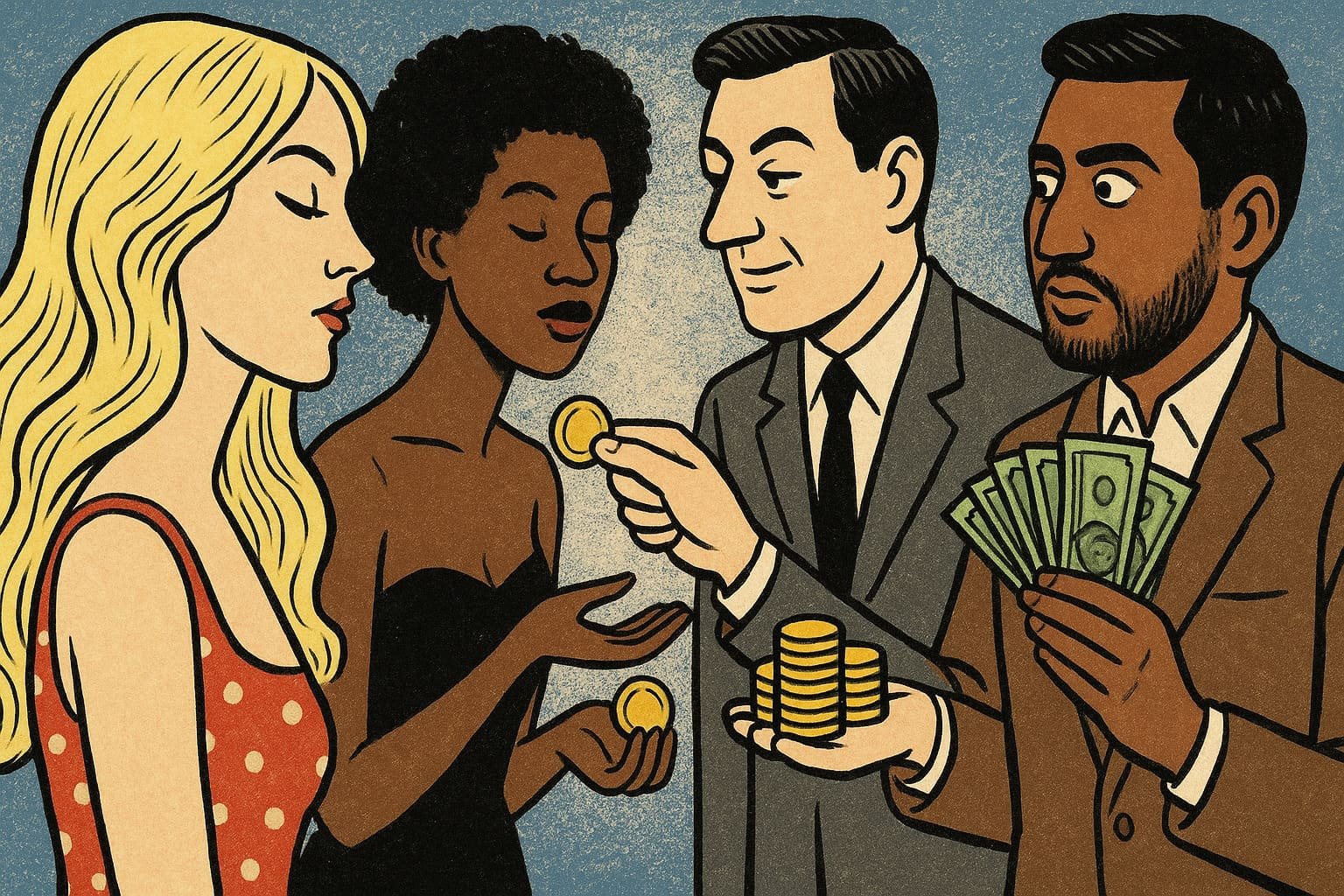
A gallery crowd pulses beneath cold LED lights, waiting for something they cannot name. Every face is a brand, every laugh a pitch. Marble floors echo the sound of heels that cost more than some people’s rent. Under each spotlight, objects sit on velvet pedestals—limited sneakers, minimalist watches, translucent gadgets. People glance sideways, pretending not to care who’s watching, while phones hover, snapping proof for invisible followers. Money still changes hands, but desire moves faster than currency.
Nobody here buys just to own. Each choice is a wager on identity. The new designer chair is not just a seat but a statement, a way to say “I belong” without words. The crowd hums with silent competition. This is capitalism’s new face: beauty is now the most valuable currency, traded with every glance and double-tap.
Even outside, beauty runs the game. Instagram kids sip neon lattes that taste like nothing but photograph like dreams. A florist called Soraya wraps stems in hand-printed paper, never mentioning the price. Her clients pay for emotion, not petals. The city itself is in on the scheme, turning parks, benches, and street art into the backdrop for private performances. Everyone is an actor, everyone is a collector, and the rarest possession is a moment that looks perfect.
The rules have shifted. Once, function ruled. Now, form wins every time. Behind the scenes, teams of designers study mood boards, color theory, TikTok trends. Every detail is a weapon in a quiet war for attention. In this new order, beauty doesn’t just sell products—it builds empires.
Somewhere, a young founder named Lucas scrolls through a hundred logo drafts, looking for the one that “feels rich.” The stakes are enormous, but nobody ever mentions the cost of taste. In aesthetic capitalism, the prettiest vision wins, and the rest are forgotten.
Quick Notes
- Beauty Sells Faster Than Logic: The world rewards brands and products that look irresistible, even when performance takes a back seat.
- Instagram Is the New Stock Exchange: A single viral image or clever unboxing video can multiply a brand’s value overnight, making aesthetics a high-yield investment.
- Luxury Is a Feeling, Not a Price Tag: From Soraya’s flower shop to the next startup’s branding, people pay extra for an emotional experience—beauty is the real product.
- Design Teams Run the Show: Companies now invest more in designers and storytellers than engineers, knowing beauty brings loyalty, not just sales.
- You Become What You Display: Aesthetic choices now define personal and professional worth, shaping careers, friendships, and futures.
The New Stock Market—Why Beauty Now Buys Influence
Aesthetic capitalism is not about what things do, but how they make you feel. It’s a system built on the trade of beauty, mood, and aspiration. In this market, the best-looking brand wins the first look, the last dollar, and the word-of-mouth jackpot. Function matters, but form closes the deal.
Online platforms turbocharged this shift. A single photo, perfectly styled, can launch a product into global obsession. When the water bottle company Oasis sent influencer Anna just one bottle, she posted a sunlit photo at the beach. Overnight, Oasis became a status symbol, outselling competitors with stronger technology. The message is clear: aesthetics are leverage.
Design-driven startups now rise faster than ever. Investors no longer just scan business plans; they scan Instagram grids. If your feed pops, so do your valuations. The coffee shop Brew House spent more on tile and lighting than espresso machines. Its look pulled in crowds, and its branding landed licensing deals, turning atmosphere into revenue.
Beauty is now a language of trust. A slick website or minimal packaging suggests competence, even when the reality lags behind. Savvy companies understand this. They curate every angle, color, and font for emotional impact, shaping the way you think and buy. Perception becomes reality, and reality bends to fit the image.
Micro-case: A shoe startup, StepLight, failed twice until founder Jasmine hired a creative director. The third launch, with matte boxes and gold-foil details, sold out instantly. Jasmine quipped, “People bought the dream, not the shoe.” That’s the new capitalism: if it looks premium, it is.
The Emotional Economy—Why Experience Trumps Function
Beauty is no longer just decoration; it’s the core value proposition. People crave more than utility. They seek products and places that trigger emotions, memories, even a sense of belonging. The true premium is the story you buy with the thing.
Airbnb’s wild success didn’t come from thread count or Wi-Fi speed. It came from dreamy photos, mood lighting, and the promise of “living like a local.” Travelers paid for an experience, not a place. Founder Brian Chesky often said, “We’re selling stories.” Those stories are currency, and design is the mint.
Brands that win emotional loyalty always lead with aesthetics. The Japanese retailer Muji built its cult by selling calm and clarity in every product. Customers rave about “how Muji feels” rather than just what it does. Each store is a sanctuary from chaos, curated to calm the senses.
Experience spills into everything. Soraya’s flower shop uses hand-tied ribbons and artful wrappings, making every bouquet a little ceremony. Clients remember the feeling, not the species of rose. In this world, the extra touch becomes the true value, and memory outshines material.
Real loyalty is never rational. It’s triggered by scent, sound, or the glint of gold foil in the morning light. Aesthetic capitalism turns these moments into assets. When brands stage beauty as ritual, customers become lifelong collectors, always chasing the next perfect moment.
The Taste Gap—Who Decides What’s Beautiful?
Every marketplace needs gatekeepers, and in aesthetic capitalism, taste is king. But who gets to decide what is beautiful? Trends move with breakneck speed, shaped by influencers, celebrities, and an endless churn of mood boards. The competition is fierce, and the rules are unwritten.
Social media drives the chaos. An unboxing video with perfect lighting can spark a viral craze, while a single meme can ruin a launch. Anna Wintour, Vogue’s legendary editor, once said, “Fashion is the armor to survive the reality of everyday life.” That armor is now worn by every brand, startup, and side hustle hoping to catch a trend.
Algorithms quietly shape the taste gap. Platforms reward the look that gets clicks, pushing certain styles and burying others. A micro-story: Jamal, an indie app designer, watched his downloads double after he changed the app icon’s color from navy to coral. No new features. Just beauty optimized for the algorithm’s hunger.
Real world brands fight for an edge by hiring “cultural strategists.” These tastemakers scan art fairs, TikTok, and street style to predict the next obsession. Their job: keep the company’s look just ahead of the herd, but not too far to be misunderstood. Their influence is enormous, but their wins are always fleeting.
Philosophers call this the “aesthetic rat race.” There’s always a new standard, a new cool. In this system, anyone can rise fast, but nobody owns beauty forever. Today’s icon is tomorrow’s cliché, and the true winners are those who can pivot—quickly, stylishly, without ever looking like they tried.
Dark Side of Pretty—When Beauty Becomes Manipulation
Aesthetic capitalism seduces, but it also distorts. The endless pursuit of beauty can lead to dangerous places—where substance is lost and anxiety takes hold. Sometimes, the perfect image becomes a trap.
Fast fashion is the case study. Brands churn out micro-trends, pushing people to update wardrobes monthly. The result: overflowing closets, ethical blind spots, and a nagging sense of inadequacy. Psychologist Dr. Sienna Roth calls it “aesthetic burnout,” when people chase beauty until it becomes a burden.
Social media compounds the stress. Every post is a performance, every selfie a battle for likes. Influencer Ethan Tran confided, “I lost track of what I liked. I just wanted to win the algorithm.” In this world, beauty becomes a race nobody can win, and well-being pays the price.
Brands are not innocent. Some manipulate with “planned obsolescence,” making sure last season’s look is now embarrassing. They stoke envy and insecurity, knowing customers will buy again to stay in the game. The line between inspiration and exploitation blurs.
Yet there’s rebellion brewing. Savvy consumers are pushing for transparency, demanding real stories behind the image. Vintage shops, slow fashion brands, and indie designers are finding loyal fans who crave authenticity over perfection. The market is shifting, but the tension remains—can beauty be both powerful and honest?
The Beauty Paradox—Can Aesthetics Change the World?
Beauty is not just vanity. It shapes habits, builds communities, and even sparks revolutions. At its best, aesthetic capitalism can do more than sell products—it can change how people live, work, and connect.
City planners now use beauty to drive positive behavior. When parks and public spaces look welcoming, people linger longer, meet neighbors, and feel safer. In Copenhagen, urban designer Sofia Madsen transformed an abandoned lot into a garden square with art installations. Crime dropped, and local pride soared.
Corporate culture is not immune. Offices with beautiful spaces—light, plants, art—see higher creativity and better morale. Architect Alejandro’s story is famous: after he convinced a software company to invest in aesthetic upgrades, productivity climbed, and so did retention. Beauty is not a perk. It’s strategy.
Aesthetic movements can inspire justice, too. Protest posters, viral logos, and street art become rallying cries. The right color or font can capture a generation’s anger, hope, or solidarity. Beauty, in this sense, is power—a tool for collective action.
Still, the paradox persists. When everyone chases the next beautiful thing, meaning can get lost. The best designers and leaders know this. They use beauty as a spark, not an end. The greatest creations leave room for the human mess: flaws, memories, and stories.
Real beauty lasts when it feels true. It becomes the currency that nobody can counterfeit—a shared experience, not just an asset.
The Final Auction of Meaning
Night falls on a city pulsing with neon, rain streaking across shop windows. People wander, carrying shopping bags with brands that shimmer like jewels. Some enter a silent gallery, where an art piece glows softly—a single red shoe, battered but elegant, displayed in a glass case. Visitors pause, whisper, and touch the glass, seeing not just a product, but a piece of someone’s story. The auctioneer’s hammer never falls. Beauty has already changed hands.
A designer named Mei stands in the back, unnoticed. She remembers the first sketch, the late nights mixing paints, the day she almost gave up. Now her work is currency—traded in looks, likes, and quiet awe. She knows the value is not in the shoe, but in the feelings it sparks: nostalgia, envy, hope, longing.
A crowd forms outside. Influencers pose, their laughter bright in the rain. A stranger stops, lifts a phone, and snaps a photo. The moment travels across the world in seconds, carried by pixels and dreams. Nobody asks for the price. Beauty has become priceless, and everyone is richer for having seen it.
A teacher leads students through the gallery, pointing at the shoe. “This is what matters,” she says. “Not what you own, but what you make others feel.” Her words linger long after the lights go out.
You are the final bidder in this invisible auction. Ask yourself: what kind of beauty will you buy, and what kind will you leave behind?
