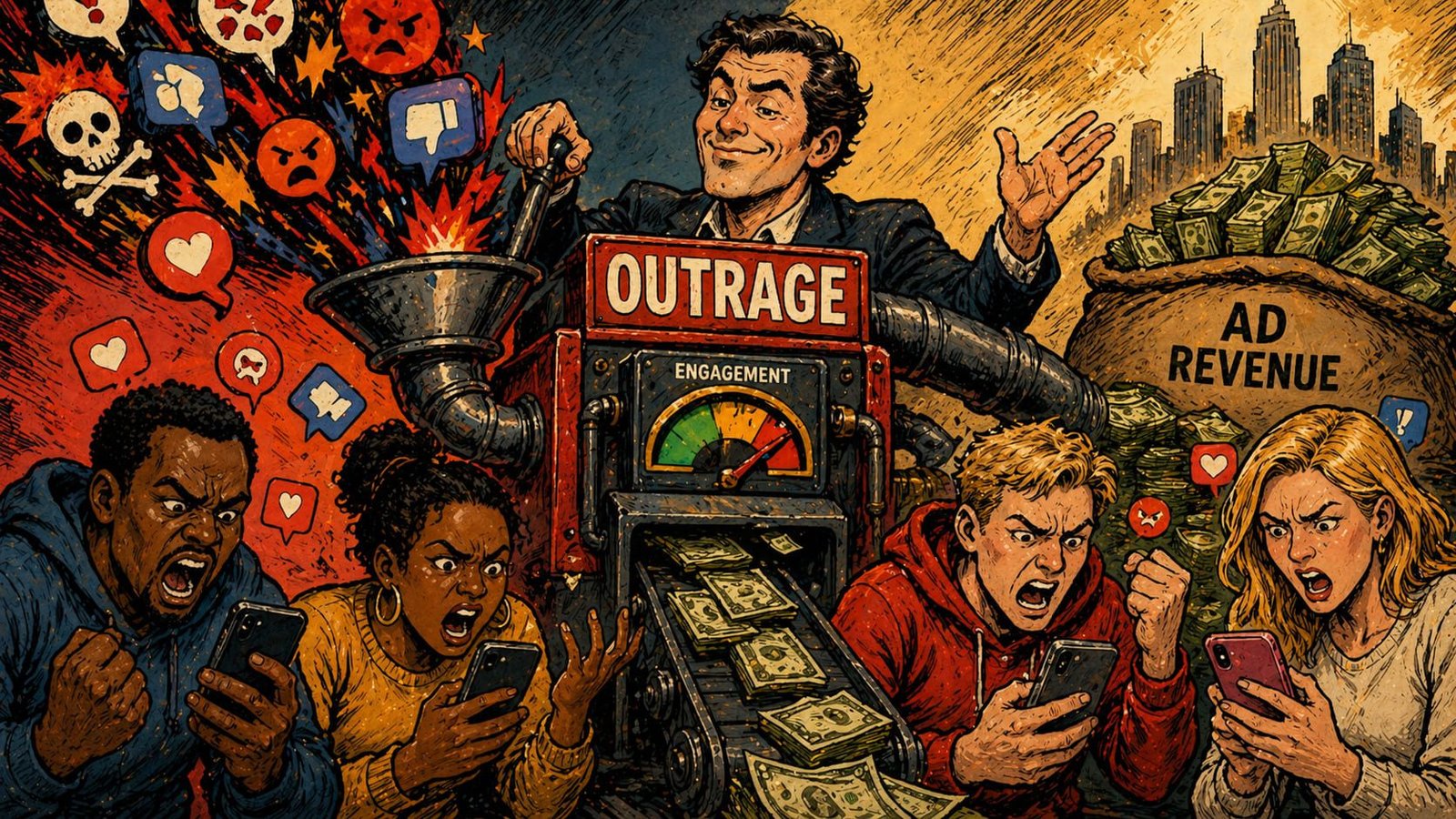
A notification pulses like a spark in dry grass, and within seconds the timeline ignites. Words sharpen, voices rise, sides harden. It feels spontaneous, almost organic, as if emotion itself has found a faster route through the bloodstream of the internet. Yet behind that surge sits a quieter engine, calibrated not for truth or resolution, but for reaction. The louder the response, the stronger the signal. The stronger the signal, the more the system feeds it.
Outrage has become a form of currency, one that circulates with remarkable efficiency. Platforms measure attention in time, clicks, and shares, but the underlying driver is often emotional intensity. The psychologist Jonathan Haidt has written about how moral emotions spread quickly through groups, binding people together while amplifying division. In a digital environment optimized for engagement, those emotions do more than connect. They convert into visibility, revenue, and influence.
The mechanism feels almost invisible until it is observed closely. A content strategist named Nura once tracked the performance of different posts for a consumer brand. Informative pieces received polite engagement. Neutral updates passed quietly. Then one post, framed with a hint of provocation, triggered a surge. Comments multiplied, debates intensified, shares climbed. The analytics dashboard lit up with activity that felt almost electric. The content itself was not more accurate or useful. It was more charged. That charge translated directly into reach.
Inside organizations, this dynamic creates a subtle but persistent pressure. A media planner named Viktor described it during a late evening review session, the room filled with the faint hum of air conditioning and the glow of performance charts. He noted that campaigns designed to provoke strong reactions often outperform those built on calm explanation. Over time, the incentive structure shifts. Teams begin to design for reaction rather than reflection. The line between informing and inflaming starts to blur.
This is where the tension becomes difficult to ignore. Outrage feels powerful, even righteous at times. It can mobilize attention, highlight injustice, force issues into the open. Yet when it becomes a default mode, it begins to distort. Complexity collapses into binaries. Nuance fades under the weight of urgency. Consider how public debates unfold online. Positions harden quickly, leaving little room for revision or dialogue. When Mark Zuckerberg has spoken about engagement, the focus often lands on connection. What remains less visible is how the architecture of that engagement can amplify division as much as unity.
A small independent newsroom in Berlin once experimented with a different approach. The editor, Anika, encouraged her team to publish pieces that slowed the conversation rather than accelerated it. The writing was deliberate, the tone measured, the framing careful. The initial response was modest. Traffic grew slowly, without spikes. Yet over time, a loyal readership formed, one that valued depth over immediacy. Anika noticed something unexpected. While outrage-driven content surged and faded quickly, the slower pieces lingered, continuing to attract readers long after publication. The contrast revealed two economies operating side by side, one driven by intensity, the other by endurance.
Pop culture mirrors this pattern in ways that feel almost theatrical. Reality shows thrive on conflict, social media amplifies moments of confrontation, viral clips often capture the most extreme reactions. These formats condition audiences to expect drama as the baseline. When calmer, more reflective content appears, it can feel underwhelming by comparison. The expectation of intensity becomes self-reinforcing, shaping both production and consumption.
The deeper consequence is not only polarization. It is emotional fatigue. Constant exposure to heightened states of anger and urgency can wear down the capacity for thoughtful engagement. A community organizer named Leila once described feeling drained after following a series of online debates. Each issue felt urgent, each reaction intense, yet little seemed to resolve. The cycle continued, leaving behind a residue of frustration rather than clarity. Outrage had mobilized attention but not necessarily understanding.
Somewhere beneath this cycle, a quieter alternative begins to take shape. It does not reject strong emotion. It repositions it. Anger becomes a signal rather than a destination, a starting point for inquiry rather than an endpoint for reaction. This shift requires a different kind of discipline, one that values pause over impulse, context over immediacy. It feels slower, less visible, often less rewarded. Yet it opens space for something more durable.
In a dimly lit café tucked between narrow streets, a writer watches the feed scroll past on a small screen, each post competing for attention with increasing urgency. The air carries the faint aroma of roasted coffee and rain-soaked pavement. Outside, conversations unfold at a human pace, voices rising and falling without amplification. Inside, the digital current continues, fast, relentless, charged. The contrast feels almost surreal.
As another wave of reaction builds, a question lingers, steady and quietly unsettling: if anger has become the fuel that keeps the system running, what happens when the supply never runs out, and who benefits from a world that cannot afford to calm down?
