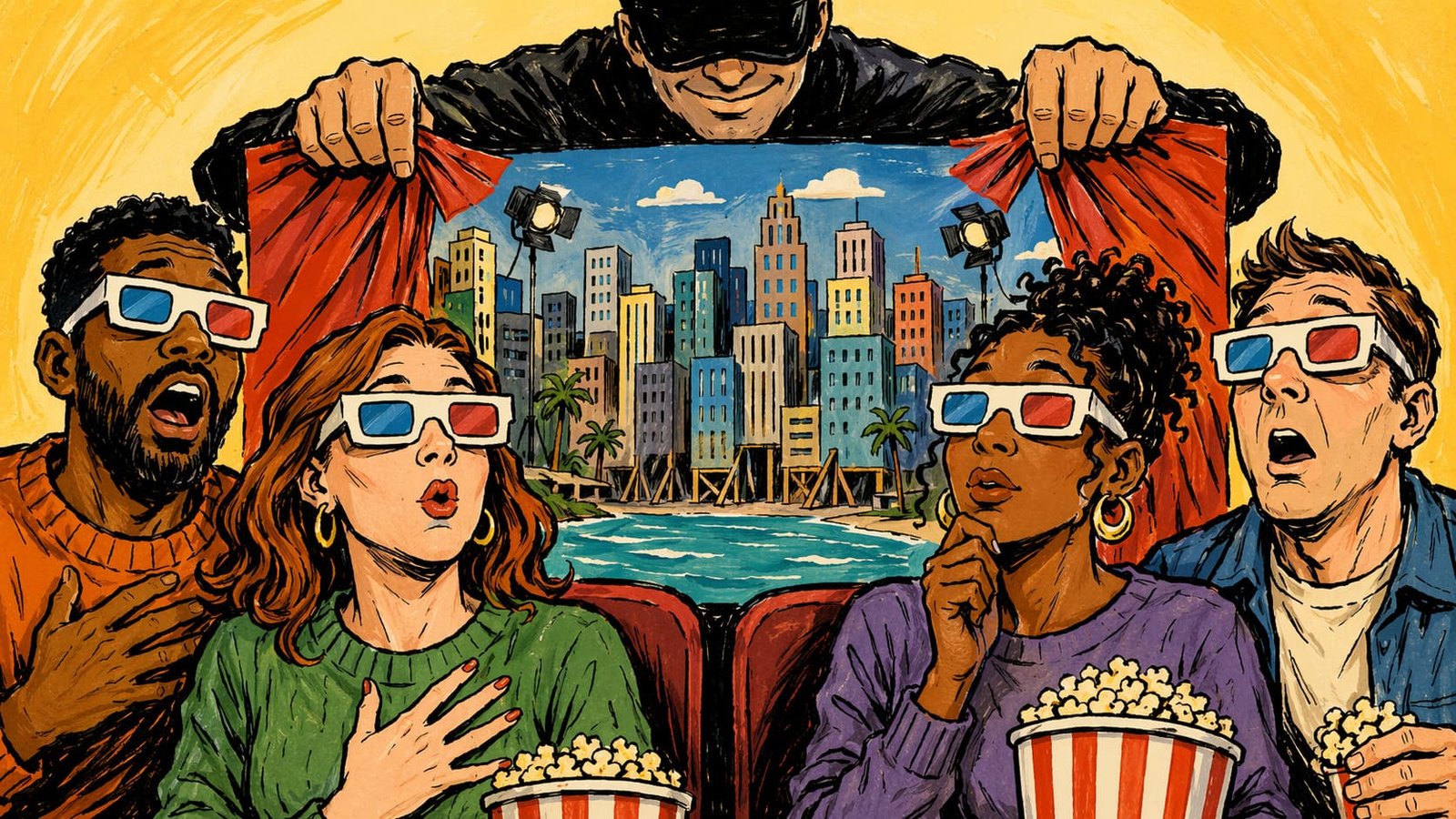
A skyline flickers into existence on a green screen stage somewhere in Los Angeles, cranes frozen in silence, extras sipping cold coffee while a digital metropolis breathes life into pixels. No wind, no history, no memory. Yet in a darkened cinema across the world, a stranger leans forward, heart racing, convinced that this city lives and aches. The illusion lands with such precision that the absence of truth becomes irrelevant. Cinema has learned a dangerous elegance: it no longer imitates reality, it replaces it.
There is something quietly unsettling about how easily the mind accepts these fabricated cities. You already know they are constructed, stitched together with software and imagination, yet the emotional response remains authentic. Think about Blade Runner 2049, where towering dystopian landscapes feel more textured than many real urban spaces. Or the shifting dreamscapes of Inception, where cities fold onto themselves like origami. These environments do not exist, yet they shape how people feel about existence. The tension sits here: truth versus emotional truth. One is factual, the other is persuasive.
A cinematographer once described modern filmmaking as “architecture without gravity.” That phrase lingers because it explains the seduction. When cities are freed from physical limits, they become expressions of desire, fear, and control. A director can remove the messiness of real infrastructure, the unpredictability of human density, the boredom of ordinary streets. What remains is distilled experience. You are not watching a place, you are absorbing a feeling engineered with precision.
Consider a producer named Elias, working on a mid-budget streaming series. He faced a decision between shooting in a real Eastern European city or building a digital version. The real location offered texture, uneven streets, unpredictable light. The digital option offered control, perfection, scalability. He chose the latter. When the show premiered, audiences praised the “immersive realism” of the setting. Elias laughed quietly during an interview, admitting that not a single brick in that city had ever existed. The audience was not deceived, they were complicit.
This complicity reveals something deeper about modern culture. People are not just consuming stories, they are rehearsing emotional realities inside fabricated environments. A teenager watching a superhero film internalizes what a city under threat feels like, even if that city is entirely synthetic. A professional unwinds with a streaming series set in an impossibly clean, hyper-designed urban landscape, slowly adjusting expectations of what real life should resemble. Over time, the imaginary begins to feel like a benchmark.
Urban theorists have started noticing this shift. The concept of hyperreality, often associated with thinkers like Jean Baudrillard, becomes less academic and more visible. The copy no longer imitates the original. The copy becomes the reference point. When real cities feel dull compared to their cinematic counterparts, dissatisfaction creeps in. You walk through a perfectly functional neighborhood and feel an absence you cannot name. It is not that the place is lacking, it is that expectation has been quietly inflated.
A location scout named Marisol once shared a small, revealing story. She spent weeks searching for a “gritty yet beautiful” neighborhood for a film. Every real location failed to meet the brief. Too clean, too chaotic, too ordinary. Eventually, the production team recreated the entire environment digitally, layering imperfections by design. Cracked walls were added intentionally. Graffiti was curated. Even the dirt was stylized. The final result looked authentic, yet it was authenticity manufactured with surgical care. Marisol later admitted that real cities had become too real to compete with fictional ones.
There is also a business logic beneath this shift. Digital cities are cheaper in the long run, easier to manipulate, and infinitely reusable. Studios no longer need to negotiate with municipalities or adapt to weather. Control becomes the ultimate currency. When Marvel Studios builds entire universes through visual effects, it is not just about spectacle. It is about owning the environment itself. A city that exists only on servers can be reshaped at will, franchised, expanded, monetized without friction.
Yet something fragile gets lost in this process. Real cities carry history in ways that cannot be fully replicated. The unevenness of architecture, the accidental beauty of aging infrastructure, the quiet stories embedded in sidewalks. When films replace these textures with controlled simulations, they offer clarity at the cost of depth. You gain visual perfection but lose the subtle chaos that makes places feel alive. The illusion becomes cleaner, sharper, and strangely emptier.
Audiences rarely articulate this loss directly. Instead, it shows up as a vague restlessness. A sense that something feels off even when everything looks right. You might notice it after leaving a theater, stepping into a real street that feels less cinematic than expected. The lighting is harsher, the scale less dramatic, the rhythm less orchestrated. It is not disappointment with reality, it is disorientation caused by prolonged exposure to enhanced fiction.
A young architect named Ravi once confessed that his design inspirations came more from films than from actual cities. He sketched buildings influenced by cinematic skylines, chasing a kind of perfection that did not exist outside screens. When one of his projects was finally built, it looked impressive in photographs but felt oddly sterile in person. Visitors described it as beautiful yet lifeless. Ravi later realized he had been designing for the camera, not for human experience.
This is where the deeper tension settles. Cinema promises emotional intensity, while reality offers complexity. One is curated, the other is lived. When audiences spend more time inside curated worlds, their relationship with complexity weakens. Patience for imperfection shrinks. The appetite for friction fades. What remains is a preference for environments that feel designed, predictable, controlled.
The cultural ripple effects extend beyond entertainment. Real estate developers now market properties using language borrowed from film. “Cinematic views,” “iconic skyline living,” “immersive urban experience.” Cities begin to sell themselves as if they are already movies. The line between representation and reality blurs further. Living becomes a kind of performance, a way of inhabiting a scene rather than a place.
There is a quiet irony in all of this. The more convincingly films create fake cities, the more real cities feel like they are failing. Not because they lack value, but because they cannot compete with something that was never constrained by reality in the first place. It is a competition with an illusion, and illusions rarely play fair.
In a dim editing room, a colorist adjusts the hue of a digital skyline, deepening the shadows, warming the lights, making the city feel more alive than any real place could sustain. Across the world, someone watches that scene and feels a strange longing, not for a specific place, but for a feeling that has no address. The screen fades, the room brightens, and the illusion lingers longer than expected.
A man stands at a real intersection later that evening, surrounded by ordinary buildings, the hum of traffic, the imperfect rhythm of life unfolding without a script. Nothing is wrong, yet something feels missing, like a melody half remembered. The city breathes, but it does not perform. It simply exists.
Somewhere between those two experiences, a quiet question begins to form, one that refuses to settle: if the places that move you most were never real, what exactly have you been learning to desire?
