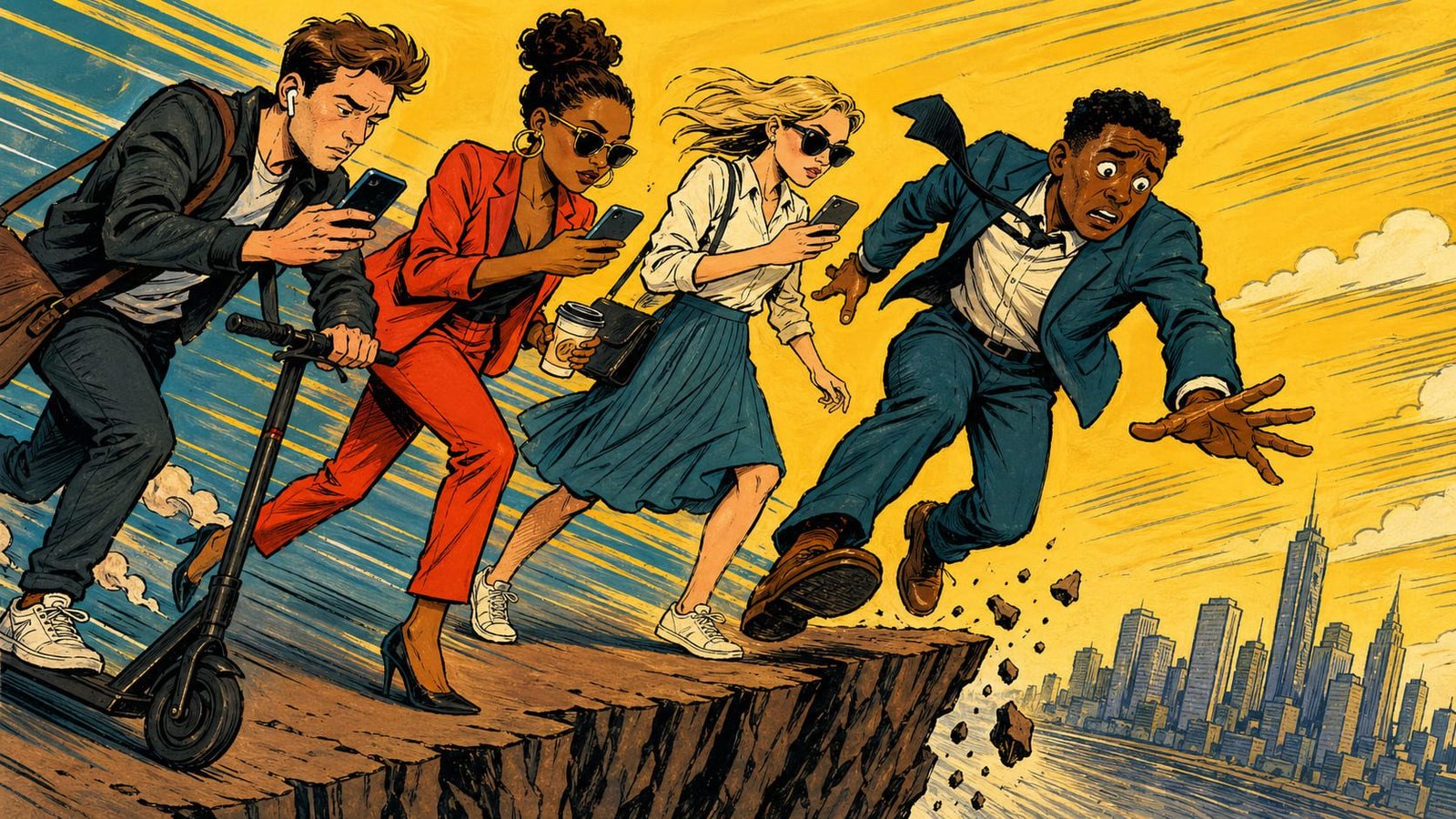
The train does not pause long enough for doubt. Doors slide open, bodies move with practiced urgency, screens glow like tiny command centers in every palm, and the rhythm of motion feels almost sacred. Somewhere between departure and arrival, time compresses into fragments. Notifications pulse, decisions stack, conversations skim the surface and move on. It all works. It all flows. Yet beneath that velocity sits a quiet disorientation, as if something slower, older, more human is struggling to keep pace with a world that no longer waits.
Acceleration has become the defining feature of modern life. Faster networks, quicker deliveries, shorter attention spans, immediate responses. Speed is framed as progress, as efficiency, as evidence that systems are improving. In many ways, they are. Tasks that once took days now take minutes. Information travels instantly. Opportunities appear and disappear in rapid cycles. The surface story is one of advancement. The deeper story is more complicated. As systems accelerate, the human capacity to process, reflect, and integrate does not expand at the same rate. The result is a subtle but persistent misalignment.
A product manager named Soren felt this misalignment during a product launch that unfolded with surgical precision. The team had executed flawlessly, timelines met, metrics exceeded, feedback loops tightened. On paper, it was a success. Yet in the quiet hours after the launch, Soren noticed a strange emptiness. There had been no time to feel the work, no space to sit with what had been built or why it mattered. The entire process had been optimized for speed, leaving little room for meaning to catch up. The next project began almost immediately, and the feeling repeated, faint but consistent, like an echo that refused to fade.
Speed reshapes not only work but perception. It compresses experiences into highlights, reduces complexity into quick takes, and favors immediacy over depth. In media, stories are consumed in fragments, headlines replace narratives, and context becomes optional. In relationships, communication becomes efficient but often thin, more frequent yet less substantial. Even rest is optimized, turned into something to be scheduled, tracked, and improved. The language of acceleration seeps into every corner, subtly redefining what it means to live well.
There was a writer named Keiko who built a following through sharp, thoughtful essays that required time both to write and to read. As her audience grew, so did the pressure to produce more frequently, to stay visible in a landscape that rewarded constant output. She adapted, shortening her pieces, simplifying her arguments, publishing more often. Engagement increased. Reach expanded. Yet something in the work began to feel diluted. One evening, after posting a piece that performed exceptionally well, she reread it and felt a quiet dissatisfaction. It was clear, concise, and widely appreciated. It also lacked the depth that had once defined her voice. The acceleration had amplified her presence while thinning her substance.
Technology does not force this shift, but it enables it. Platforms are designed for engagement, for speed, for continuous interaction. They reward what is immediate, what is easily consumed, what can be processed quickly. That design shapes behavior, often without conscious awareness. People begin to think in shorter loops, to value responsiveness over reflection, to equate activity with progress. The system is efficient. It is also relentless.
The tension here is not between technology and humanity, but between pace and presence. It is the gap between what is happening and what can be fully experienced. When that gap widens, life begins to feel like a series of events that are completed but not absorbed. Achievements accumulate, but their significance remains shallow. Experiences multiply, but their impact diminishes. The soul, if one chooses to use that word, does not stumble dramatically. It simply lags behind, unable to keep up with the speed at which life is moving.
A founder named Rafael once described this feeling during a conversation that stretched late into the night, long after the usual cadence of his days. His company was growing rapidly, opportunities arriving faster than he could evaluate them. He spoke of decisions made quickly, sometimes correctly, sometimes not, but always with the same urgency. At one point, he paused and admitted something that did not fit the narrative of success. “It feels like everything is happening to me before I can understand it.” The admission was quiet, almost reluctant, but it captured the essence of acceleration. When speed dominates, comprehension becomes secondary.
Pop culture mirrors this dynamic in subtle ways. Films are edited more tightly, scenes cut faster, narratives move with less pause. Music shifts toward shorter tracks, designed to capture attention quickly. Even trends themselves accelerate, rising and fading in cycles that feel almost absurd in their brevity. The cultural environment becomes a kind of current, pulling everything forward at a pace that discourages stillness.
Yet there are moments when the current slows, often unexpectedly. A delayed flight that forces stillness. A conversation that stretches without interruption. A piece of art that demands attention rather than offering it easily. In those moments, something recalibrates. Time expands, even if briefly. The mind catches up. The experience deepens. These moments feel different, not because they are rare, but because they resist the dominant rhythm.
In a small coastal town, far from the usual circuits of urgency, a chef named Lina closed her kitchen early one evening after a particularly busy season. She sat alone at a wooden table, the air carrying the faint scent of salt and citrus. There was no schedule pressing in, no notifications demanding response. For the first time in months, the day did not feel like a sequence to be completed, but something to be inhabited. The simplicity of that shift was striking. Nothing extraordinary had happened. The pace had simply slowed enough for experience to settle.
The question that emerges from these observations is not whether acceleration can be reversed. It likely cannot, at least not on a broad scale. The systems that drive it are deeply embedded, continuously evolving, and widely accepted. The more relevant question is how individuals navigate within that environment. How they create pockets of slowness within speed, moments of depth within flow, spaces where meaning has time to form.
This navigation requires intention. It asks for choices that may seem inefficient in a culture that prizes optimization. It involves resisting the impulse to fill every gap, to respond instantly, to move on before something has been fully understood. It is not about rejecting progress, but about refusing to let pace dictate experience entirely. It is about reclaiming a measure of control over how life is lived, even within systems that encourage the opposite.
Somewhere between two stops on a line that never truly rests, a figure looks up from a glowing screen and notices, perhaps for the first time that day, the quiet details of the world passing by. The movement continues, the rhythm unchanged, but something in the perception shifts. The moment stretches, just slightly, enough to feel it rather than simply move through it.
In that brief expansion, a question forms, steady and difficult to ignore: if life keeps moving faster, who or what is still allowed to keep up with it?
