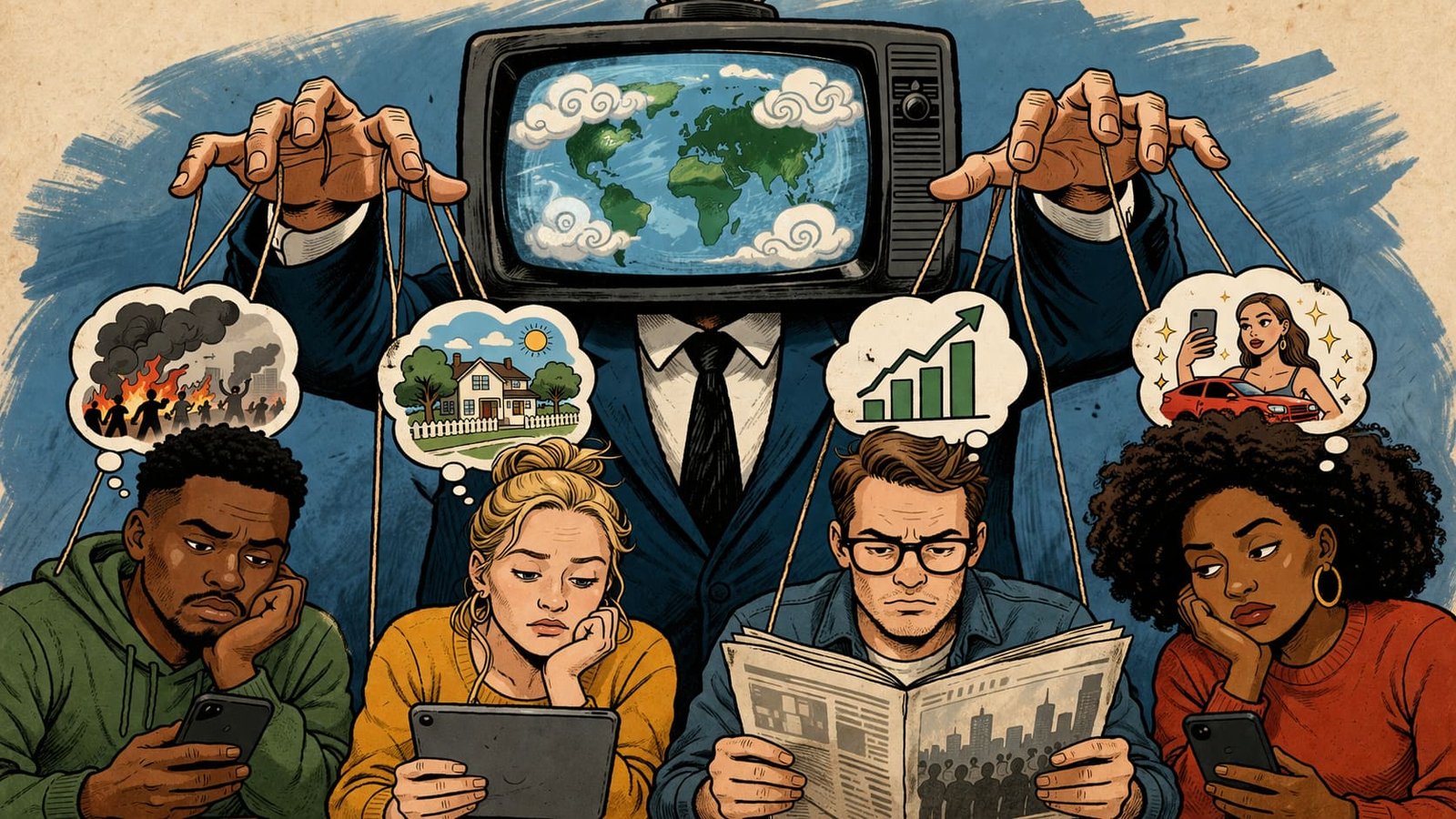
A quiet kind of power hums beneath the glow of every screen, soft enough to feel harmless, sharp enough to redraw the edges of reality without permission. It does not arrive like a tyrant. It behaves more like weather, surrounding, shaping, saturating everything until resistance feels unnatural. Somewhere between a breaking news alert and a late-night scroll, whole worlds are assembled in fragments, stitched together by images, headlines, and tones that seem incidental but are anything but. A person does not notice the shift at first. They simply begin to feel that certain things are obvious, others unthinkable, and a few quietly impossible.
That shift rarely announces itself. It hides in repetition, in framing, in the strange comfort of familiarity. When a crisis is shown through a particular lens enough times, it stops being one version of events and becomes the event itself. The philosopher Jean Baudrillard once suggested that simulations can replace reality, not by force but by saturation. It sounds abstract until you watch how quickly a narrative solidifies after a few cycles of coverage. A protest becomes chaos or courage depending on the edit. A leader becomes decisive or reckless depending on the soundtrack. The audience does not inherit facts. They inherit a constructed atmosphere that feels like fact.
There is a particular moment when this construction becomes personal. It happens quietly, often alone, often at night. A product manager named Idris once sat with three tabs open, each covering the same geopolitical tension. One spoke in alarm, another in measured analysis, the third in outright dismissal. By morning, Idris did not feel informed. He felt aligned. Not because he had verified anything, but because one version felt more coherent with the emotional rhythm he had been absorbing for months. The selection did not feel like a choice. It felt like recognition. That is how media builds worlds. It offers not just information but belonging.
The machinery behind this is less mysterious than it appears. Editors choose angles. Algorithms reward engagement. Producers shape pacing. Each layer introduces a preference, sometimes conscious, often not. Over time, those preferences compound into something that feels like gravity. A marketing director named Selina once described it in a meeting while sipping cold espresso that had gone slightly bitter, saying that audiences do not chase truth, they chase consistency. Her team noticed that campaigns aligned with prevailing narratives performed better, even when the data behind them was weaker. Consistency felt safer than accuracy. It felt like home.
This is where the tension sharpens. Reality is messy, layered, often contradictory. Media, by design, prefers clarity. It trims edges, removes friction, highlights patterns. The result is a version of the world that is easier to consume but harder to question. Consider how business success stories are often told. Founders appear visionary in hindsight, decisions seem inevitable, failures are framed as necessary steps rather than chaotic missteps. When Elon Musk speaks about risk, it lands differently because the narrative around him has been curated to amplify boldness over uncertainty. The complexity remains, but it is edited into something cleaner, more digestible, more myth-like.
A small design studio in Lisbon once ran an internal experiment. The founder, Marta, asked her team to track how their perception of a competitor changed after a week of reading only curated positive coverage. By the end, the competitor felt almost untouchable, despite no change in actual performance. When the team then reviewed critical pieces, the perception swung back, not to neutrality, but to confusion. Marta noted something unsettling. The team trusted the feeling created by repetition more than the conflicting evidence. It was not about truth anymore. It was about narrative stability.
Pop culture reinforces this architecture in ways that feel almost playful. Films, series, and even memes rehearse patterns that later appear in news coverage. The lone genius, the corrupt system, the sudden redemption. These are not just stories. They are templates. When reality unfolds, it is interpreted through these templates because they are familiar, emotionally satisfying, and easy to process. A journalist once admitted during a panel that audiences respond better when real events resemble the arcs they already recognize. It is not manipulation in the traditional sense. It is alignment with expectation. The danger is subtle. When reality does not fit the template, it risks being ignored or reshaped until it does.
The deeper consequence is not misinformation alone. It is orientation. People begin to navigate the world using borrowed maps. They develop instincts that feel personal but are quietly outsourced. A young analyst named Koen once realized this during a debate at a conference in Rotterdam. He caught himself repeating a stance he had heard multiple times online, delivered with confidence but lacking any personal grounding. The realization was not dramatic. It was quiet, almost embarrassing. The thought felt less like his own and more like something he had been handed, polished, and rehearsed without consent.
And somewhere, in a room filled with screens and soft electric light, a different kind of awareness begins to take shape. Not a rejection of media, but a recalibration. A recognition that every story arrives with a frame, every frame carries a bias, and every bias shapes perception in ways that are easy to overlook. The world does not become less complex when seen through media. It becomes selectively illuminated. Shadows deepen in places that receive less attention. Highlights intensify where focus lingers.
There is a moment, difficult to describe, when this realization stops being intellectual and becomes visceral. It feels like standing in a gallery where every painting subtly shifts depending on where the light falls. Nothing is entirely false. Nothing is entirely complete. The viewer begins to notice not just the image, but the lighting itself. That awareness does not provide easy answers. It introduces a different kind of responsibility, one that is less about consuming more information and more about questioning the structure of what is already seen.
And then a quiet question lingers, almost stubborn in its simplicity, refusing to leave: if the world being perceived has been carefully assembled piece by piece, how much of it was ever truly chosen, and how much of it quietly chose you?
