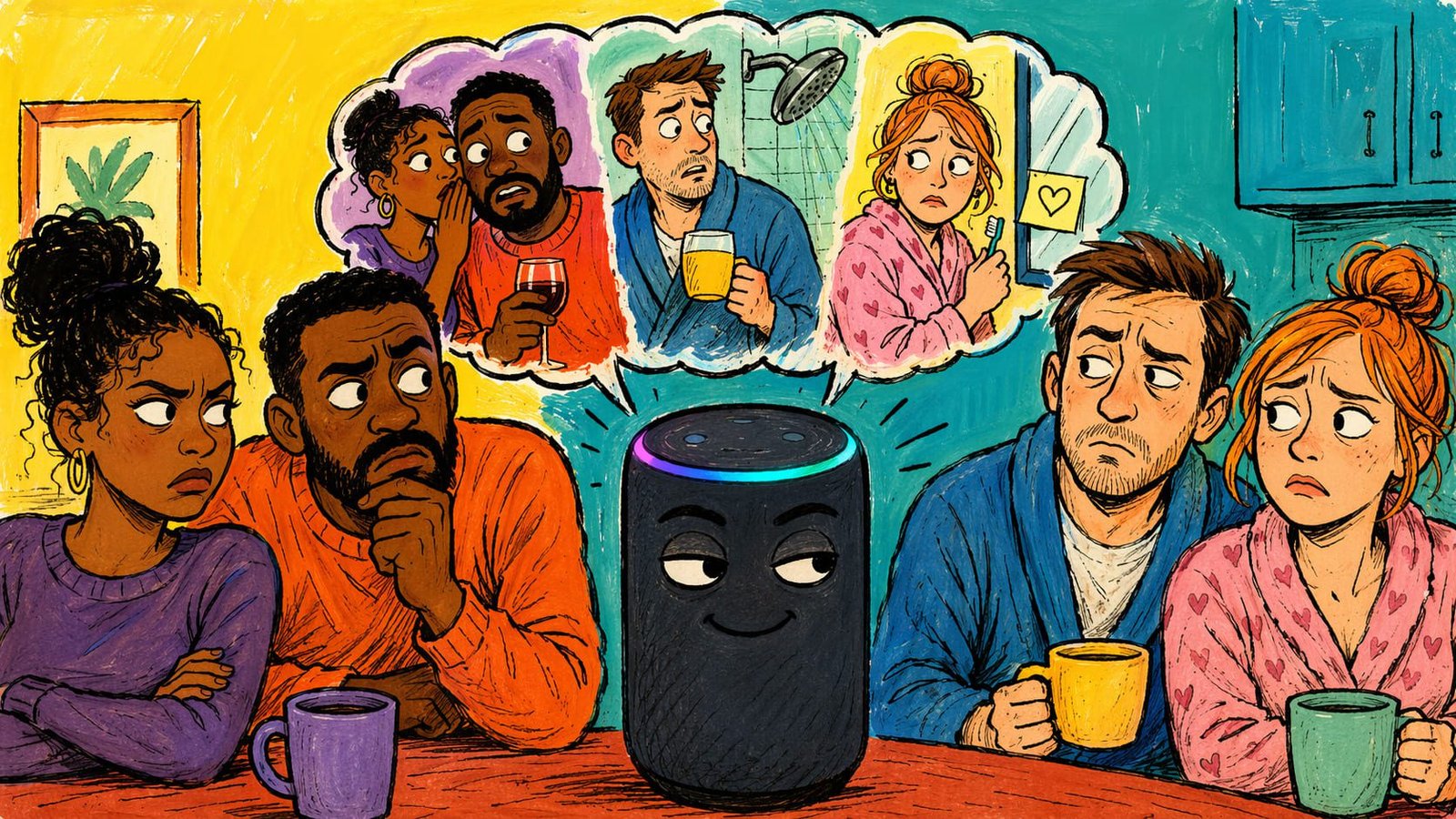
A quiet room carries more than silence now. A phone rests face down on a table, still, unassuming, almost polite. No one speaks, yet something is always receiving. Not in a dramatic, cinematic way. No flashing lights. No whispered warnings. Just a constant readiness, like a door that never fully closes. The modern device does not sleep in the way people imagine. It waits.
Voice assistants were introduced as helpers, small conveniences that turned commands into action. Lights dimmed. Music played. Questions answered instantly. It felt efficient, almost magical. The friction of daily tasks dissolved into simple requests spoken into the air. What began as novelty became habit. And habit, once formed, rarely invites scrutiny.
The deeper reality is less theatrical but more unsettling. Devices are designed to detect activation words, which means they are always listening at a low level, filtering sound for a signal. Companies like Amazon and Google have built entire ecosystems around this capability. The intention is functionality, not surveillance in the traditional sense. Yet the distinction matters less when the effect feels similar. A presence that is always attentive, always ready to interpret.
There have been moments when this system has revealed its edges. Reports surfaced of voice recordings being reviewed by human contractors to improve accuracy. Users discovered that snippets of private conversations, captured unintentionally, had traveled beyond their homes. The companies responded, adjusted policies, introduced more controls. The system evolved, but the underlying dynamic remained. Listening is not occasional. It is continuous by design.
Consider Samuel, a lawyer who installed a smart speaker to streamline his routines. Over time, he noticed something odd. Conversations about specific topics seemed to echo later in subtle ways, through ads or suggestions. While direct causation is difficult to prove, the pattern felt consistent enough to unsettle him. He began to question not just what the device could hear, but what it could infer. Eventually, he unplugged it. The silence felt heavier at first, then strangely restorative.
The trade-off between convenience and privacy is often framed as a conscious choice. In reality, it rarely feels that explicit. Features are introduced gradually. Permissions are accepted quickly. The benefits are immediate. The costs are abstract, distant, difficult to measure. Over time, what once felt intrusive becomes normal. The threshold shifts. What would have been unacceptable a decade ago now passes without comment.
A privacy advocate like Edward Snowden has long argued that surveillance does not need to be overt to be effective. It can operate quietly, embedded in systems that people rely on daily. The power lies not in constant observation, but in the possibility of observation. That possibility shapes behavior, often without conscious awareness. People adjust, not because they are forced to, but because the environment suggests it.
A small but telling example comes from Priya, a marketing executive who once joked with a colleague about a niche product during a meeting. Later that evening, she noticed advertisements related to that exact topic appearing across her devices. The coincidence may have been algorithmic, based on broader data patterns. Yet the experience felt personal, almost intrusive. It created a moment of doubt, a question about how much of her environment was truly private.
The architecture of modern technology is built on data. Listening is one part of a larger system that collects, analyzes, and predicts behavior. The goal is optimization, to make services more relevant, more responsive, more aligned with user needs. This alignment is what makes the system feel valuable. It anticipates, adapts, improves. Yet it also narrows the space between action and response, reducing the unpredictability that once defined human interaction.
There is a subtle psychological shift that accompanies this constant presence. People begin to curate their environments, not just visually, but verbally. Certain topics are avoided. Certain phrases are softened. The awareness may not be conscious, but it exists. The idea that something could be listening, even passively, introduces a layer of caution. It is not fear in the dramatic sense. It is adjustment.
In a modern living room, a conversation pauses briefly as someone glances at a device sitting quietly in the corner. The moment passes. The conversation resumes. Nothing outward changes. Yet the awareness lingers, faint but persistent. The device remains, integrated into the space, offering convenience with a quiet expectation of access.
The question is not whether technology should exist in this form. It already does, deeply embedded in daily life. The question is how that presence is understood, how it is managed, how boundaries are defined in a landscape where boundaries are increasingly fluid.
In that quiet, almost imperceptible exchange between human and machine, a thought begins to surface, not loudly, but with steady clarity: if convenience requires constant listening, what exactly have you agreed to be heard?
