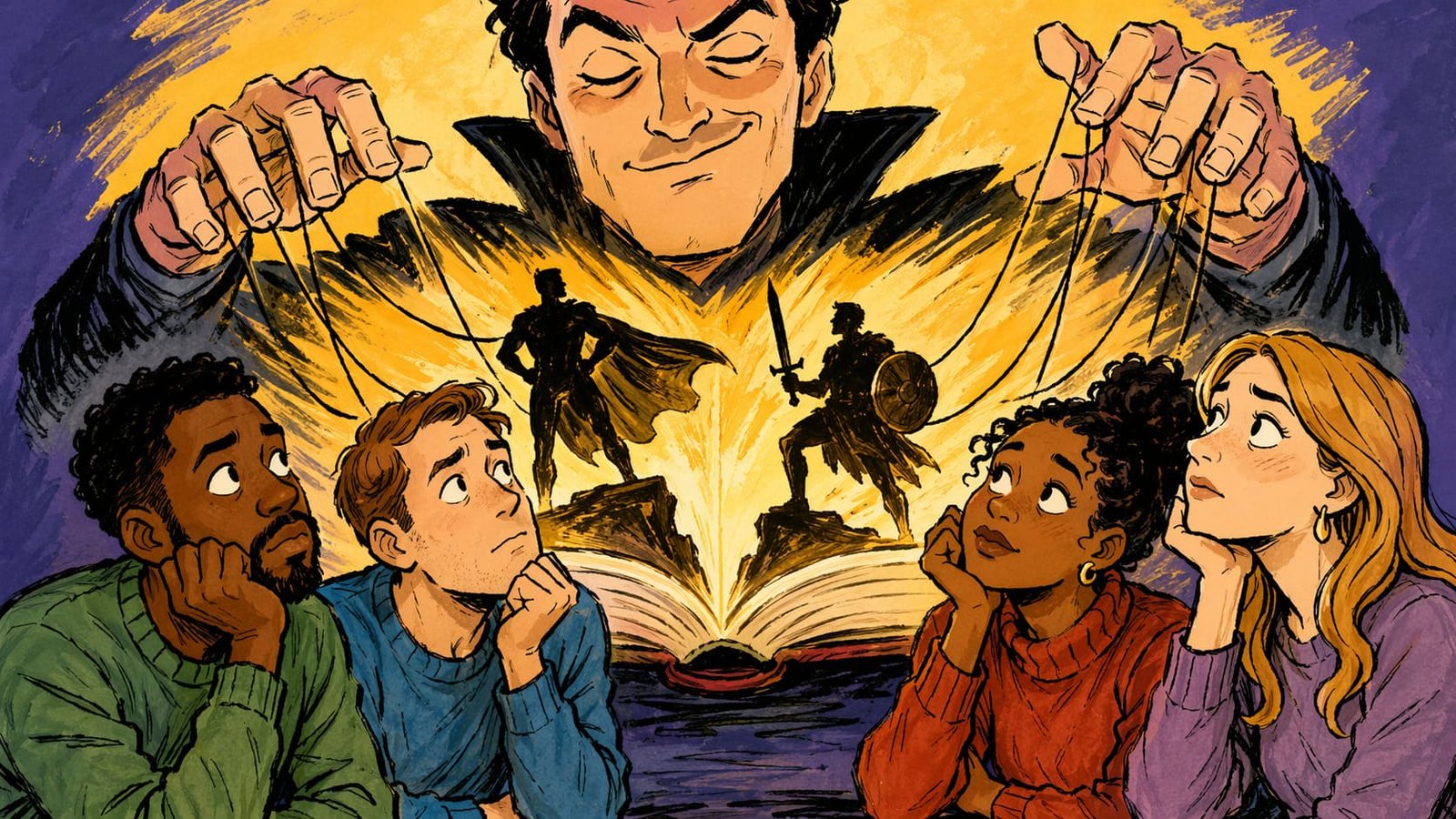
A stadium roars under blinding light, the kind that turns individuals into symbols. A figure stands at the center, larger than life, every gesture amplified, every word echoed. The crowd does not just watch. It aligns. Something in the posture, the certainty, the narrative feels reassuring. Leadership appears clear, direction unquestioned. In that moment, admiration slides easily into acceptance. The hero is not just being observed. The hero is being trusted to define what matters.
Hero narratives rarely present themselves as lessons in obedience. They arrive as stories of courage, resilience, vision. The structure feels familiar. A challenge emerges, a figure rises, order is restored. The pattern satisfies something deep, a desire for clarity in a complex world. Yet within that structure lies a quiet instruction. It suggests that progress often depends on following someone who sees more clearly, acts more decisively, knows more than the rest.
A young analyst named Omar once noticed this during a strategy meeting. His team frequently referenced a well-known business leader celebrated for bold, unilateral decisions. The admiration was genuine. The results were impressive. Over time, however, the team began to mirror not just the outcomes, but the style. Debate shortened. Dissent softened. The leader’s approach became a template. Omar realized that the influence extended beyond inspiration. It shaped how authority was perceived and accepted.
This pattern appears across entertainment, history, and modern storytelling. Heroes are often portrayed as individuals who cut through uncertainty, who act when others hesitate. Their confidence becomes a signal of correctness. The audience, drawn to that clarity, begins to associate decisiveness with legitimacy. The complexity of collective decision-making fades into the background, replaced by the appeal of singular vision.
A small tech company experienced this shift in a subtle way. The founder, Elena, built her reputation on making fast, confident calls. Early success reinforced the approach. Employees admired her decisiveness, often deferring to her judgment even when they had alternative ideas. Over time, the culture adjusted. Initiative narrowed. The team became efficient, but less exploratory. Elena had not demanded obedience. The narrative of her success had encouraged it.
Sociologists often point to the role of narratives in shaping perceptions of authority. When stories consistently reward certain behaviors, they create expectations. If heroes succeed by acting alone, collaboration can feel secondary. If heroes are portrayed as infallible, questioning them can feel unnecessary or even disloyal. These patterns do not dictate behavior, but they influence what feels appropriate in a given context.
A film producer named Marcus once reflected on this during a panel discussion. He noted that audiences often respond more strongly to characters who act with certainty, even when that certainty is flawed. The emotional impact of decisive action can overshadow the value of deliberation. Marcus admitted that this influenced how stories were written. The goal was engagement, and engagement often followed clarity, even if that clarity simplified reality.
There is a tension at the heart of hero narratives. They provide direction and inspiration, yet they can also reduce complexity. Real-world decisions often require nuance, multiple perspectives, and a willingness to question assumptions. When narratives prioritize singular authority, they risk overshadowing these elements. The result is not overt control, but a subtle shift in how authority is understood and accepted.
A consultant named Priyanka once encountered this during a corporate transformation project. Leadership encouraged open dialogue, yet employees hesitated to challenge senior figures. The hesitation was not enforced. It was internalized. Years of observing hierarchical decision-making had shaped expectations. Priyanka realized that changing processes was not enough. The underlying narratives about authority needed to be addressed.
Hero stories also shape identity. People often align themselves with the traits they admire. If those traits emphasize certainty, dominance, or control, they can influence how individuals approach their own roles. This alignment feels natural, even empowering. Yet it can limit the range of behaviors considered valid. Qualities like doubt, collaboration, or restraint may be undervalued, not because they lack merit, but because they are less visible in dominant narratives.
A writer named Daniel once explored this idea in a series of essays. He argued that the most compelling heroes are not those who eliminate uncertainty, but those who navigate it openly. His work gained attention, suggesting a growing appetite for more nuanced representations. Still, the broader landscape remained oriented toward clarity and decisiveness. The tension between complexity and simplicity persisted.
Somewhere in a writer’s room, a new hero is being crafted. The character will face obstacles, make choices, and emerge with a sense of purpose that resonates. The audience will connect, admire, perhaps even emulate. Beneath that connection, a quieter influence will take hold. The story will suggest how authority should look, how it should act, how it should be followed.
That narrative settles into memory, shaping expectations in ways that feel intuitive, a question lingers with quiet force: are you inspired by the heroes you admire, or slowly learning how to stand behind them without question?
