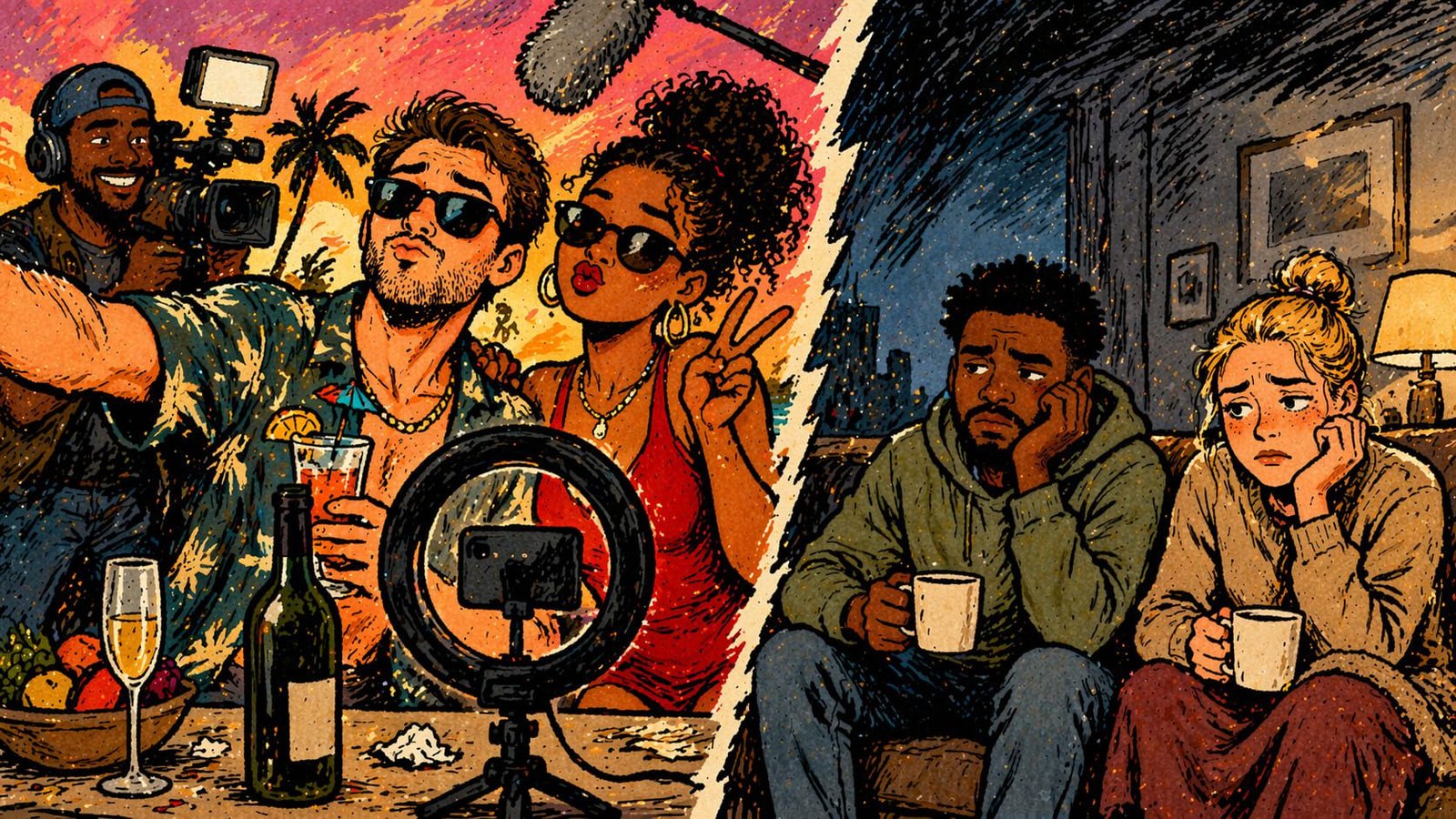
The camera does not blink anymore. It hovers, patient and omnipresent, waiting for something worth capturing or something that can be made to look that way. A conversation begins, pauses, restarts with a slightly sharper tone. A laugh arrives half a second too late, almost as if it checked for approval before existing. Reality unfolds, then subtly adjusts itself, aware that it is being watched. Somewhere between authenticity and awareness, the line dissolves.
There was a time when the mockumentary felt like a clever trick, a playful distortion of truth designed to expose how absurd real life could be. Shows like The Office turned ordinary workplace moments into something both exaggerated and painfully familiar. The humor came from recognition. Characters believed they were being real, while the audience saw the performance beneath it.
Now the structure has escaped the genre. It has moved into everyday life. People speak as if they are being interviewed, narrating their own experiences with a subtle layer of self-awareness. Social platforms reward this behavior, amplifying those who can package reality into something that feels both spontaneous and curated. The performance is no longer hidden. It is expected.
This shift did not announce itself. It emerged gradually, as cameras became smaller, then invisible, then internalized. The lens moved from external devices into the mind. People began to anticipate how moments would be perceived before they were fully lived. The result is a strange dual consciousness, where experience and presentation happen simultaneously.
You can see it in the way stories are told. A simple event is framed with context, pacing, and a hint of irony, as if it were already being edited for an audience. The language carries a rhythm that feels rehearsed, even when it is not. Authenticity becomes something performed convincingly rather than experienced naturally.
Marcus, a content strategist working with emerging creators, once described a client who struggled with this tension. She wanted to share her daily life without turning it into a spectacle. Each time she recorded, her tone shifted, becoming sharper, more animated, slightly less her own. She would watch the footage back and feel a quiet discomfort. The version of herself on screen was engaging, but unfamiliar. Growth followed. So did a subtle sense of distance from her own experiences.
This dynamic reflects a broader cultural adaptation. Visibility has become a form of capital. Being seen, being recognized, being shared carries tangible benefits. The incentive to perform reality grows stronger, not because people are inauthentic, but because the system rewards those who can make authenticity legible and engaging.
The language of documentary itself has evolved. Traditional formats aimed to capture truth through observation, accepting that the presence of a camera always alters behavior. Mockumentary inverted that premise, highlighting the artificiality within the real. Today, both forms converge. The awareness of being observed is no longer a disruption. It is part of the experience.
Pop culture mirrors this convergence. Films like Borat blurred the line between staged and spontaneous, revealing how easily people slip into performance when placed in a frame. The humor worked because it exposed something uncomfortable. That same instinct now operates at scale, embedded in everyday interaction.
There is a psychological cost to this constant framing. When every moment carries the potential to be shared, the pressure to make it meaningful increases. Ordinary experiences begin to feel insufficient unless they can be narrated compellingly. Silence becomes awkward, not because it lacks value, but because it lacks content.
Friendships adapt in subtle ways. Conversations include an awareness of how they might sound if retold. Humor becomes slightly sharper, more quotable. Even vulnerability can take on a performative edge, shaped to resonate rather than simply exist. The boundary between genuine expression and crafted narrative becomes harder to locate.
A small production company experimenting with unscripted formats once conducted an unusual exercise. They asked participants to spend a day without recording, sharing, or documenting anything. At first, the absence felt liberating. Then it became unsettling. Without the option to frame their experiences, participants reported feeling less certain about how to interpret them. The act of narration had become a way of understanding reality itself.
This reveals a deeper shift. Performance is no longer just about external validation. It has become a tool for internal coherence. By shaping experiences into stories, people make sense of them. The risk is that the story begins to take precedence over the experience, subtly guiding behavior toward what can be narrated well.
The economic layer reinforces this pattern. Platforms prioritize content that engages quickly and consistently. Creators learn to anticipate these dynamics, adjusting their behavior accordingly. The feedback loop tightens. What works is repeated. What feels natural is reshaped to fit what performs.
Yet there is a quiet resistance emerging. Some individuals deliberately step away from constant documentation, seeking spaces where presence is not mediated by potential visibility. These choices are often small, almost invisible, but they carry weight. They suggest a desire to reclaim experiences that do not need to be framed.
A filmmaker known for observational work once described watching a group of people interact without cameras. The conversation was slower, less polished, occasionally awkward. It lacked the sharp edges that make for compelling footage. It also felt more grounded, less strained. The absence of performance revealed something simple and rare.
The tension between reality and performance is not new, but its scale is unprecedented. What was once a stylistic choice has become a cultural default. The question is not whether people perform. It is how much of that performance shapes their sense of self.
In a quiet corner of a city park, a group sits together without devices in hand. The conversation drifts without direction, pauses stretching longer than usual. There is no audience, no implicit framing. The moment feels slightly unfamiliar, almost unstructured. Then it settles. The lack of performance becomes its own kind of presence.
This is where the possibility of recalibration begins. Not through rejection of the tools that enable visibility, but through a more conscious relationship with them. Recognizing when performance serves expression, and when it replaces it. Allowing some moments to remain unshaped, unshared, simply lived.
The camera will not disappear. The instinct to narrate will remain. What can change is the space people allow for experiences that do not need to be turned into stories. The moments that resist framing may be the ones that carry the most meaning.
And somewhere between what is lived and what is shown, a quieter form of reality waits, not asking to be performed, only to be noticed.
