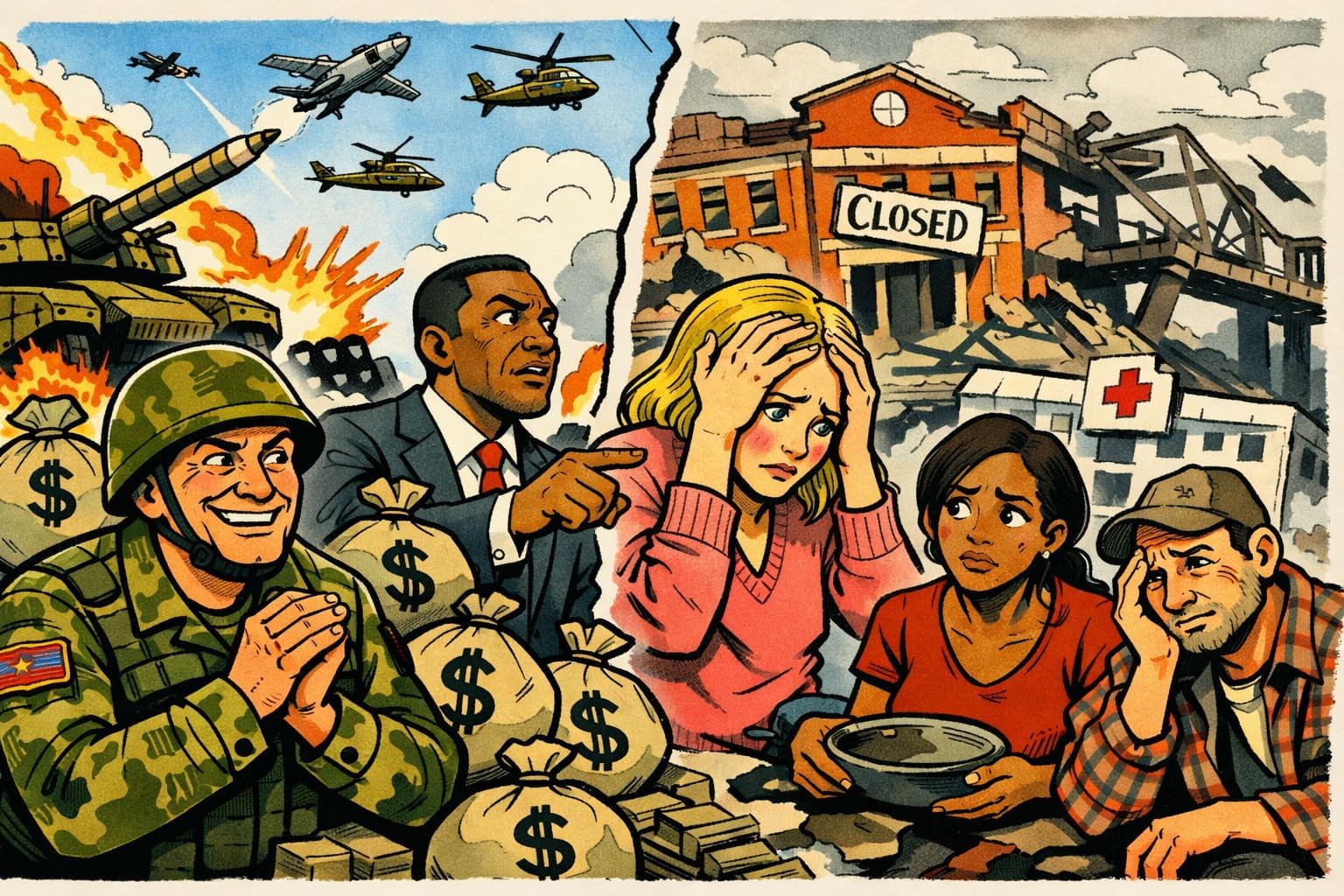
The budget table looks different when war moves from television to doctrine. Chairs pull tighter. Voices lower. Defense ministers stop sounding like procurement nerds and start sounding like surgeons in a corridor. Suddenly, money that once had ten competing suitors acquires a single, irresistible claimant called security. In that moment the state rediscovers an ancient habit: when danger rises, civil priorities are told to wait outside. War spending does not merely add new bills. It changes the emotional hierarchy of government.
There are times when this shift is not only justified but unavoidable. A country facing direct threat cannot conduct itself like a sleepy shopping district debating bench colors. Deterrence matters. Ammunition matters. Cyber defenses matter. Industrial capacity matters. The problem is that the defense turn rarely occurs in a vacuum. It lands on budgets already strained by debt service, ageing populations, climate adaptation, healthcare costs, and political promises that were expensive even before geopolitics caught fire. That is why military spending is not just a security story. It is a fiscal reordering with human consequences.
SIPRI reported that global military expenditure reached a record level in 2024, with especially rapid growth in Europe and the Middle East, and it has also highlighted how higher military spending creates trade-offs with other forms of public and international spending when resources are limited. NATO’s 2025 summit in The Hague pushed the security conversation even further by endorsing a much higher benchmark for defense-related investment.
What collapses first is not always welfare or healthcare in a direct, cinematic slash. More often it is optionality. A housing program becomes “under review.” Rail modernization slows. cultural budgets get treated like decorative cushions on a sinking boat. Universities face restraint. Aid becomes politically exposed. The civilian state loses elasticity because defense absorbs urgency better than almost any rival claim. Security spending has a rhetorical superpower. If a minister asks for more missiles, critics are made to sound naïve. If a minister asks for more mental health funding, the reply is often a spreadsheet wearing a frown.
A port city once celebrated a new defense contract that brought jobs, overtime pay, and a sense of national purpose. Cafes filled up. Workshop lights stayed on late. Yet in the same regional budget, flood resilience work slipped back, and a social care expansion vanished into “future consideration.” Nobody was irrational in that sequence. The defense money felt immediate and patriotic. The missing floodwall did not. Still, when the next storm arrived, the city learned the hard way that national strength has a strange habit of leaking if local systems fail.
There is an old political trick in times like these. Leaders imply that defense spending exists above ideology, as though it were pure reality while everything else remains opinion. That framing is too neat. Military budgets also contain waste, lobbying, prestige projects, and institutional inertia. They are not exempt from scrutiny simply because the language around them is draped in flags. A fiscally serious government can strengthen defense while still asking what builds genuine capability, what mainly enriches contractors, and what quietly crowds out the social foundations that make resilience possible in the first place.
The hardest truth is that civil priorities are part of national security too. A brittle health system weakens crisis response. Crumbling infrastructure damages logistics. Poor housing strains labor markets and social stability. Weak schools erode the skills base needed for advanced manufacturing and cyber capability. A hungry, distrustful population does not become strategically confident because the procurement deck uses bold fonts. Real security is not only a matter of hardware. It is also the endurance of the society behind it. War spending that hollows that society can produce a polished shell with a tired heart.
That contradiction is why fiscal strategy matters more than military slogans. Countries facing legitimate security threats need more than bigger budgets. They need sequencing, institutional discipline, local industrial logic, and public honesty about trade-offs. Defense-first politics without defense reform is just expensive theater. It buys volume, not always effectiveness. It can also trap governments in a familiar bind: once civil priorities have been squeezed to elevate security, any attempt to restore balance gets portrayed as softness. The budget becomes a hostage to its own war language.
Pop culture understands this better than many white papers. Every dystopian franchise eventually discovers the same plot twist. The fortress built to save the people starts forgetting what people were for. A state can harden itself into something impressive and still lose the softer systems that make life worth defending. That is the fiscal danger hidden inside the defense surge. Not that security spending exists, but that it begins claiming moral superiority over every competing use of public money. Once that happens, the ordinary citizen becomes a background character in a story supposedly written for them.
None of this argues for pacifist budget fantasy. The world is rougher now. That is obvious. The argument is sharper than that. A government serious about security must be equally serious about what security is protecting. The strongest states build arsenals and drainage systems, cyber teams and clinics, munitions plants and classrooms. They resist the lazy choice between guns and society because the choice is false over the long run. Underfund the civil base long enough and the defense posture itself becomes brittle, costly, and politically corrosive.
The budget, in the end, reveals a country’s emotional reflexes. Under stress, does it only know how to harden, or can it also preserve? Can it strengthen deterrence without starving the social tissue that makes democratic endurance possible? These are not soft questions. They are among the hardest in economics because they force a nation to price fear against continuity. That price is never paid only in money. It is paid in silence too, in the deferred clinic, the shelved rail line, the cooling library, the street left darker than it should be.
And that is where the real unease settles, not in the headline defense number, but in the faint civic hush that follows it. The cranes still move. Contracts still get signed. Politicians still speak of resolve. Yet somewhere beyond the ceremony, ordinary priorities stand at the edge of the budget like relatives in a hospital corridor, waiting to be called back in. A country can survive by choosing security first. The haunting question is whether it will still recognize itself if everything worth securing keeps being told to wait.
